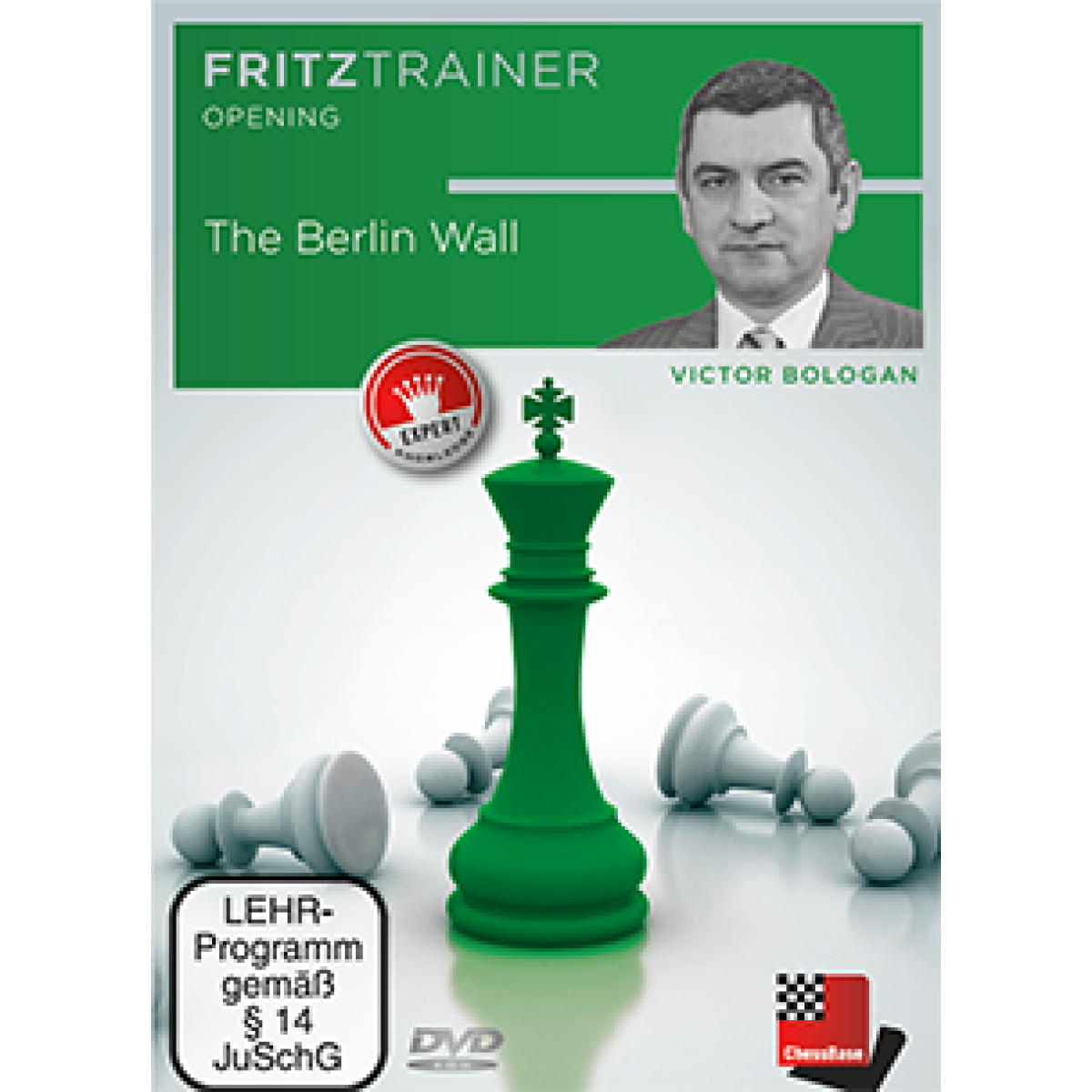

The Berlin Wall
search
  • The Berlin Wall

The Berlin Wall

€29.90
Tax included
Discover "The Berlin Wall," the Berlin Defense in chess, a solid and modern opening that has transformed the game since 2000. This video course (over 4 hours) covers everything from Anti-Berlin systems to complex endgames, featuring interactive exercises and exclusive analyses of great games. Ideal for players of all levels, improve your strategy and master this impenetrable defense. Includes database, video feedback, and compatibility with Fritztrainer.

FORMAT: DOWNLOAD
This product is not supplied in physical format. You will receive an email from our store with the download link and product activation code.

Quantity
In Stock

  Security policy

(edit with the Customer Reassurance module)

  Delivery policy

(edit with the Customer Reassurance module)

  Return policy

(edit with the Customer Reassurance module)

The Berlin Defense, also known as the Berlin Wall, is one of the most solid and popular openings of the 21st century. Unlike the real wall, this defense almost never falls. Its serious use began in the World Chess Championship between Kasparov and Kramnik in London, 2000, marking a shift from the dynamic and romantic style of the 20th century towards a more pragmatic, solid, and strategic approach. Kramnik won that match, and the Berlin Defense gained great popularity. This DVD is divided into two parts: the first analyzes the "Anti-Berlin" variations where White avoids the endgame, and the second focuses on the typical Berlin endgame. Nowadays, White tends to opt more for Anti-Berlin setups as no advantage is found in the main line, demonstrating the strength of this defense. The endgame is a serious and complex scenario, full of tactical possibilities. Studying the Berlin Defense considerably improves endgame understanding. Additionally, the course offers exercises to perfect practice with this defense. It is aimed at players from beginners to experts. Incorporate the Berlin Defense into your repertoire and let your opponent worry about how to face it.

• Video duration: 4 h 07 min (in English)
• Interactive training with video feedback
• Exclusive database with more than 50 essential games and variation analyses by Bologan
• Includes CB 12 Reader

More... Less...
Included content:
  • Fritztrainer application for Windows
  • Available for download or on DVD
  • Video course with an approximate duration of 4 to 8 hours
  • Repertoire database: save and integrate Fritztrainer games into your repertoire (in WebApp Opening or ChessBase)
  • Interactive exercises with video feedback: the authors present exercises and key positions, the user must input the solution; includes additional explanations and error correction
  • Example games in ChessBase database format
Features of the FritzTrainer application:
  • Videos playable in the FritzTrainer app or ChessBase with board, notation, and function bar
  • Analysis engine activatable at any time
  • Video pause for manual navigation and analysis in game notation
  • Input and storage of personal variations with engine analysis
  • Learning variations: view specific lines in ChessBase WebApp Opening with automatic playback, memorize and practice transformations (starting position – final position)
  • Active opening training: selected positions transfer to ChessBase WebApp Fritz-online to play against Fritz and put acquired knowledge into practice
More options: start FritzTrainer from ChessBase
  • Database with all games and analyses accessible directly
  • Easy incorporation of games into the opening repertoire
  • Direct evaluation with playable reference games on the analysis board
  • Personal variations saved and added to the personal repertoire
  • Repetition training
  • Active LiveBook
  • Ability to use all engines installed in ChessBase for analysis
  • Assisted analysis
  • Printing of notation and diagrams for study materials

Sample video

Content

  • 01: Introduction [06:00]
  • 1.e4 e5 2.Nf3 Nc6 3.Bb5 Nf6:
  • 02: 4.d4 exd4 5.O-O/e5 - Analysis [12:21]
  • 03: 4.Qe2 Bc5 - Analysis [07:02]
  • 04: 4.Bxc6 dxc6 5.d3 Bd6 6.Nbd2 Be6/Bg4 - Analysis [04:59]
  • 05: 4.d3 Bc5 5.O-O d6 - Analysis [06:55]
  • 06: 4.d3 Bc5 5.Nbd2 O-O 6.Bxc6 bxc6 - Analysis [02:53]
  • 07: 4.d3 Bc5 5.c3 O-O 6.O-O d6 with various seventh moves - Analysis [13:46]
  • 08: 4.d3 Bc5 5.c3 O-O 6.O-O d6 7.Nbd2 - Analysis [09:09]
  • 09: 4.d3 Bc5 5.Bxc6 bxc6 with various sixth moves - Analysis [16:38]
  • 10: 4.O-O Nxe4 5.Re1 Nd6 6.Nxe5 Be7 with various seventh moves - Analysis [06:08]
  • 11: 4.O-O Nxe4 5.d4 Nd6 6.dxe5 Nxb5 7.a4 Nbd4 - Analysis [11:05]
  • 12: 4.O-O Nxe4 5.d4 Nd6 6.Bg5 Be7 - Analysis [05:39]
  • 13: 4.O-O Nxe4 5.d4 Nd6 6.Bxc6 dxc6 7.dxe5 Nf5 8.Qxd8 Kxd8 with various ninth moves - Analysis [10:36]
  • 14: 4.O-O Nxe4 5.d4 Nd6 6.Bxc6 dxc6 7.dxe5 Nf5 8.Qxd8 Kxd8 9.h3 Bd7 - Analysis [14:50]
  • 15: 4.O-O Nxe4 5.d4 Nd6 6.Bxc6 dxc6 7.dxe5 Nf5 8.Qxd8 Kxd8 9.Rd1+ Ke8 - Analysis [22:28]
  • 16: 4.O-O Nxe4 5.d4 Nd6 6.Bxc6 dxc6 7.dxe5 Nf5 8.Qxd8 Kxd8 9.Nc3 Bd7 10.b3 Kc8 - Analysis [09:54]
  • 17: 4.O-O Nxe4 5.d4 Nd6 6.Bxc6 dxc6 7.dxe5 Nf5 8.Qxd8 Kxd8 9.Nc3 Bd7 10.Rd1 Kc8 - Analysis [16:07]
  • 18: 4.O-O Nxe4 5.d4 Nd6 6.Bxc6 dxc6 7.dxe5 Nf5 8.Qxd8 Kxd8 9.Nc3 Bd7 10.h3 h6 with various eleventh moves - Analysis [12:46]
  • 19: 4.O-O Nxe4 5.d4 Nd6 6.Bxc6 dxc6 7.dxe5 Nf5 8.Qxd8 Kxd8 9.Nc3 Bd7 10.h3 h6 11.b3 Kc8 - Analysis [11:56]
  • 20: 4.O-O Nxe4 5.d4 Nd6 6.Bxc6 dxc6 7.dxe5 Nf5 8.Qxd8 Kxd8 9.Nc3 Bd7 10.h3 h6 11.b3 c5 - Analysis [16:39]
  • Test positions
  • 21: Position 1 [01:56]
  • 22: Position 2 [01:56]
  • 23: Position 3 [02:04]
  • 24: Position 4 [02:06]
  • 25: Position 5 [01:02]
  • 26: Position 6 [01:29]
  • 27: Position 7 [01:52]
  • 28: Position 8 [01:26]
  • 29: Position 9 [01:28]
  • 30: Position 10 [01:34]
  • 31: Position 11 [01:31]
  • 32: Position 12 [02:01]
  • 33: Position 13 [01:06]
  • 34: Position 14 [01:40]
  • 35: Position 15 [01:07]
  • 36: Position 16 [01:22]
  • 37: Position 17 [01:34]
  • 38: Position 18 [01:10]
  • 39: Position 19 [01:17]
More...
Less...

Ruy López

The Spanish Opening is one of the oldest, named after the Spanish priest Ruy López de Segura, who in 1561 published a book with his analysis on this way to start the game. Today it is still widely used by elite players and is the most important opening of Open Games. Besides developing the bishop, White pressures the black pawn on e5. While 3...a6 was almost compulsory before, today 3...Nf6 — the Berlin Defense — is the preferred choice.

TBW-RFDH