

The Scotch Game
search
  • The Scotch Game

The Scotch Game

€29.90
Tax included
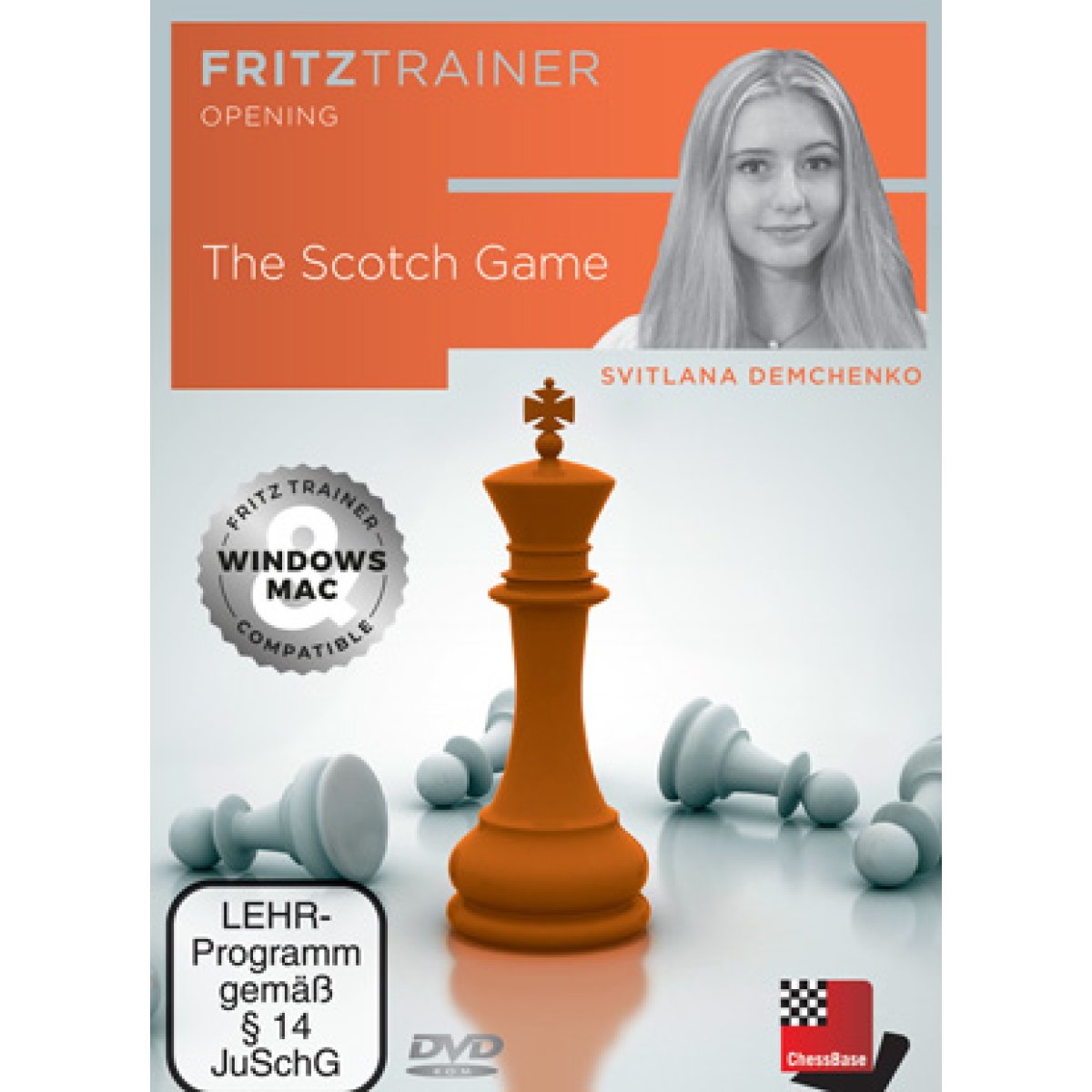
Master the Scotch Game opening with this nearly 6-hour video course, which combines deep theory, tactical exercises, and interactive training. Learn not only the main variations but also the dynamic Scotch Gambit, with analysis, model games, and practice against Fritz. Ideal for players looking for a solid and active repertoire, endorsed by legends like Kasparov and Carlsen. Includes the FritzTrainer application for Windows and Mac.

FORMAT: DOWNLOAD
This product is not supplied in physical format. You will receive an email from our store with the download link and product activation code.

Quantity
In Stock

  Security policy

(edit with the Customer Reassurance module)

  Delivery policy

(edit with the Customer Reassurance module)

  Return policy

(edit with the Customer Reassurance module)

The Scotch Opening (1.e4 e5 2.Nf3 Nc6 3.d4) is an excellent choice for players seeking a solid and active opening, based more on understanding than memorization. Its popularity grew notably when Garry Kasparov employed it in the World Championship against Anatoly Karpov in 1990, remaining relevant ever since. Today, the Scotch Opening is used by grandmasters such as Magnus Carlsen, Fabiano Caruana, Hikaru Nakamura, and Ian Nepomniachtchi, all of whom have achieved very positive results with it. Besides the deep theory and tactical exercises on the Scotch, this video course includes an additional section on the Scotch Gambit (1.e4 e5 2.Nf3 Nc6 3.d4 cxd4 4.Bc4), a dynamic variation leading to very active positions.

• Video duration: 5 hours 50 minutes (in English)
• Interactive training with video feedback
• Extra: training with ChessBase applications to memorize the repertoire and play key positions against Fritz at various levels
• Database with exemplary games

More... Less...
Product content:
  • Fritztrainer application for Windows and Mac
  • Available for download or on DVD
  • Video course with an approximate duration of 4 to 8 hours
  • Repertoire database: saves and integrates Fritztrainer games into your repertoire (in WebApp Opening or ChessBase)
  • Interactive exercises with video feedback: the authors present exercises and key positions; the user must enter the solution, with explanations and corrections
  • Model games in ChessBase database
  • New: many Fritztrainers also available for streaming on the ChessBase video portal
FritzTrainer application features:
  • Videos can be played in the Fritztrainer app or in the ChessBase program with graphical board, notation, and function bar
  • Analysis engine available at all times
  • Video pause for manual navigation and notation analysis
  • Input of your own variations, engine analysis, and saving within the game
  • Learning variations: view specific lines in ChessBase WebApp Opening with automatic playback, memorize and practice transformations (from initial to final position)
  • Active opening training: selected positions transfer to ChessBase WebApp Fritz-online to play against Fritz and test your knowledge
More options: launch FritzTrainer from ChessBase
  • Direct access to the database with all games and analysis
  • Easy incorporation of games into the personal repertoire
  • Direct evaluation with reference to games, playback on analysis board
  • Saving of your own variations integrable into the repertoire
  • Repetition training
  • Active LiveBook
  • Ability to use all engines installed in ChessBase for analysis
  • Assisted analysis
  • Printing of notation and diagrams (for study materials)

Sample video

Contents

  • Introduction
  • Secondary variations
  • Secondary variations on third and fourth moves
  • 4...Qf6/Bb4
  • 4...Bb4
  • 4...Qf6
  • Main line 4...Nf6
  • 5.Nxc6 bxc6 6.e5 Qe7 7.Qe2 Nd5 8.c4 Bb6 9.b3 g6 10.f4 d6
  • 10...Bg7
  • Secondary variations
  • Secondary variations 4...Nf6
  • 5.Nxc6 bxc6 6.e5 Qe7 7.Qe2 Nd5 8.c4 Bb6 9.b3 - Setup 1: immediate central attack 9...f6
  • Setup 2: knight retreat 9...Nb6
  • Setup 3: aggressive 9...Qh4
  • Setup 4: quick long castling 9...O-O-O
  • Setup 5: bold 9...g5
  • 4...Bc5
  • Introduction and 5.Nb3 Bb6 6.Nc3 Nf6
  • 6...Ng6
  • 6...Qf6
  • 6...d6 Main line
  • 4.Bc4 - Scotch Gambit
  • Introduction
  • 4...Bb4 and secondary variations
  • 4...Bc5 Part 1
  • 4...Bc5 Part 2
  • 4...Nf6 Main line
  • Model games
  • Introduction
  • Kasparov - Karpov
  • Model games
  • Tactics
  • Introduction
  • Exercise 1
  • Exercise 2
  • Exercise 3
  • Exercise 4
  • Exercise 5
  • Exercise 6
  • Exercise 7
  • Exercise 8
  • Exercise 9
  • Exercise 10
  • Exercise 11
  • Exercise 12
More...
Less...

Scotch Opening

The Scotch Opening gets its name from a correspondence match between the cities of Edinburgh and London from 1824 to 1828. In that encounter, initially the Scots played with the black pieces and lost after 3.d4, but later redeemed themselves by opening with 3.d4 as White. At the beginning of the 20th century, interest in this direct method had waned, but in 1990 Garry Kasparov used it in game 14 of the World Championship against Anatoly Karpov (Lyon/New York) when the score was tied, reviving this opening. That game ended in a draw, but Kasparov repeated the opening in the next game with White and succeeded. This sparked a resurgence of the Scotch, which went from being considered outdated to modern and popular among many grandmasters.

TSG-HPOH