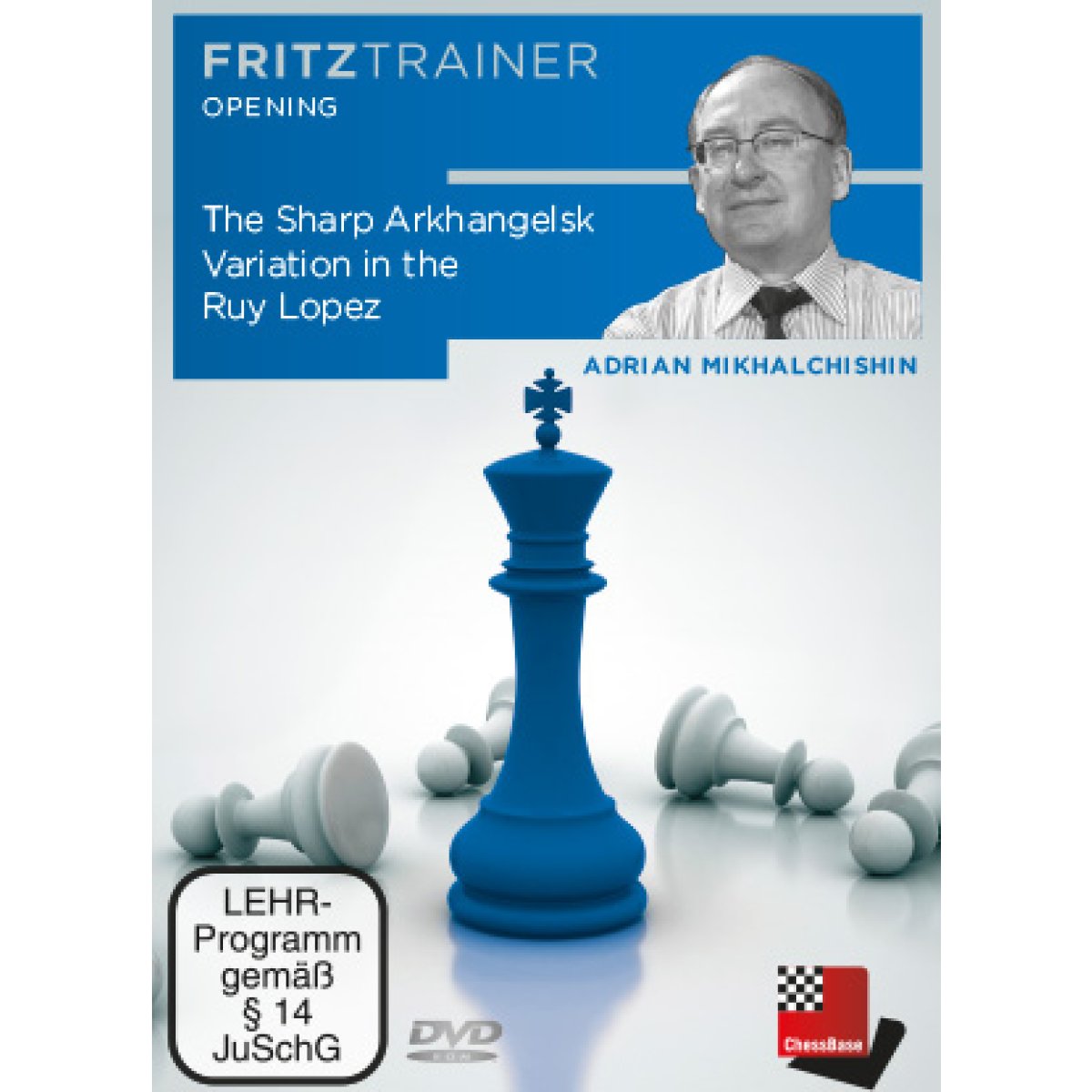

The Sharp Arkhangelsk Variation in the Ruy Lopez
search
  • The Sharp Arkhangelsk Variation in the Ruy Lopez

La Variación Sharp Arkhangelsk en la Ruy López

€35.90
Tax included
Master the sharp Arkhangelsk variation of the Ruy López, a strategic weapon used by Magnus Carlsen and Fabiano Caruana. This video course of over 4 hours guides you through ideas and model games to understand key concepts, not just memorize moves. With interactive training and advanced analysis in the Fritztrainer app, you can learn, practice, and apply this powerful opening at any level.

FORMAT: DOWNLOAD
This product is not supplied in physical format. You will receive an email from our store with the download link and product activation code.

Quantity
In Stock

  Security policy

(edit with the Customer Reassurance module)

  Delivery policy

(edit with the Customer Reassurance module)

  Return policy

(edit with the Customer Reassurance module)

Top players always have their own successful opening variations. One of them is the Sharp Arkhangelsk variation, which arises after 1.e4 e5 2.Nf3 Nc6 3.Bb5 a6 4.Ba4 Nf6 5.O-O b5 6.Bb3 followed by Bb7 and/or Bc5. It is one of the most powerful opening weapons for prominent players like Magnus Carlsen and Fabiano Caruana. This variation is very rich as it allows playing in three different ways, making it difficult for opponents to prepare. The author presents model games to highlight the ideas and lines this variation offers. Instead of memorizing moves, the concepts and strategies will give you the confidence to employ this opening against opponents of any level.

This video course is useful for any player who wants to follow in the footsteps of Carlsen and Caruana.

• Video duration: 4 hours and 11 minutes (in English)

• Interactive training with video feedback

• Train with ChessBase applications to memorize the repertoire and play key positions against Fritz at various levels

More... Less...
This includes:
  • Fritztrainer application for Windows and Mac
  • Available for download or on DVD
  • Video course with an approximate duration of 4 to 8 hours
  • Repertoire database: save and integrate Fritztrainer games into your own repertoire (in WebApp Opening or ChessBase)
  • Interactive exercises with video feedback: the authors present exercises and key positions, the user must enter the solution, with additional explanations and error correction
  • Model games as a ChessBase database
  • New: many Fritztrainers also available for streaming on the ChessBase video portal
FritzTrainer application features:
  • Videos play in the Fritztrainer app or in the ChessBase program with graphics, notation, and function bar
  • Analysis engine available at any time
  • Video pause for manual navigation and analysis in game notation
  • Input of own variations, engine analysis, and storage within the game
  • Learn variations: view specific lines in ChessBase WebApp Opening with automatic playback, memorize and practice transitions between initial and final positions
  • Active opening training: selected positions transfer to ChessBase WebApp Fritz-online to play against Fritz and test your knowledge
More options: start FritzTrainer in the ChessBase program
  • Open directly the database with all games and analyses
  • Easily add games to the opening reference
  • Direct evaluation with game reference and playback on the analysis board
  • Save and add your own variations to your repertoire
  • Playback training
  • Active LiveBook
  • Use all engines installed in ChessBase for analysis
  • Assisted analysis
  • Print notation and diagrams (for worksheets)

Sample Video

Contents

  • Introduction
  • 1.e4 e5 2.Nf3 Nc6 3.Bb5 a6 4.Ba4 Nf6 5.O-O
  • 5...b5 6.Bb3 Bb7 - Classic Arkhangelsk setup
  • 5..Bc5 6.c3 b5 7.Bb3 - Neo-Arkhangelsk
  • 5...b5 6.Bb3 Bb7
  • 1.e4 e5 2.Nf3 Nc6 3.Bb5 a6 4.Ba4 Nf6 5.O-O b5 6.Bb3 Bb7
  • 6...Bc5 7.a4 Bb7
  • 6...Bc5 7.c3 d6 8.d4 Bb6 9.Be3 O-O 10.Nbd2 Bb7
  • 7.Nc3 Be7 8.d3 O-O 9.a3 Nd4/d6
  • 7.d3 Be7 8.Nc3 O-O 9.a4/9.a3
  • 5.Nc3 b5 6.Bb3 Be7 7.Nd5 & 5.O-O b5 6.Bb3 Bc5 7.Nc3 d6 8.Nd5
  • 7.Re1 Bc5 8.c3 d6 9.d4 Bb6 10.Be3 O-O 11.Nbd2 h6 12.h3 Re8
  • 7.Re1 Bc5 8.c3 d6 9.d4 Bb6 10.Be3 O-O 11.Nbd2 Nd7/h6 12.h3 Nd7
  • 7.Re1 Bc5 8.c3 d6 9.d4 Bb6 10.Be3 O-O 11.Nbd2 h6 12.h3 Rb8
  • 7.Re1 Bc5 8.c3 d6 9.d4 Bb6 10.Be3 O-O 11.Nbd2 exd4 12.cxd4 Nb4 13.d5
  • 7.Re1 Bc5 8.c3 d6 9.d4 Bb6 10.Be3 O-O 11.Nbd2 exd4 12.cxd4 Nb4 13.Ng5
  • 7.Re1 Bc5 8.c3 d6 9.d4 Bb6 10.Be3 O-O 11.Nbd2 exd4 12.cxd4 Nb4 13.Ng5
  • 7.Re1 Bc5 8.c3 d6 9.d4 Bb6 10.a4 O-O 11.Bg5
  • 7.Re1 Bc5 8.c3 d6 9.d4 Bb6 10.a4 h6
  • 7.Re1 Bc5 8.c3 d6 9.d4 Bb6 10.Bg5
  • 5...Bc5
  • 1.e4 e5 2.Nf3 Nc6 3.Bb5 a6 4.Ba4 Nf6 5.O-O Bc5
  • 6.c3 b5 7.Bc2 d5 8.a4
  • 6.c3 b5 7.Bc2 d5 8.exd5
  • 6.c3 b5 7.Bb3 d6 8.d4/a4
  • 6.Nxe5
  • 6.c3 O-O 7.d4 Ba7 8.Bg5
  • 6.c3 O-O 7.d4 Ba7 8.Re1 b5 9.Bb3 d6 10.h3/Bg5
  • 6.c3 O-O 7.d4 Ba7 8.dxe5 Nxe4 9.Qd5 Nc5 10.Bc2 Be7 11.Qd1 d5 12.exc6 Qxd6/cxd6
  • 6.c3 O-O 7.d4 Ba7 8.dxe5 Nxe4 9.Bc2 d5 10.exd6 Nxd6 11.Bg5
  • 6.c3 O-O 7.d4 Ba7 8.Bg5 exd4 9.e5
  • Secondary variations
  • 1.e4 e5 2.Nf3 Nc6 3.Bb5 a6
  • 4.Bxc6 dxc6 5.O-O Ne7/Bd6/Be6/f6
  • 4.Bxc6 dxc6 5.O-O Qd6/Qf6 6.d4 exd4 7.Bg5 Qd6
  • 4.Ba4 Nf6 5.d3 d6 6.c3 g6
  • 4.Ba4 Nf6 5.d3 b5 6.Bb3 Bc5 and 5...Bc5 6.c3 d6 7.Bg5 Ba7
  • 4.Qe2 and 4.Ba4 Nf6 5.Qe2
  • 4.Ba4 Nf6 5.Bxc6 dxc6
  • 4.Ba4 Nf6 5.d4 Nxd4
  • Exercises
  • Description
  • Exercise 1
  • Exercise 2
  • Exercise 3
  • Exercise 4
  • Exercise 5
  • Repertoire training
  • Description
  • Secondary variations
  • 5...Bc5 and 5...b5 6.Bb3 Bc5
  • 5...b5 6.Bb3 Bb7
  • Positions to practice
  • Description
  • 5...Bc5 6.c3 b5 7.Bb3 d6 8.d4 Bb6 9.a4
  • 5...Bc5 6.c3 O-O 7.d4 Ba7 8.Re1 b5
  • 5...Bc5 6.c3 O-O 7.d4 Ba7 8.dxe5
  • 5...Bc5 6.c3 b5 7.Bc2 d5 8.a4
  • 5...b5 6.Bb3 Bc5 7.a4 Bb7
  • 5...Bc5 6.c3 b5 7.Bb3 d6 8.a4 Bb7 9.d3 h6
  • 5...b5 6.Bb3 Bb7 7.Nc3 Be7
  • 5...b5 6.Bb3 Bb7 7.Re1 Bc5
  • 5...b5 6.Bb3 Bb7 7.Re1 Bc5 8.c3 d6
  • 5...b5 6.Bb3 Bb7 7.Re1 Bc5 8.c3 d6
  • 5...b5 6.Bb3 Bb7 7.Re1 Bc5 8.c3 d6
  • 5...b5 6.Bb3 Bb7 7.d3 Bc5
  • 5...b5 6.Bb3 Bb7 7.d3 Be7
  • 4.Bxc6
  • 4.Bxc6
  • Bonus
  • Games
More...
Less...

Ruy López

The Spanish Opening is one of the oldest. Its name comes from the Spanish priest Ruy López de Segura, who in 1561 published a book with his analyses on this way to start the game. Today, it remains very common in high-level games and is the most important among open games. Besides developing its bishop, White immediately exerts pressure on Black's pawn on e5. While 3...a6 used to be almost mandatory, nowadays 3...Nf6, the Berlin Defense, is preferred.

TSAVITRL-ESXN