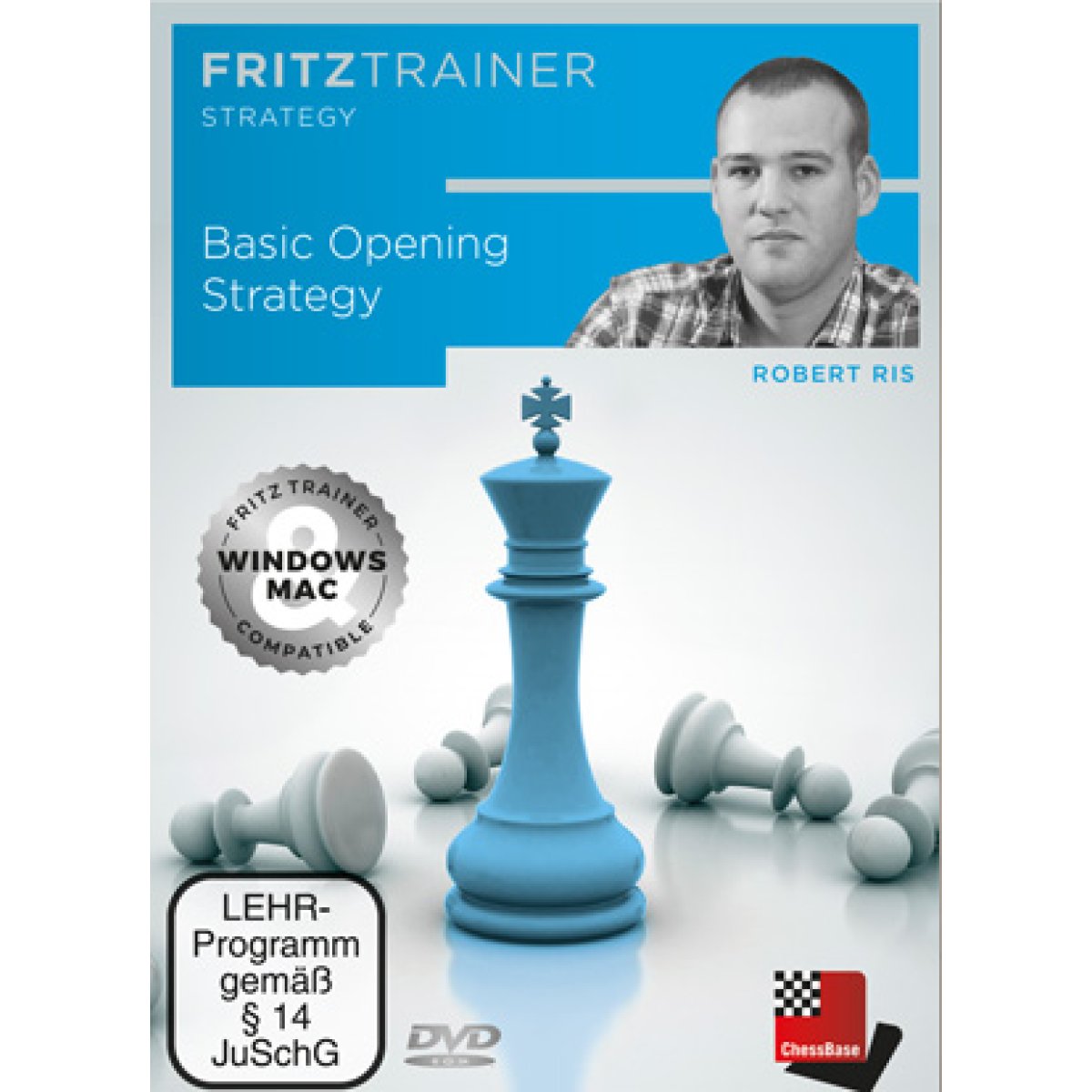

Basic Opening Strategy
search
  • Basic Opening Strategy

Basic Opening Strategy

€32.90
Tax included
Learn the basic strategies to master the opening in chess with this video course. Discover the famous Fool's Mate trap, the golden rules for controlling the center, and how to avoid common mistakes such as prematurely advancing the queen or moving the "f" pawn. With over 50 interactive exercises and detailed analyses, you will improve your game from the start and prepare for the middlegame. Ideal for players who want to strengthen their tactical and strategic foundation.

FORMAT: DOWNLOAD
This product is not supplied in physical format. You will receive an email from our store with the download link and product activation code.

Quantity
In Stock

  Security policy

(edit with the Customer Reassurance module)

  Delivery policy

(edit with the Customer Reassurance module)

  Return policy

(edit with the Customer Reassurance module)

In this video course, you will learn the basic strategies for the chess opening, essential to start your games successfully. You will discover the most famous trap, the Scholar's Mate, which allows winning in just four moves, and also how to defend against it. But there's much more!

You will uncover the Golden Rules for the opening and the importance of controlling the center of the board, as well as the consequences of ignoring these principles. You will learn why it is generally not advisable to advance the queen in the first moves and how to take advantage of that mistake. Did you know that the "f" file pawn is a key weakness in your position and that moving it can cause immediate disasters? We will also explore the technique of the bishop pinning the opponent’s knight, where moving it can endanger the queen. We will teach you how to identify and exploit this vulnerability in the opponent’s position, as well as how to face this tactical pattern. Although playing the opening optimally does not guarantee victory, a good start will guide you in the right direction. What to do after applying these basic principles? Additionally, you will understand what positions require in the middlegame. The course includes 50 exercises to practice and assess your ability to apply these general opening rules. However, you will need to think critically, as each position is unique and sometimes a standard idea is not advisable for tactical reasons.

  • Video duration: 4 hours and 17 minutes
  • Interactive training with video feedback
  • Database with 50 exercises
More... Less...
This includes:
  • Fritztrainer application for Windows and Mac
  • Available for download or on DVD
  • Video course with approximate duration of 4 to 8 hours
  • Repertoire database to save and integrate Fritztrainer games into your personal repertoire (in WebApp Opening or ChessBase)
  • Interactive exercises with video feedback: the authors present exercises and key positions, the user must input the solution, receiving explanations and corrections
  • Example games in a database for ChessBase
  • New: many Fritztrainers also available for streaming on the ChessBase video portal
Functions of the FritzTrainer application:
  • Videos can be played in the Fritztrainer app or in the ChessBase program with graphics, notation, and function bar
  • Analysis engine activatable at any time
  • Video pause for navigation and manual analysis in the game notation
  • Input of own variations, engine analysis, and saving within the game
  • Learning variations: visualization of specific lines in ChessBase WebApp Opening with automatic playback, memorization, and practice of transformations (initial to final position)
  • Active opening training: selected positions are transferred to ChessBase WebApp Fritz-online to play games against Fritz and put into practice what was learned
More functions when starting FritzTrainer in ChessBase:
  • Database with all games and analysis accessible directly
  • Easy incorporation of games into the opening reference
  • Direct evaluation with game reference, playback on the analysis board
  • Saving own variations to add to the personal repertoire
  • Playback training
  • Active LiveBook
  • Use of all engines installed in ChessBase for analysis
  • Assisted analysis
  • Printing of notation and diagrams for study materials

Sample Video

Content

  • Introduction
  • Section 1
  • The Center
  • Scholar's Mate
  • The "Golden Rules" in the Opening
  • How to Develop Minor Pieces
  • Importance of the "f7 and f2" Squares
  • What to Avoid
  • Do Not Move the "f" Pawn
  • Section 2
  • Developing the Queen Early
  • Think!
  • The Pin: Bishop to g5
  • Development Advantage
  • Small Plans
  • Fianchetto
  • Pawns Advance One Step at a Time
  • Exercises: "The Center"
  • Description
  • Exercise 1
  • Exercise 2
  • Exercise 3
  • Exercise 4
  • Exercise 5
  • Exercise 6
  • Exercise 7
  • Exercise 8
  • Exercises: "Development"
  • Exercise 1
  • Exercise 2
  • Exercise 3
  • Exercise 4
  • Exercise 5
  • Exercise 6
  • Exercise 7
  • Exercise 8
  • Exercise 9
  • Exercise 10
  • Exercise 11
  • Exercises: "f Pawn"
  • Exercise 1
  • Exercise 2
  • Exercise 3
  • Exercise 4
  • Exercise 5
  • Exercise 6
  • Exercise 7
  • Exercise 8
  • Exercises: "Pin and Queen"
  • Exercise 1
  • Exercise 2
  • Exercise 3
  • Exercise 4
  • Exercise 5
  • Exercise 6
  • Exercise 7
  • Exercise 8
  • Exercise 9
  • Exercise 10
  • Exercise 11
  • Exercises: "Scholar’s Mate and Small Plans"
  • Exercise 1
  • Exercise 2
  • Exercise 3
  • Exercise 4
  • Exercise 5
  • Exercise 6
  • Exercise 7
  • Exercises: "Think!"
  • Exercise 1
  • Exercise 2
  • Exercise 3
  • Exercise 4
  • Exercise 5
More...
Less...
BOS-FGOC