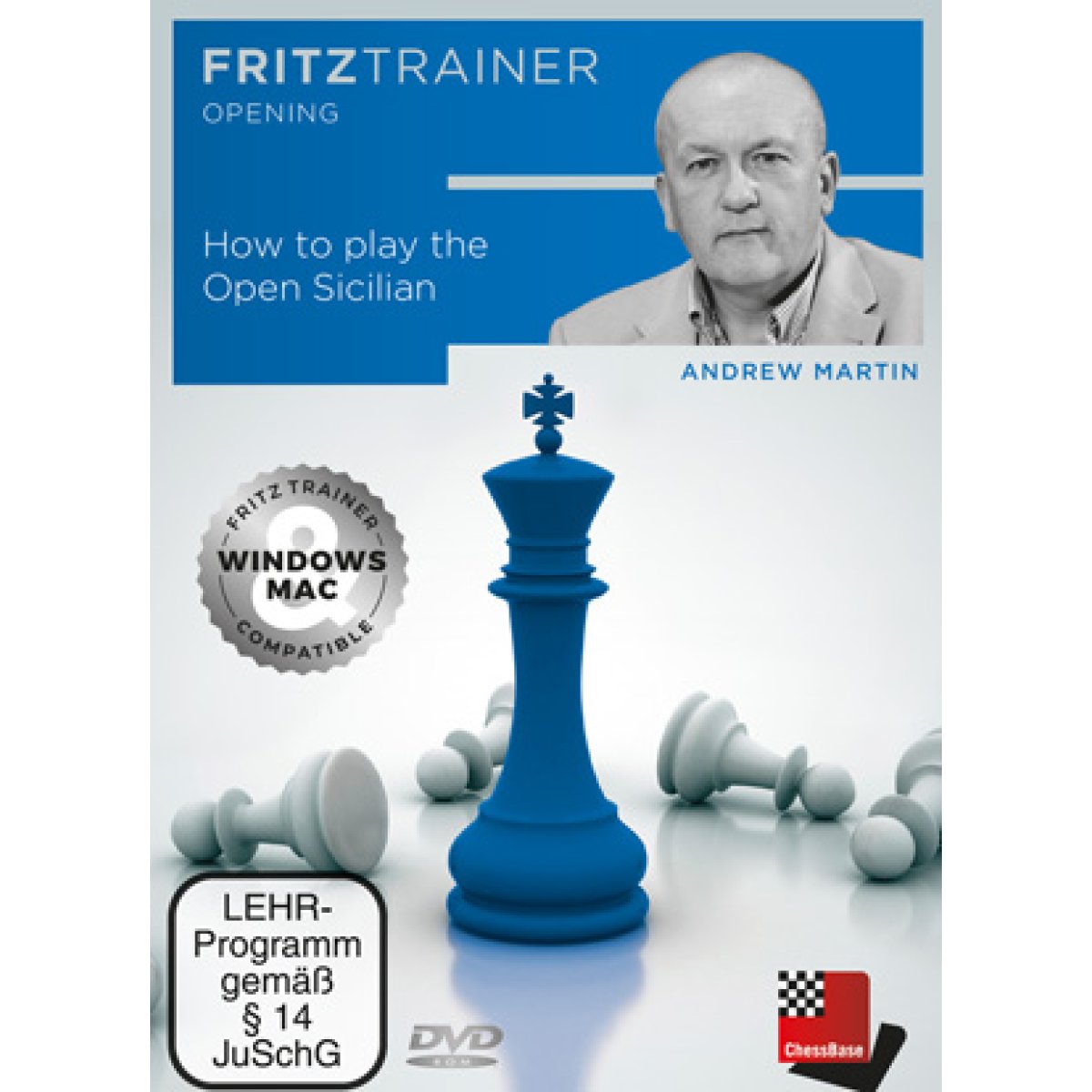


How to play the Open Sicilian
search
  • How to play the Open Sicilian

Cómo jugar la Siciliana Abierta

€32.90
Tax included
Discover the Sicilian Defense with this video course by IM Andrew Martin, ideal for players rated under 1800. Learn the key ideas and main lines of the Open Sicilian after 1.e4 c5 2.d4. With nearly 6 hours of content, interactive exercises, and practice against Fritz, you will master both classical and modern variations to play confidently and aim for victory from the opening. Boost your repertoire with this comprehensive and dynamic guide!

FORMAT: DOWNLOAD
This product is not supplied in physical format. You will receive an email from our store with the download link and product activation code.

Quantity
In Stock

  Security policy

(edit with the Customer Reassurance module)

  Delivery policy

(edit with the Customer Reassurance module)

  Return policy

(edit with the Customer Reassurance module)

The Sicilian Defense is one of the most popular and aggressive responses to 1.e4. After 1.e4 c5, a dynamic and unbalanced position arises where Black can strive for a win from the very beginning. The Open Sicilian includes all variations in which White plays d2-d4 early.

In this new video course from ChessBase, IM Andrew Martin introduces you to this exciting world so you can start playing the Sicilian in your own games. The main themes and fundamental ideas of the Open Sicilian are analyzed, followed by a summary of all the main accepted lines, so you can choose the one you prefer. This course is packed with master games that delight and teach, with the hope of inspiring you to play the Sicilian. It is especially useful for players rated below 1800.

  • Video duration: 5 hours and 50 minutes
  • Interactive training with video feedback
  • Bonus: Training with ChessBase applications – Memorize the repertoire and play key positions against Fritz at various levels
More... Less...
Included content:
  • Fritztrainer application for Windows and Mac
  • Available for download or on DVD
  • Video course with approximate duration of 4 to 8 hours
  • Repertoire database: save and integrate Fritztrainer games into your own repertoire (in WebApp Opening or ChessBase)
  • Interactive exercises with video feedback: the authors present exercises and key positions; the user must enter the solution, with comments and corrections
  • Example games in ChessBase database
  • New: many Fritztrainers also available for streaming on the ChessBase video portal
Features of the FritzTrainer application:
  • Video playback with board, notation, and control bar in the Fritztrainer app or in ChessBase
  • Ability to activate the analysis engine at any time
  • Video pauses for manual navigation and notation analysis
  • Input of own variations, engine analysis, and saving within the game
  • Learning variations: view specific lines with autoplay in WebApp Opening and practice transformations (initial to final position)
  • Active opening training: selected positions transfer to WebApp Fritz-online to play against Fritz and test your knowledge
More options: launch FritzTrainer in the ChessBase program
  • Direct access to the database with games and analysis
  • Easy incorporation of games into the opening reference
  • Direct evaluation with game references and playback on analysis board
  • Saving personal variations to add to your repertoire
  • Repetition training
  • Active LiveBook
  • Ability to use all engines installed in ChessBase for analysis
  • Assisted analysis
  • Printing of notations and diagrams for study materials

Sample Video

Content

  • Introduction
  • An extra central pawn
  • Game 1: Stanojoski - Kurajica
  • Game 2: Zavoronkov - Shulman
  • Game 3: Blandon - Lu
  • Counterplay on the queenside
  • Counterplay on the queenside
  • Game 5: Hartston - Westerinen
  • Game 6: Svidler - Karjakin
  • Game 7: Bakalchuk - Smirin
  • Sacrifice possibilities
  • Introduction
  • Game 8: Karpov - Kasparov
  • Game 9: Large - Basman
  • Game 10: Suarez Uriel - Moreno Ruiz
  • Game 11: Unzicker - Taimanov
  • Game 12: Grieve - Artemiev
  • Various pawn structures
  • Introduction
  • Game 13: Drygalov - Nakamura
  • How not to play the Open Sicilian
  • Introduction
  • Game 14: Bok - Yu Yangyi
  • Game 15: Almasi - Mohr
  • Game 16: Spassky - Fischer
  • The Najdorf Sicilian
  • 1.e4 c5 2.Nf3 d6 3.d4 cxd4 4.Nxd4 Nf6 5.Nc3 a6
  • Introduction
  • Game 17: Polgar - Anand
  • Game 18: Paravyan - Aronian
  • Dragon Systems
  • 1.e4 c5 2.Nf3 d6 3.d4 cxd4 4.Nxd4 Nf6 5.Nc3 g6 and 2...Nc6 3.d4 cxd4 4.Nxd4 g6
  • Introduction
  • Game 19: Karthikeyan - Vachier Lagrave
  • Game 20: Sarana - Martinez Alcantara
  • Game 21: Kurayan - Spiridonov
  • Game 22: Al Modiahki - Motylev
  • Game 23: Do Valle Cardoso - Xiong
  • The Kan/Taimanov/Paulsen Sicilian
  • 1.e4 c5 2.Nf3 e6 3.d4 cxd4 4.Nxd4 Nc6 5.Nc3 Qc7
  • Introduction
  • Game 24: Liang - Mareco
  • Game 25: Erigaisi - Carlsen
  • Classical and Scheveningen Sicilian
  • 1.e4 c5 2.Nf3 d6 3.d4 cxd4 4.Nxd4 Nc6 5.Nc3 Nc6/e6
  • Introduction
  • Game 26: Zarnicki - Kasparov
  • Game 27: Renet - Apicella
  • Systems with an early e7-e5
  • Introduction
  • Game 28: 2...Nc6 3.d4 cxd4 4.Nxd4 e5 5.Nb5 a6; Lanka - Majorovas
  • Game 29: 2...Nc6 3.d4 cxd4 4.Nxd4 e5 5.Nb5 d6; Fiedorek - Sebenik
  • Game 30: 2...Nc6 3.d4 cxd4 4.Nxd4 Nf6 5.Nc3 e5 6.Ndb5 d6; Mchedlishvili - Gharibyan
  • Uncommon variations
  • Introduction
  • Game 31: 2...a6; Sidletskiy - Lodici
  • Game 32: 2...b6; Struk - Meister
  • Game 33: 2...Nf6; Karjakin - Mamedyarov
  • Game 34: 2...e6 3.d4 cxd4 4.Nxd4 Bc5; Arjun - Del Rio de Angelis
  • Game 35: 2...e6 3.d4 cxd4 4.Nxd4 Nf6 5.Nc3 Bb4; Berg - Johnsen
  • Conclusion
  • Exercises
  • Description
  • Exercise 1
  • Exercise 2
  • Exercise 3
  • Exercise 4
  • Exercise 5
  • Exercise 6
  • Exercise 7
  • Exercise 8
  • Exercise 9
  • Exercise 10
  • Exercise 11
  • Exercise 12
  • Exercise 13
  • Farewell
  • Positions to practice
  • Najdorf
  • Dragon
  • Kan
  • Classical
  • Scheveningen
  • Lowenthal
  • Sveshnikov
  • Repertoire training
  • Repertoire for Black
More...
Less...

Sicilian Defense

The moves 1.e4 c5 define the Sicilian Defense. Black fights for the d4 square, but unlike advancing the e-pawn two squares, symmetry is immediately broken, showing that Black does not merely seek equality. Development can vary depending on whether Black plays 2...d6, 2...e6, or 2...Nc6. Nowadays, systems where White avoids an early d4 are also popular.

HTPTOS-MDSF