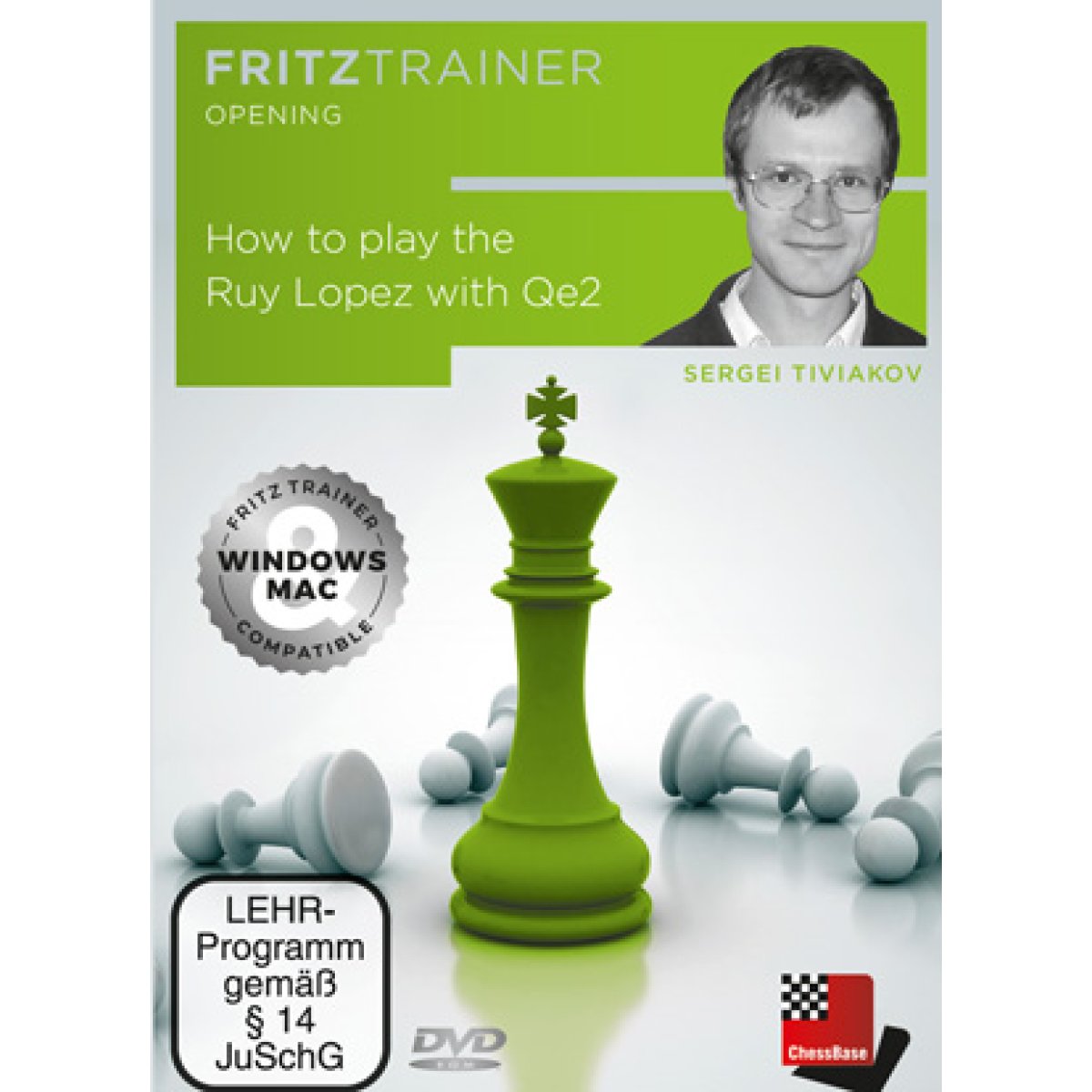

How to play the Ruy Lopez with Qe2
search
  • How to play the Ruy Lopez with Qe2

Cómo jugar la Ruy López con Qe2 How to play the Ruy Lopez with Qe2

€29.90
Tax included
Avoid the theoretical complications of the Ruy Lopez with Sergey Tiviakov's innovative early move 4.Qe2. In this video course of over 6 hours, based on his 40 years of experience, you will discover effective and easy-to-learn lines to surprise your opponent. It includes interactive training, detailed analysis, and a database with model games to improve your repertoire and master this original and powerful variation.

FORMAT: DOWNLOAD
This product is not supplied in a physical format. You will receive an email from our store with the download link and product activation code.

Quantity
In Stock

  Security policy

(edit with the Customer Reassurance module)

  Delivery policy

(edit with the Customer Reassurance module)

  Return policy

(edit with the Customer Reassurance module)

To avoid theoretical complications in the main lines against the Ruy López (such as the Berlin Defense, the Open Variation, or the Marshall Attack), Sergey Tiviakov suggests an early and unconventional move with the White queen: Qe2. An elegant, powerful, and easy-to-learn option.

This DVD covers the following variations: 1.e4 e5 2.Nf3 Nc6 3.Bb5 Nf6 4.Qxe2, 3...a6 4.Ba4 Nf6 5.Qxe2, and 5.0-0 Be7 6.Qxe2 (Worrall Attack). Sergey Tiviakov has been using this line since he was 6 years old, accumulating over 40 years of experience, which he now shares in 5 hours of video content. The material is mainly based on his own games and his deep knowledge of the Qe2 move in the Ruy López. By studying this material, you will be able to steer your opponent into less explored territory, with good chances to win as the author himself does.

• Video duration: 6 hours 30 minutes (in English)
• Interactive training with video feedback
• Bonus: additional training chapter with repertoire and gameplay features

Included content:

  • Fritztrainer application for Windows and Mac
  • Available for download or on DVD
  • Video course with an approximate duration of 4 to 8 hours
  • Repertoire database: save and integrate Fritztrainer games into your own repertoire (in WebApp Opening or ChessBase)
  • Interactive exercises with video feedback: the authors present exercises and key positions you must solve, with detailed explanations and error correction
  • Example games in ChessBase database
  • New: many Fritztrainers now also available for streaming on the ChessBase video portal

Features of the FritzTrainer application:

  • Watch videos with board, notation, and function bar in the Fritztrainer app or in the ChessBase program
  • Activate the analysis engine at any time
  • Pause the video to manually navigate and analyze the notation
  • Enter your own variations and analyses with saving in the game
  • Learn variations with the WebApp ChessBase Opening, using automatic playback and practice of opening and endgame positions
  • Active opening training: transfer selected positions to ChessBase WebApp Fritz-online to play against Fritz and put what you learned into practice

More features: Use FritzTrainer from ChessBase

  • Open the database directly with all games and analyses
  • Easily add games to your opening repertoire
  • Evaluate games with reference and replay on the analysis board
  • Save your own variations and add them to your repertoire
  • Repetition training
  • Active LiveBook
  • Use any engine installed in ChessBase for analysis
  • Assisted analysis
  • Print notation and diagrams for worksheets

Sample video

Contents

  • Introduction
  • Introduction
  • 3...Nf6 4.Qxe2
  • Description
  • 1.e4 e5 2.Nf3 Nc6 3.Bb5 Nf6 4.Qxe2
  • Less usual lines 4...a6/Bd6
  • 4...Bd6 5.c3 0-0 6.d3 Be8 7.Bg5 Be7 8.Nbd2 d6 - Tiviakov vs Malakhov
  • 4...Be7
  • 4...Bc5
  • 3...a6 4.Ba4 Nf6 5.Qxe2
  • Description
  • 1.e4 e5 2.Nf3 Nc6 3.Bb5 a6 4.Ba4 Nf6 5.Qxe2
  • 5...Qe7/Bd6
  • 5...d6
  • 5...Bc5
  • 5...Be7
  • 5...b5 6.Bb3 Na5/d6
  • 6...Be7 7.a4
  • 6...Be7 7.c3 d6/d5
  • 6...Be7 7.c3 0-0
  • 6...Bc5 7.a4/c3 Part 1
  • 6...Bc5 7.a4/c3 Part 2
  • 3...a6 4.Ba4 Nf6 5.0-0 Be7 6.Qxe2
  • Description
  • 1.e4 e5 2.Nf3 Nc6 3.Bb5 a6 4.Ba4 Nf6 5.0-0 Be7 6.Qxe2
  • 6...d6
  • 6...b5 7.Bb3 Bb7/d6
  • 6...b5 7.Bb3 0-0 8.c3 d6 Part 1
  • 6...b5 7.Bb3 0-0 8.c3 d6 Part 2
  • 6...b5 7.Bb3 0-0 8.c3 d5 9.d3 d4/Qd6/dxe4
  • 6...b5 7.Bb3 0-0 8.c3 d5 9.d3 Be8/Bb7
  • Conclusion
  • Exercises 1-10
  • Description
  • Exercise 01
  • Exercise 02
  • Exercise 03
  • Exercise 04
  • Exercise 05
  • Exercise 06
  • Exercise 07
  • Exercise 08
  • Exercise 09
  • Exercise 10
  • Exercises 11-20
  • Description
  • Exercise 11
  • Exercise 12
  • Exercise 13
  • Exercise 14
  • Exercise 15
  • Exercise 16
  • Exercise 17
  • Exercise 18
  • Exercise 19
  • Exercise 20
  • Exercises 21-30
  • Description
  • Exercise 21
  • Exercise 22
  • Exercise 23
  • Exercise 24
  • Exercise 25
  • Exercise 26
  • Exercise 27
  • Exercise 28
  • Exercise 29
  • Exercise 30

Ruy López

The Spanish Opening is one of the oldest. It is named after the Spanish priest Ruy López de Segura, who published a book with his analyses of this opening in 1561. Today, it remains one of the most used openings by elite players and is clearly the most important among the Open Games. In addition to developing its bishop, White directly pressures Black's pawn on e5. While 3...a6 used to be almost mandatory, nowadays 3...Nf6 — the Berlin Defense — is preferred.

HTPTRLWQ-SQWE