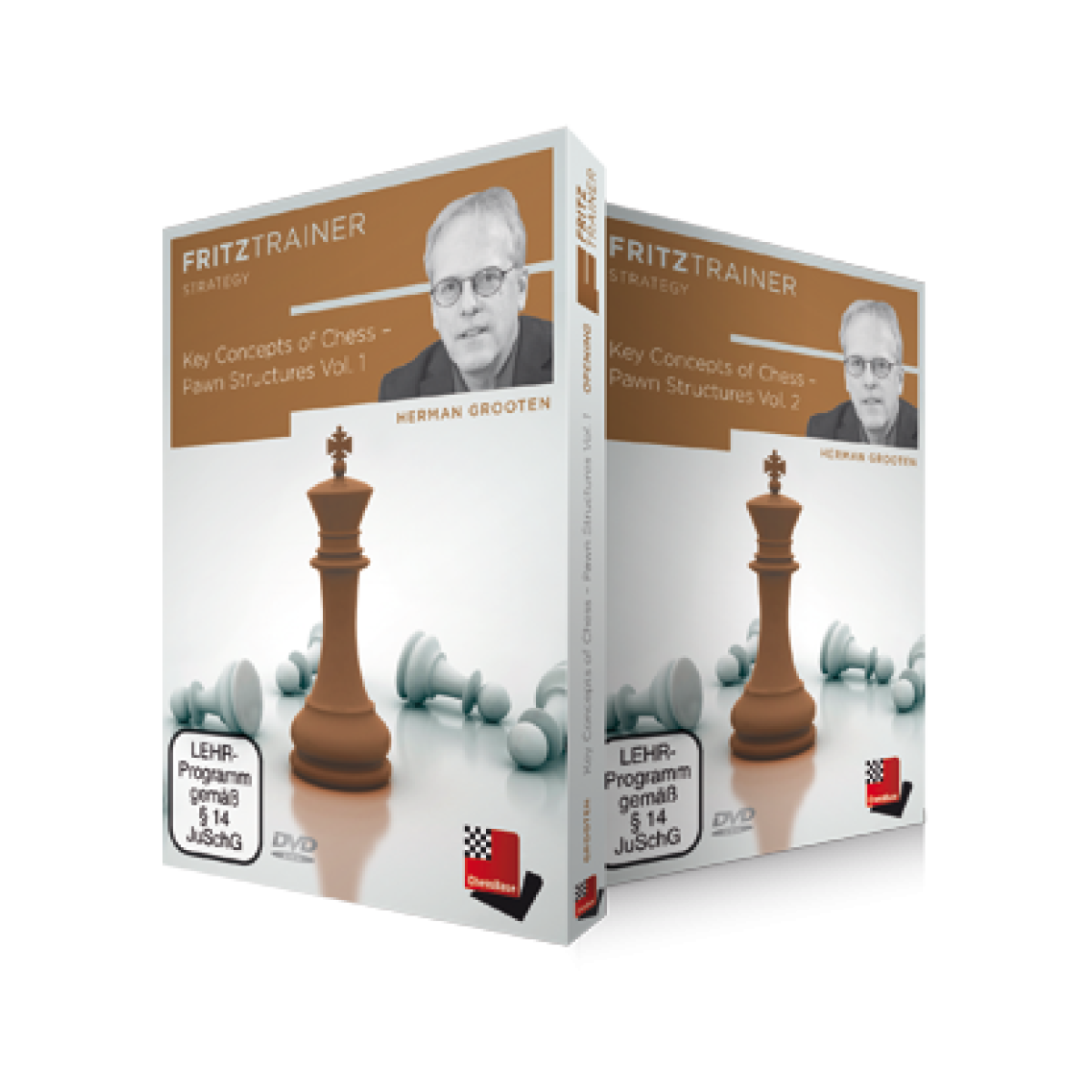

Key Concepts of Chess - Pawn Structures Vol.1 and 2
search
  • Key Concepts of Chess - Pawn Structures Vol.1 and 2

Key Concepts of Chess - Pawn Structures Vol.1 and 2

€54.90
Tax included
Improve your club play with this instructional series focused on key pawn structures. IM Herman Grooten explains clear strategies and covers topics such as open files, pawn chains, isolated pawns, and passed pawns, all with practical examples and interactive exercises. Includes over 10 hours of video in English, analysis with feedback, and training with the FritzTrainer app to master essential concepts and enhance your positioning and maneuvers on the board.

FORMAT: DOWNLOAD
This product is not supplied in physical format. You will receive an email from our store with the download link and product activation code.

Quantity
In Stock

  Security policy

(edit with the Customer Reassurance module)

  Delivery policy

(edit with the Customer Reassurance module)

  Return policy

(edit with the Customer Reassurance module)

This series is dedicated to strategy for club players, explained simply and with clear examples. The focus is on specific topics related to pawn structures, posing the question: how to maneuver the pieces into advantageous positions and what aspects to consider? IM Herman Grooten offers practical rules and concepts that guide club players to find the best options in their games.

This course, divided into two parts, concentrates on common pawn structures that frequently appear in games and are recognizable to club players. The first video course extensively covers topics such as "Open and Semi-Open Files" and "The Pawn Chain".

  • Total video duration: 6 hours and 30 minutes (in English)
  • Interactive training with video feedback
  • Extra material: Model games and training with ChessBase applications to practice key pawn structures

In the second part, the focus is on typical structures such as the isolated queen pawn (IQP) and the passed pawn in the middlegame, topics that will be explained in detail. Since the IQP appears in many opening variations, its study is fundamental. Additionally, the value and impact of a passed pawn will be addressed with examples that will be very useful for club players.

  • Total video duration: 4 hours (in English)
  • Interactive training with video feedback
  • Extra material: Model games and training with ChessBase applications to face key pawn structures against Fritz at various levels
More... Less...

The package includes:

Included content:
  • Fritztrainer application for Windows and Mac
  • Available for download or on DVD
  • Video course with an approximate duration of 4 to 8 hours
  • Repertoire database to save and integrate games in WebApp Opening or ChessBase
  • Interactive exercises with video feedback, where the user must enter solutions and receives explanations, even when making mistakes
  • Model games in ChessBase database format
  • New: many Fritztrainer also available for streaming on the ChessBase video portal
Functions of the FritzTrainer application:
  • Videos play in the Fritztrainer app or in the ChessBase program with graphics, notation, and function bar
  • The analysis engine can be activated at any time
  • Video pause to navigate and manually analyze the game notation
  • Input of own variations and engine analysis, with storage in the game
  • Learning variations: viewing and practicing specific lines in ChessBase WebApp Opening with automatic playback
  • Active openings training: selected positions are transferred to ChessBase WebApp Fritz-online to play and test knowledge against Fritz
More options: launch FritzTrainer from the ChessBase program
  • Direct access to the database with all games and analyses
  • Easy incorporation of games into the opening reference
  • Direct evaluation with game references and playback on the analysis board
  • Saving own variations to expand the personal repertoire
  • Repetition training
  • Active LiveBook
  • Use of all engines installed in ChessBase for analysis
  • Assisted analysis
  • Printing of notations and diagrams for study material

Sample video

Content

    Key Chess Concepts - Pawn Structures Vol.1

  • Introduction
  • Fundamentals Part 1
  • Definitions 1
  • Definitions 2
  • Creating doubled pawns: Spiesberger-Galdunts
  • Creating doubled pawns: Van Wely-Short
  • Eliminating doubled pawns: Constructed position
  • Winning with tripled pawns: Lysyj-Ernst
  • Playing against a backward pawn: Estrin
  • Handling tension between two pawns: Gerlagh-Mollema
  • Tension: Hibma-Breuker
  • Tension: Fischer-Taimanov
  • Typical structures: Suba-Zadrima
  • Fundamentals Part 2
  • Capture towards the center: Babula-Rustemov
  • Capture away from the center: Carlsen-Naiditsch
  • Capture away from the center: Topalov-Van Wely
  • Capture away from the center: Gershon-Shinkevich
  • Capture away from the center: Atalik-Metin
  • Capture away from the center: Lanchava-Schuurman
  • Relieving tension: Sokolov-Marcelin
  • The pawn chain, attacking the base: Moskalenko-Fedorchuk
  • Isolated queen pawn - attack plan: Roiz-Beccaris
  • Passed pawn: Van der Wiel-Haver
  • Exercises
  • Exercise 1
  • Exercise 2
  • Exercise 3
  • Exercise 4
  • Exercise 5
  • Exercise 6
  • Exercise 7
  • Exercise 8
  • Open and semi-open files Part 1
  • Backward pawn: Gheorghiu-Shapiro
  • Minority attack: Van den Berg-Kramer
  • Manoeuvres against pawns: Gashimov-Ivanchuk
  • Open file and seventh rank: Zivanic-Kovacevic
  • Opening files with king in center 1: A.Haast-Coenen
  • Opening files with king in center 2: Avrukh-Schripkenko
  • Which is the correct file? 1: Leniart-Kriebel
  • Which is the correct file? 2: Berg-Bareev
  • Open and semi-open files Part 2
  • Removing defender 1: Suba-Spraggett
  • Removing defender 2: NN-NN
  • Removing defender 3: Anastasian-Chatalbashev
  • Entering the seventh rank 1: Kveinys-Comp
  • Entering the seventh rank 2: Leko-Mamedyarov
  • Breaking down the seventh rank: Fleming-Knopf
  • Queen entry via the correct path: Grandelius-Sokolov
  • The back rank 1: NN
  • The back rank 2: Lautier-Onischuk
  • The sixth rank: Kasparov-Gavrikov
  • Exercises
  • Description
  • Exercise 1
  • Exercise 2
  • Exercise 3
  • Exercise 4
  • Exercise 5
  • Exercise 6
  • Exercise 7
  • Exercise 8
  • The pawn chain
  • Instructive example
  • Attacking the chain with white
  • Attacking the chain with black
  • Breaking the structure 1: Moskalenko-Fedorchuk
  • Breaking the structure 2: Forgacs-Tartakower
  • Breaking the structure 3: Hess-P.Gerlagh
  • Exploiting spatial advantage: Ostovic-Rogul
  • Standard sacrifice 1: P.Kuipers-P.Gerlagh
  • Standard sacrifice 2: Kosten-Adrian
  • Summary of King's Indian Defense
  • Model game for white: Korchnoi-Van Wely
  • Model game for black: Tratat-Ye Jiangchuan
  • Exercises
  • Exercise 1
  • Exercise 2
  • Exercise 3
  • Exercise 4
  • Exercise 5
  • Exercise 6
  • Exercise 7
  • Exercise 8

    Key Chess Concepts - Pawn Structures Vol.2

  • Introduction
  • Isolated queen pawn Part 1
  • Introduction, advantages and disadvantages
  • Sacrifice Nxf7
  • Pawn break d4-d5
  • Pin on the d-file
  • Sacrifice Nxf7 1: Khenkin-Bertran
  • Sacrifice Nxf7 2: Iturrizaga-Papin
  • Sacrifice Nxf7 3: Botvinnik-Batuyev
  • Sacrifice Nxf7 4: Janev-Ilchev
  • Sacrifice Nxf7 5: Botvinnik-Vidmar
  • Isolated queen pawn Part 2
  • Raising and exchanging the rook 1: Timofeev-Svidler
  • Raising and exchanging the rook 2: Buhmann-Wichmann
  • Raising and exchanging the rook 3: Onischuk-Vescovi
  • Break d4-d5 1: Ligterink-Donner
  • Break d4-d5 2: Portisch-Bilet
  • Break d4-d5 3: Sokolov-Fischer
  • Break d4-d5 4: Rodshtein-Diamant
  • Transition to "hanging pawns": Donaldson-Kudrin
  • Exploiting weaknesses 1: Bojkov-Dreev
  • Exploiting weaknesses 2: Arngrimmson-Damljanovic
  • Exercises
  • Description
  • Exercise 1
  • Exercise 2
  • Exercise 3
  • Exercise 4
  • Exercise 5
  • Exercise 6
  • Exercise 7
  • Exercise 8
  • Passed pawn Part 1
  • Creating a passed pawn 1: Razuvayev-Honfi
  • Creating a passed pawn 2: Nielsen-NN
  • Pawn break: Thipsay-Peng
  • Pawn advances!: A.Haast-M.Bensdorp
  • Piece positioning relative to a passed pawn 1: Hughes-Chirila
  • Piece positioning relative to a passed pawn 2: Reinderman-Bosboom
  • Piece positioning relative to a passed pawn 3: Holt-Shetty
  • Capturing or driving away a defender: Cano Sanchez-Carrasco
  • Interference: Morozevich-Adams
  • Pin: Mentasi
  • Blocking a square 1: Troitzky
  • Blocking a square 2: Wall-Schuurman
  • Double attack: Engels-Maroczy
  • Passed pawn Part 2
  • Exploiting a passed pawn: Halkias-Asrian
  • Creating a second passed pawn 1
  • Creating a second passed pawn 2: Nunn
  • Creating a second passed pawn 3: Schuurman-Gara
  • Defending against a passed pawn 1: Zenyuk-Abrahamyan
  • Defending against a passed pawn 2: Van den Ende
  • Defending against a passed pawn 3: Zheltukhov
  • Defending against a passed pawn 4: Kasparov-Timman
  • Exploiting weaknesses and the passed pawn 1: Grooten-Douven
  • Exploiting weaknesses and the passed pawn 2: Petrosian-Korchnoi
  • Exercises
  • Description
  • Exercise 1
  • Exercise 2
  • Exercise 3
  • Exercise 4
  • Exercise 5
  • Exercise 6
  • Exercise 7
  • Exercise 8
KCOC-PSVA2-CAQS