
Key Concepts of Chess - Pawn Structures Vol.2
search
  • Key Concepts of Chess - Pawn Structures Vol.2

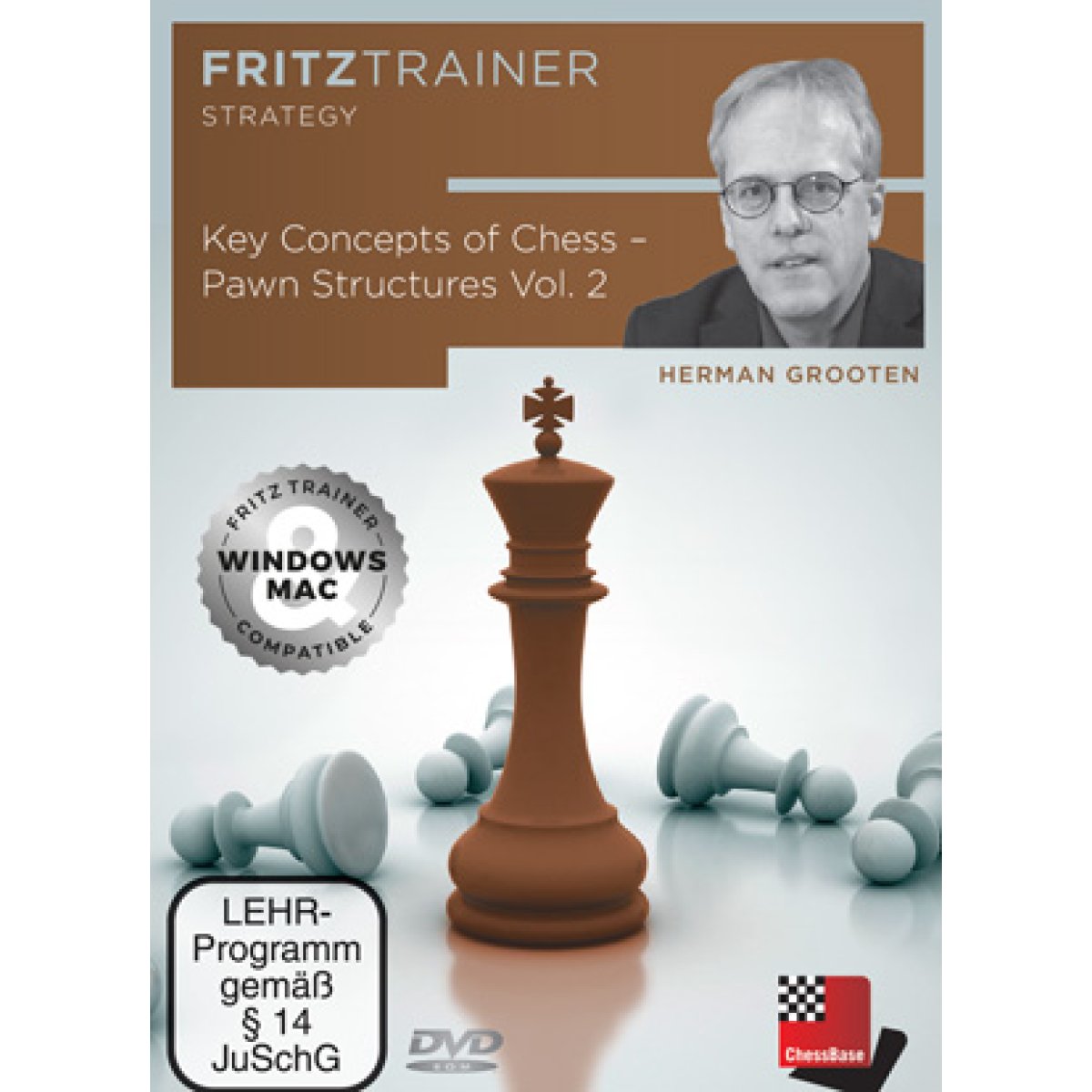
Key Concepts of Chess - Pawn Structures Vol.2

€29.90
Tax included
Discover the second installment of the "Key Concepts of Chess" series, focused on common and strategic pawn structures for club players. IM Herman Grooten explains how to maneuver pieces effectively around themes such as the isolated queen pawn (IQP) and the passed pawn in the middlegame. With 4 hours of video, interactive exercises, and model games, this course guides you to improve your understanding and tactical practice in your games.

FORMAT: DOWNLOAD
This product is not supplied in physical format. You will receive an email from our store with the download link and product activation code.

Quantity
In Stock

  Security policy

(edit with the Customer Reassurance module)

  Delivery policy

(edit with the Customer Reassurance module)

  Return policy

(edit with the Customer Reassurance module)

A new installment in the "Key Concepts of Chess" series. This course focuses on specific topics through concrete pawn structures. The main question is: how can the pieces be maneuvered to achieve optimal positions, and what aspects need to be considered? IM Herman Grooten offers practical rules and concepts that guide club players to find the best strategies in their games.

In this second part, the focus is on typical pawn structures that frequently appear and are familiar to club players. For example, this video course thoroughly addresses topics such as "the isolated queen’s pawn (IQP)" and "the passed pawn in the middlegame." Since the IQP arises in many opening variations, its study is very valuable. Additionally, understanding the decisive impact a passed pawn can have will be especially useful for the club player.

• Video duration: 4 hours (in English)
• Interactive training with video feedback
• Additional content: Model games and training with ChessBase applications – Play key pawn structures against Fritz at various levels

More... Less...
This includes:
  • Fritztrainer application for Windows and Mac
  • Available as download or DVD
  • Video course with an approximate duration of 4 to 8 hours
  • Repertoire database: save and integrate Fritztrainer games into your own repertoire (in WebApp Opening or ChessBase)
  • Interactive exercises with video feedback: the authors present exercises and key positions, and the user must input the solution. Includes additional explanations and error correction.
  • Example games in ChessBase database
  • New: several Fritztrainers also available via streaming on the ChessBase video portal
Functions of the FritzTrainer application:
  • Videos playable in the Fritztrainer application or in ChessBase with board graphics, notation, and function bar
  • Analysis engine activatable at any time
  • Video pauses for manual navigation and analysis in game notation
  • Input of personal variations, engine analysis, and saving in the game
  • Learning variations: view specific lines in ChessBase WebApp Opening with automatic playback, memorize and practice transformations (starting position – final position)
  • Active opening training: selected positions transfer to ChessBase WebApp Fritz-online to play against Fritz and test your knowledge
More functions when launching FritzTrainer in ChessBase:
  • Direct access to the database with all games and analyses
  • Easy incorporation of games into the opening repertoire
  • Direct evaluation with reference to games, including playback on the analysis board
  • Saving of personal variations to add to the personal repertoire
  • Repetition training
  • Active LiveBook
  • Use of all engines installed in ChessBase for analysis
  • Assisted analysis
  • Printing of notation and diagrams for teaching materials

Sample Video

Content

  • Introduction
  • The Isolated Queen’s Pawn Part 1
  • Introduction, advantages and disadvantages
  • The Nxf7 sacrifice
  • The d4-d5 pawn break
  • The pin along the d-file
  • The Nxf7 sacrifice 1: Khenkin-Bertran
  • The Nxf7 sacrifice 2: Iturrizaga-Papin
  • The Nxf7 sacrifice 3: Botvinnik-Batuyev
  • The Nxf7 sacrifice 4: Janev-Ilchev
  • The Nxf7 sacrifice 5: Botvinnik-Vidmar
  • The Isolated Queen’s Pawn Part 2
  • Elevation and rook exchange 1: Timofeev-Svidler
  • Elevation and rook exchange 2: Buhmann-Wichmann
  • Elevation and rook exchange 3: Onischuk-Vescovi
  • The d4-d5 pawn break 1: Ligterink-Donner
  • The d4-d5 pawn break 2: Portisch-Bilet
  • The d4-d5 pawn break 3: Sokolov-Fischer
  • The d4-d5 pawn break 4: Rodshtein-Diamant
  • Transition to "hanging pawns": Donaldson-Kudrin
  • Exploiting weaknesses 1: Bojkov-Dreev
  • Exploiting weaknesses 2: Arngrimmson-Damljanovic
  • Exercises
  • Description
  • Exercise 1
  • Exercise 2
  • Exercise 3
  • Exercise 4
  • Exercise 5
  • Exercise 6
  • Exercise 7
  • Exercise 8
  • Passed Pawn Part 1
  • Creating a passed pawn 1: Razuvayev-Honfi
  • Creating a passed pawn 2: Nielsen-NN
  • Pawn break: Thipsay-Peng
  • Push the pawn!: A.Haast-M.Bensdorp
  • Piece positioning relative to a passed pawn 1: Hughes-Chirila
  • Piece positioning relative to a passed pawn 2: Reinderman-Bosboom
  • Piece positioning relative to a passed pawn 3: Holt-Shetty
  • Attracting or driving away a defender: Cano Sanchez-Carrasco
  • Interference: Morozevich-Adams
  • Pin: Mentasi
  • Blocking a square 1: Troitzky
  • Blocking a square 2: Wall-Schuurman
  • Double attack: Engels-Maroczy
  • Passed Pawn Part 2
  • Exploiting a passed pawn: Halkias-Asrian
  • Creating a second passed pawn 1
  • Creating a second passed pawn 2: Nunn
  • Creating a second passed pawn 3: Schuurman-Gara
  • Defending against a passed pawn 1: Zenyuk-Abrahamyan
  • Defending against a passed pawn 2: Van den Ende
  • Defending against a passed pawn 3: Zheltukhov
  • Defending against a passed pawn 4: Kasparov-Timman
  • Exploiting weaknesses and using the passed pawn 1: Grooten-Douven
  • Exploiting weaknesses and using the passed pawn 2: Petrosian-Korchnoi
  • Exercises
  • Description
  • Exercise 1
  • Exercise 2
  • Exercise 3
  • Exercise 4
  • Exercise 5
  • Exercise 6
  • Exercise 7
  • Exercise 8
More...
Less...
KCOC-PSV-WCJN