

Key Concepts of Chess - The Hedgehog
search
  • Key Concepts of Chess - The Hedgehog

Key Concepts of Chess - The Hedgehog

€29.90
Tax included
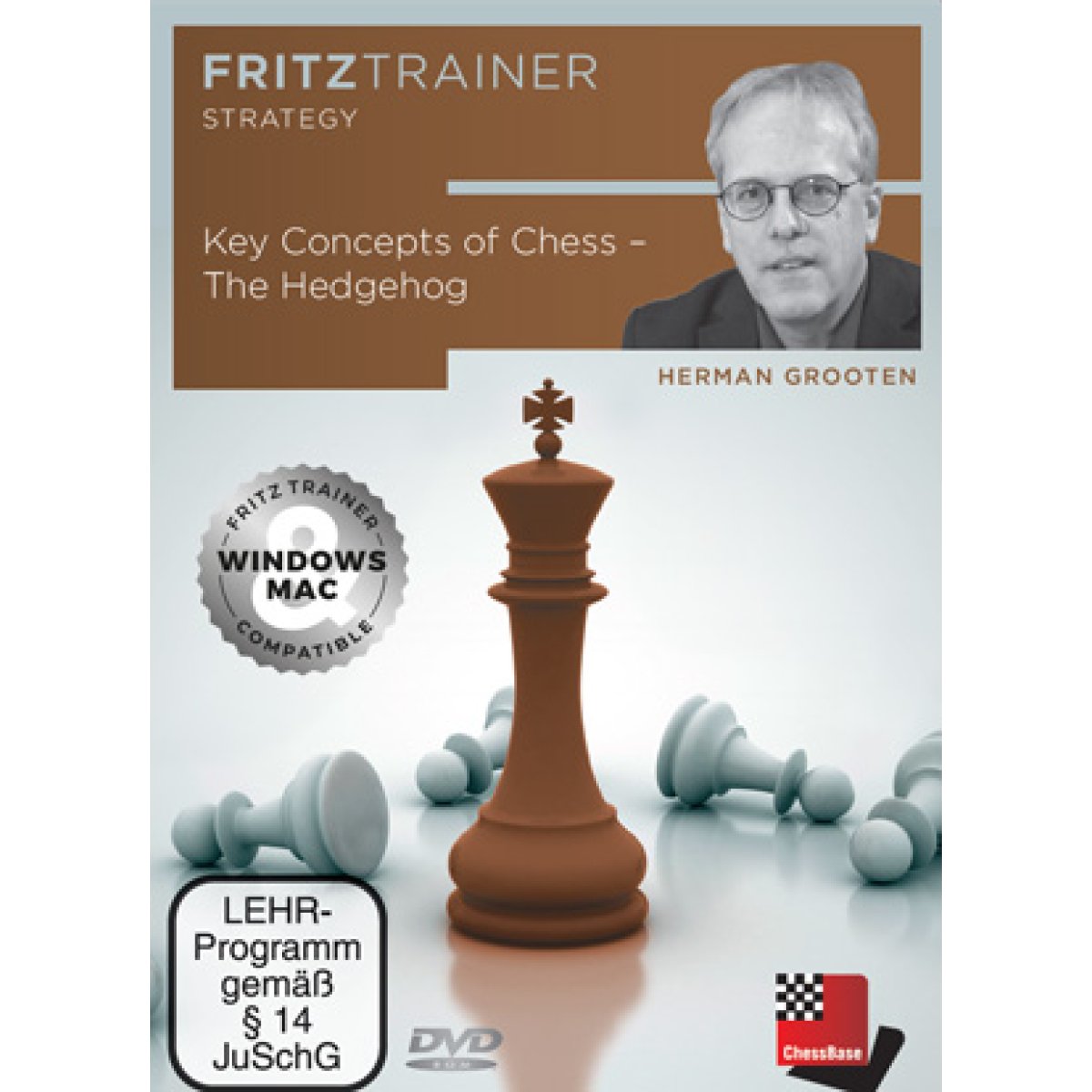
Discover the keys to the "Hedgehog" system with IM Herman Grooten in this 4-hour course in English. Learn to master the typical pawn structures of this system, the plans for White and Black, and how to capitalize on spatial advantages. Includes interactive exercises with video feedback, model games, and training against Fritz at various levels—ideal for club players looking to deepen their middlegame and opening skills.

FORMAT: DOWNLOAD
This product is not supplied in physical format. You will receive an email from our store with the download link and product activation code.

Quantity
In Stock

  Security policy

(edit with the Customer Reassurance module)

  Delivery policy

(edit with the Customer Reassurance module)

  Return policy

(edit with the Customer Reassurance module)

To properly understand openings, it is essential to first study the middlegame, since all plans in this phase are directly related to the ideas of the opening. Much of the strategy depends on pawn structures. For this reason, IM Herman Grooten guides club players to analyze common middlegame structures in detail.

In this video course, Grooten explains the basic ideas for White and Black pieces of a typical structure that can arise from various opening variations. This is the so-called "hedgehog system," characterized by at least four black pawns on the sixth rank forming the "spines" of the hedgehog. An essential aspect is that the exchange of Black's c-pawn for White's d-pawn (as in the Sicilian) creates a position where, partly thanks to c2-c4, White gains a significant spatial advantage. The viability of the "hedgehog" is demonstrated in all presented examples, as the author frequently uses this system.

• Video duration: 4 hours (in English)
• Interactive training with video feedback
• Extras: Model games and training with ChessBase applications to play key pawn structures against Fritz at various levels

Included content:
  • FritzTrainer application for Windows and Mac
  • Available for download or on DVD
  • Video course with an approximate duration of 4 to 8 hours
  • Repertoire database: saves and integrates FritzTrainer games into your own repertoire (in WebApp Opening or ChessBase)
  • Interactive exercises with video feedback: the authors present exercises and key positions; the user must enter the solution with explanations and corrections
  • Model games in the ChessBase database
  • New: many FritzTrainers also available for streaming on the ChessBase video portal
Features of the FritzTrainer App:
  • Playback of videos with board, notation, and control bar in the FritzTrainer app or ChessBase program
  • Analysis engine available at all times
  • Video pause for manual navigation and notation analysis
  • Entry of personal variations and engine analysis, saved within the game
  • Learning variations: visualizes specific lines in ChessBase WebApp Opening with automatic playback to memorize and practice position transformations
  • Active opening training: selected positions are sent to ChessBase WebApp Fritz-online to play against Fritz and practice the opening
More options: use FritzTrainer within the ChessBase program
  • Direct access to the database with all games and analyses
  • Easy incorporation of games into the opening reference
  • Direct evaluation with reference to games and playback on the analysis board
  • Saving personal variations to add to the personal repertoire
  • Playback training
  • Active LiveBook
  • Use of all engines installed in ChessBase for analysis
  • Assisted analysis
  • Printing of notation and diagrams for study materials

Sample Video

Contents

  • Introduction
  • Schematic Plan a
  • Schematic Plan b
  • Schematic Plan c
  • Basic Knowledge
  • Stean-Andersson
  • Learning from the Classics of the Hedgehog
  • Fischer-Andersson
  • Byrne-Andersson
  • Typical Plans for White
  • Sharpening the Spines: the Nd5!? Motif
  • Sharpening the Spines: a2-a4-a5
  • Sharpening the Spines: b2-b4 and c4-c5
  • Sharpening the Spines: e4-e5
  • Provoking Weaknesses: f4-f5
  • Advancement of the g and h Pawns: g2-g4-g5; h2-h4-h5; g6
  • Summary of Plans for White
  • Typical Plans for Black
  • Pawn Advances: b6-b5
  • Pawn Advances: d6-d5
  • Pawn Advances: b5 and ...d5
  • Pawn Bayonet on the h-pawn
  • Repositioning of the Bishop
  • Fischer's ...g5 Plan I
  • Fischer's ...g5 Plan II
  • The Maróczy Bind in Relation to the Hedgehog
  • Move Orders with e4
  • Move Orders with c4
  • Move Orders with d4
  • Move Orders with Nf3
  • Own Games in the Hedgehog
  • Wintzer-Grooten
  • Hausrath-Grooten
  • I.Böhm-Grooten
  • Conclusion
  • Exercises
  • Exercise 01
  • Exercise 02
  • Exercise 03
  • Exercise 04
  • Exercise 05
  • Exercise 06
  • Exercise 07
  • Exercise 08
  • Exercise 09
  • Exercise 10
  • Exercise 11
  • Exercise 12
  • Exercise 13
  • Exercise 14
  • Exercise 15
  • Exercise 16
  • Exercise 17
  • Exercise 18
  • Exercise 19
  • Exercise 20

Sicilian Defense

The moves 1.e4 c5 define the Sicilian Defense. Black fights for the d4 square, but unlike White’s double pawn advance with e4-e5, symmetry is immediately broken, showing that Black does not seek just equality. The game can then continue in various directions. 2.Nf3 followed by 3.d4 cxd4 4.Nxd4 leads to the Open Sicilian. Before this, Black can determine the course of the opening with 2...d6, 2...e6, or 2...Nc6. Currently, systems where White avoids an early d4 are also popular.

KCOC-TH-LHQT