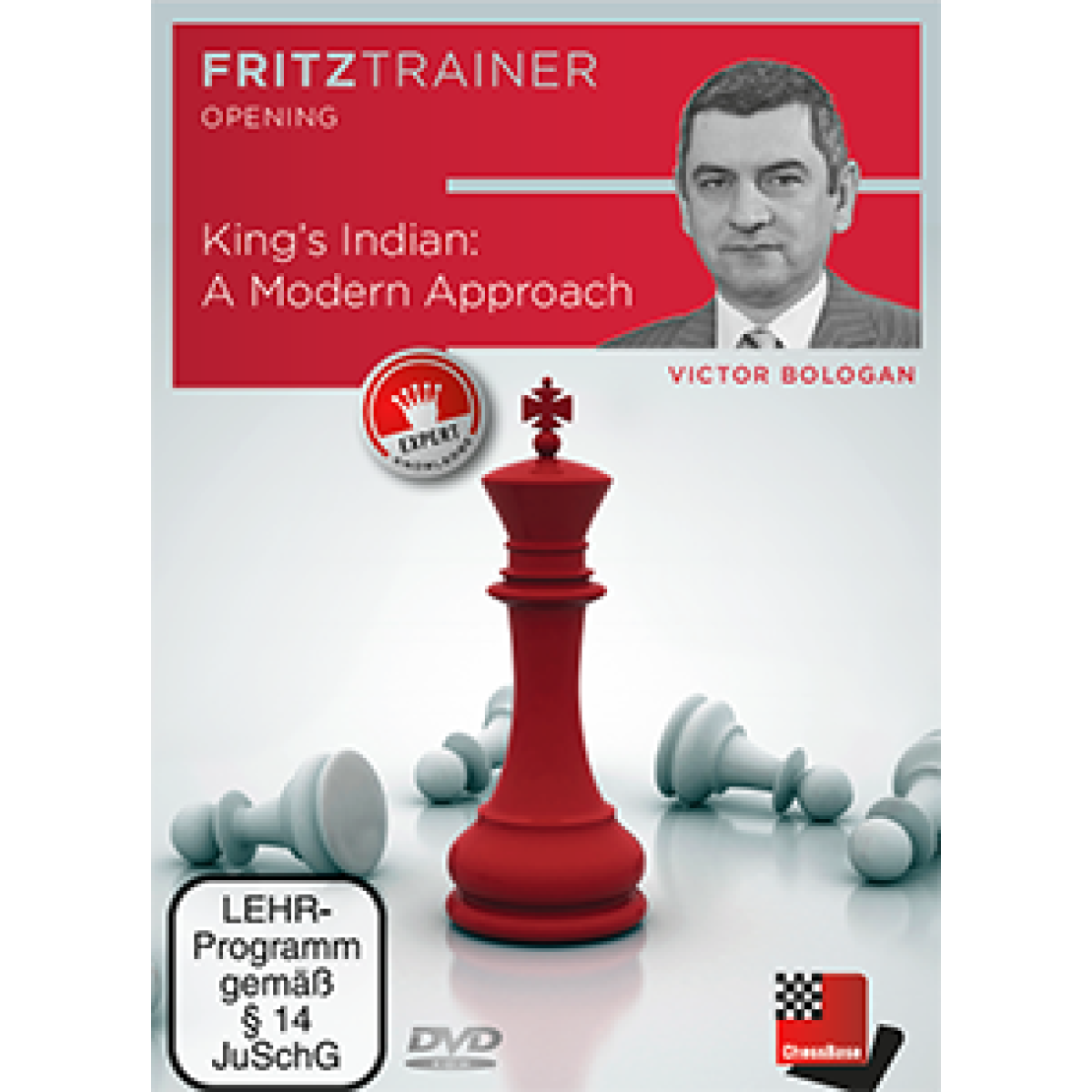


King's Indian: A modern approach
search
  • King's Indian: A modern approach

King's Indian: A Modern Approach

€29.90
Tax included
Discover the King's Indian Defense with Victor Bologan in this comprehensive 7-hour DVD. Learn from the fundamentals to the classic and modern variations, with analyses by grandmasters such as Kasparov and Nakamura. Includes interactive exercises with video feedback, a database with over 50 instructive games, and access to the Fritztrainer App for Windows. Improve your vocabulary and confidence in this dynamic opening.

FORMAT: DOWNLOAD
This product is not supplied in physical format. You will receive an email from our store with the download link and product activation code.

Quantity
In Stock

  Security policy

(edit with the Customer Reassurance module)

  Delivery policy

(edit with the Customer Reassurance module)

  Return policy

(edit with the Customer Reassurance module)

Author Victor Bologan comments on his DVD: “When chess players visit Iceland, they usually pay tribute to the genius of Bobby Fischer, the eleventh World Champion, by visiting his grave in Selfoss, Reykjavik. With this DVD, I also want to express my gratitude to Fischer for his great contribution to chess in general and for having helped popularize the King's Indian Defense in particular. When I was a child, at ten years old, my coach recommended that I study Fischer’s openings, and that’s how I discovered the King's Indian. Later, I learned the different options Black has in this defense: maintaining a flexible pawn structure with pawns on d6 and c6; playing the sharp and principled Nc6 in classical lines; and, in some variations, conceding a pawn with ...b5 as in the Benko.”

Great players such as Geller, Smirin, Kasparov, Radjabov, Nakamura, and Ding Liren have used and continue to use the King's Indian Defense, each with a different style and approach. While preparing this DVD, I analyzed games from these experts, verified analyses with modern engines, and consulted abundant material from correspondence chess databases. Day by day, my knowledge of the King's Indian grew broader and more varied, as did my confidence and conviction in this defense. If you study this DVD carefully and solve the interactive exercises, you will also expand your chess vocabulary, strengthen your handling of the King's Indian, and win more games.”

• Video duration: 7 hours 14 minutes (English)
• Interactive training with video feedback
• Database with over 50 instructive games and detailed analysis of the presented theory
• Includes CB 12 Reader

More... Less...
Product content:
  • Fritztrainer application for Windows
  • Available for download or on DVD
  • Video course approximately 4 to 8 hours long
  • Repertoire database: save and integrate Fritztrainer games into your own repertoire (in WebApp Opening or ChessBase)
  • Interactive exercises with video feedback: the authors present exercises and key positions; the user must input the solution, with corrections and additional explanations
  • Example games in a database compatible with ChessBase
Functions of the FritzTrainer application:
  • Videos playable in the Fritztrainer app or in ChessBase with board graphics, notation, and control bar
  • Analysis engine activatable at any time
  • Video pause for manual navigation and analysis in the game notation
  • Input of personal variations, engine analysis, and saving within the game
  • Variant learning: visualize specific lines in ChessBase WebApp Opening with automatic playback, memorization, and practice of transformations (starting position - final position)
  • Active opening training: selected positions are transferred to ChessBase WebApp Fritz-online, where you can test your knowledge in games against Fritz
More options: start FritzTrainer from ChessBase
  • Direct access to the database with all games and analyses
  • Easy incorporation of games into the opening repertoire
  • Direct evaluation with reference to games, playback on the analysis board
  • Saving and adding personal variations to the personal repertoire
  • Playback training
  • Active LiveBook
  • Use of any engine installed in ChessBase for analysis
  • Assisted analysis
  • Printing of notations and diagrams for teaching materials

Sample video

Contents

  • 01: Introduction [06:01]
  • King's Indian Defense: 1.d4 Nf6 2.c4 g6 3.Nc3 Bg7 4.e4 d6
  • 02: Plans with Bg5 and Bf4: 4.Bg5; 4.Nf3 0-0 5.Bg5/Bf4; 4.e4 d6 5.Bg5 - Video analysis [22:35]
  • 03: Plans with Nge2: 5.Bd3 0-0 6.Nge2; 5.Nge2 - Video analysis [17:23]
  • 04: 5.h3 0-0 6.Bg5/Be3 c5 - Video analysis [18:57]
  • 05: 5.h3 0-0 6.Nf3 e5 - Video analysis [17:29]
  • 06: Averbakh System 5.Be2 0-0 6.Bg5 c5 - Video analysis [13:28]
  • 07: 5.f4 c5 - Video analysis [18:11]
  • 08: 5.f3 0-0 6.Nge2 c5 - Video analysis [12:32]
  • 09: 5.f3 0-0 6.Bg5 c5 - Video analysis [12:31]
  • 10: 5.f3 0-0 6.Be3 c5 7.dxc5 dxc5 - Video analysis [22:33]
  • 11: 5.f3 0-0 6.Be3 c5 7.Nge2 Nc6/7.d5 e6 - Video analysis [23:24]
  • 12: Fianchetto System 4.g3 0-0 5.Bg2 d6 6.0-0 Nc6 7.Nc3 a6 8.e3 Rb8/8.Qd3 Bd7 - Video analysis [13:18]
  • 13: Fianchetto System 4.g3 0-0 5.Bg2 d6 6.0-0 Nc6 7.Nc3 a6 8.e4 Bg4 - Video analysis [07:43]
  • 14: Fianchetto System 4.g3 0-0 5.Bg2 d6 6.0-0 Nc6 7.Nc3 a6 8.h3 Bd7 - Video analysis [14:23]
  • 15: Fianchetto System 4.g3 0-0 5.Bg2 d6 6.0-0 Nc6 7.Nc3 a6 8.b3 Rb8 - Video analysis [15:59]
  • 16: Fianchetto System 4.g3 0-0 5.Bg2 d6 6.0-0 Nc6 7.Nc3 a6 8.d5 Na5 9.Nd2 c5 10.Rb1 Bf5 - Video analysis [13:49]
  • 17: Fianchetto System 4.g3 0-0 5.Bg2 d6 6.0-0 Nc6 7.Nc3 a6 8.d5 Na5 9.Nd2 c5 10.Qc2 Rb8 - Video analysis [19:51]
  • 18: Classical System - Exchange Variation 4.e4 d6 5.Nf3 0-0 6.Be2 e5 7.dxe5 dxe5 8.Qxd8 Rxd8 9.Bg5 Re8 - Video analysis [08:56]
  • 19: Classical System - 4.e4 d6 5.Nf3 0-0 6.Be2 e5 7.d5 a5 - Video analysis [14:05]
  • 20: Classical System - Bayonet Variation 4.e4 d6 5.Nf3 0-0 6.Be2 e5 7.0-0 Nc6 8.d5 Ne7 9.b4 Ne8 various 10th moves - Video analysis [17:33]
  • 21: Classical System - Bayonet Variation 4.e4 d6 5.Nf3 0-0 6.Be2 e5 7.0-0 Nc6 8.d5 Ne7 9.b4 Ne8 10.Nd2 f5 - Video analysis [15:32]
  • 22: Classical System - 4.e4 d6 5.Nf3 0-0 6.Be2 e5 7.0-0 Nc6 8.d5 Ne7 9.Nd2 a5 - Video analysis [10:04]
  • 23: Classical System - 4.e4 d6 5.Nf3 0-0 6.Be2 e5 7.0-0 Nc6 8.d5 Ne7 9.Ne1 Nd7 10.Nd3 f5 - Video analysis [20:57]
  • 24: Classical System - 4.e4 d6 5.Nf3 0-0 6.Be2 e5 7.0-0 Nc6 8.d5 Ne7 9.Ne1 Nd7 10.f3 f5 - Video analysis [14:28]
  • 25: Classical System - 4.e4 d6 5.Nf3 0-0 6.Be2 e5 7.0-0 Nc6 8.d5 Ne7 9.Ne1 Nd7 10.Be3 f5 11.f3 f4 12.Bf2 g5 13.a4 a5 - Video analysis [14:58]
  • 26: Classical System - 4.e4 d6 5.Nf3 0-0 6.Be2 e5 7.0-0 Nc6 8.d5 Ne7 9.Ne1 Nd7 10.Be3 f5 11.f3 f4 12.Bf2 g5 13.Rc1 Ng6 - Video analysis [16:08]
  • Positions for testing
  • 27: Position 1 [02:25]
  • 28: Position 2 [02:11]
  • 29: Position 3 [02:19]
  • 30: Position 4 [02:06]
  • 31: Position 5 [02:28]
  • 32: Position 6 [02:03]
  • 33: Position 7 [02:06]
  • 34: Position 8 [01:55]
  • 35: Position 9 [02:16]
  • 36: Position 10 [01:55]
More...
Less...

King's Indian Defense

The main characteristic of the King's Indian Defense is Black's kingside fianchetto of the bishop, combined with ...Nf6 and ...d6. Black allows White to advance pawns in the center with the c-, d-, and e-pawns, and claims his share later with ...e5 or ...c5. Its popularity is initially due to Soviet grandmasters Isaac Boleslavsky (1919–1977) and David Bronstein (1924–2006). Its first golden era was in the 1950s and 1960s, when Bobby Fischer also employed it. In the late 1980s, Garry Kasparov was its most prominent exponent, a position now held by Teimour Radjabov.

KIAMA-MDQM