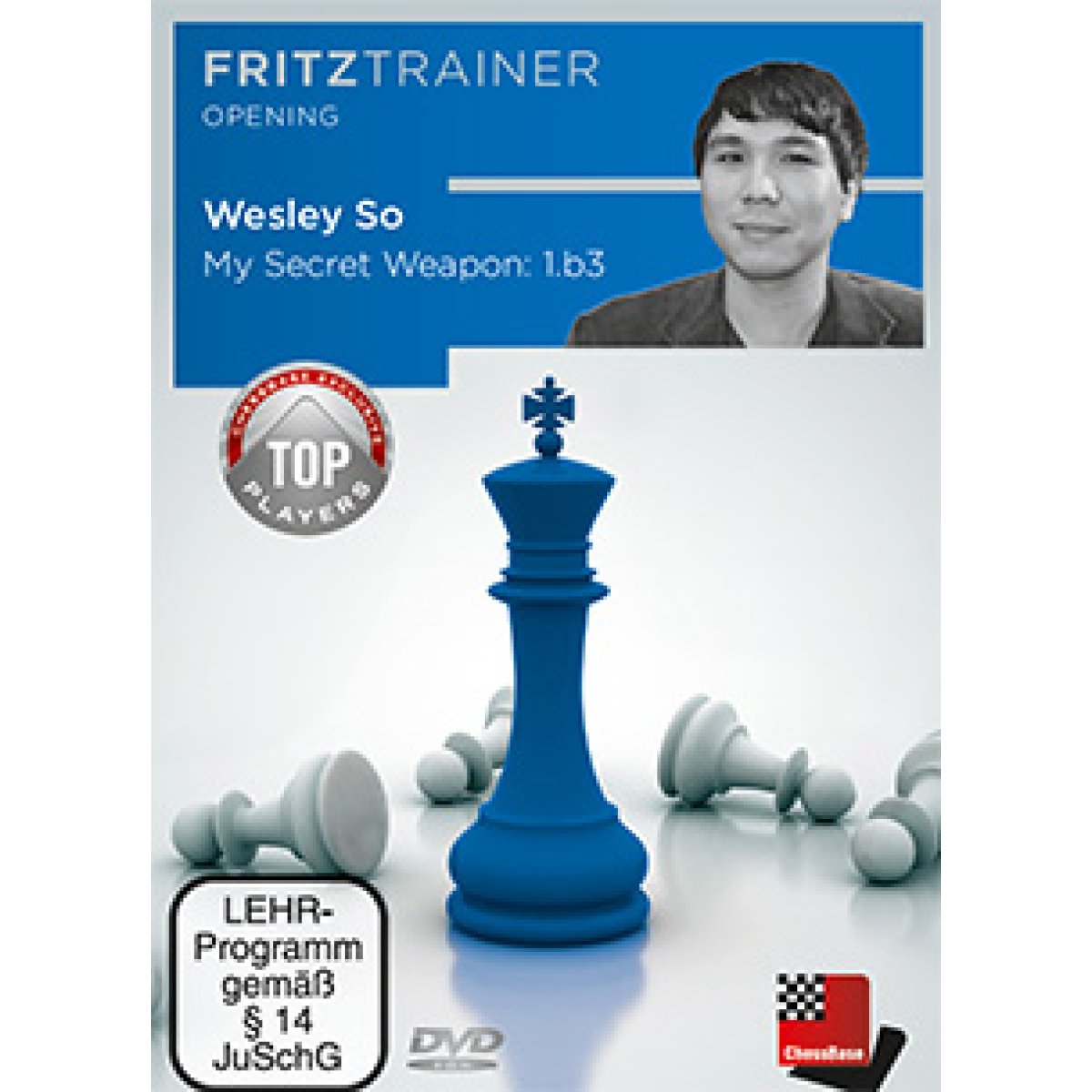


My Secret Weapon: 1.b3
search
  • My Secret Weapon: 1.b3

My Secret Weapon: 1.b3

€34.90
Tax included
Discover the Nimzowitsch-Larsen Attack with 1.b3, a rarely explored but powerful opening in expert hands. Learn from GM Wesley So in this nearly 3-hour video course, which analyzes Black’s main responses and reveals modern strategies and positional plans. It includes interactive exercises, an exclusive database, and access to the FritzTrainer App to refine your repertoire with the insight of a current grandmaster.

FORMAT: DOWNLOAD
This product is not supplied in physical format. You will receive an email from our store with the download link and product activation code.

Quantity
In Stock

  Security policy

(edit with the Customer Reassurance module)

  Delivery policy

(edit with the Customer Reassurance module)

  Return policy

(edit with the Customer Reassurance module)

The Nimzowitsch-Larsen Attack with 1.b3 (or 1.Nf3 followed by 2.b3) is a system little explored by theorists, but it can be a powerful weapon in the hands of an ambitious White player. Even Bobby Fischer used this opening in several games, sometimes preferring it over his beloved 1.e4, and its greatest advocate was the legendary Dane Bent Larsen. Nowadays, 1.b3 has also been adopted by the world elite, and finally a top player has dedicated a study to the subject for ChessBase: none other than Grandmaster Wesley So.

In nine videos, So talks with IM Oliver Reeh, explaining his approach to White's strategy against Black's four main replies: 1...e5, 1...d5 (with 2.Nf3), 1...c5, and 1...Nf6. Often, the game transitions into openings such as the Queen’s Indian or Nimzo-Indian with colors reversed, where White enjoys the advantage of a tempo. Transitions to the English Opening can also occur, where 1.b3 is again advantageous for White, since their bishop will always appear first on the long diagonal. Besides the plans and ideas in the various lines after 1.b3, this DVD offers insight into the personal thinking of a modern grandmaster. For example, So highlights his appreciation for the bishop pair and enjoys when the opponent has doubled pawns (as after Bb2xNf6). Positional understanding and opening knowledge combine in this work by one of today’s great players. Broaden your chess vision with GM Wesley So and 1.b3.

  • Total duration: 2 h 50 min (in English)
  • Analysis by Wesley So
  • Includes exclusive database with additional model games
  • Compatible with CB Reader
More... Less...
Included content:
  • Fritztrainer application for Windows
  • Available for download or on DVD
  • Video course with an approximate duration of 4 to 8 hours
  • Database with repertoire: saves and integrates Fritztrainer games into your own repertoire (in WebApp Opening or ChessBase)
  • Interactive exercises with video feedback: authors present exercises and key positions, the user must input the solution, receiving comments and additional explanations via video
  • Model games in ChessBase database
FritzTrainer application features:
  • Videos can be viewed in the FritzTrainer app or in ChessBase with board, notation, and function bar
  • Analysis engine activatable at any time
  • Video pause for manual navigation and analysis in game notation
  • Input of own variations, engine analysis, and saving within the game
  • Line learning: view variations in ChessBase WebApp Opening with automatic playback, memorize and practice transformations (starting position - final position)
  • Active opening training: selected positions are transferred to ChessBase WebApp Fritz-online to play against Fritz and test acquired knowledge
More options: Run FritzTrainer in ChessBase
  • Direct access to the database with all games and analyses
  • Easy incorporation of games into your opening repertoire
  • Direct evaluation with game references, playback on analysis board
  • Saving own variations to add to personal repertoire
  • Repetition training
  • Active LiveBook
  • Use of all engines installed in ChessBase for analysis
  • Assisted analysis
  • Printing notation and diagrams (for teaching material)

Sample video

Content

  • 01: 1.b3 e5 2.Bb2 Nc6 3.c4 Nf6 4.e3 Be7 5.a3 O-O 6.d3/Qc2 - Analysis [11:13]
  • 02: 1.b3 e5 2.Bb2 Nc6 3.e3 g6/d5 - Analysis [18:02]
  • 03: 1.b3 e5 2.Bb2 Nc6 3.e3 Nf6 4.Nf3/Bb5 - Analysis [20:30]
  • 04: 1.b3 d5 2.Bb2 Nf6 3.e3 e6/g6 and 2...Bf5/Bg4 - Analysis [20:26]
  • 05: 1.b3 c5 2.Bb2 Nc6 3.Nf3 d6 4.d4 cxd4 5.Nxd4 Nf6 and 2...d5 3.e3 - Analysis [20:03]
  • 06: 1.b3 Nf6 2.Bb2 g6 3.Nf3 Bg7 4.g3 b6/c5/d5 and 2...b6 - Analysis [26:33]
  • 07: 1.b3 Nf6 2.Bb2 g6 3.g3 Bg7 4.Bg2 O-O 5.Nf3 d6 6.d4 Nbd7 and 5...d5 6.c4 c6/e6 - Analysis [14:34]
  • 08: 1.b3 e5 2.Bb2 d6 3.e3 Nf6 4.d4/c4/g3 and 3...c5 4.d4 cxd4 5.exd4 exd4 - Analysis [16:41]
  • 09: 1.b3 d5 2.Nf3 Bg4 3.Ne5 Bf5/Bh5 and 2.Bb2 Bg4 3.h3/f3 and 2.Bb2 Nf6 3.Nf3 Bf5/Bg4 - Analysis [22:28]
More...
Less...

Other openings

Besides the two main moves 1.e4 and 1.d4, there are 1.c4 and 1.Nf3, considered solid and respectable ways to start. However, White can also choose 1.b3, 1.g3, or even 1.f4 or 1.b4.

MSW1-FXRB