

Play the Sveshnikov Sicilian
search
  • Play the Sveshnikov Sicilian

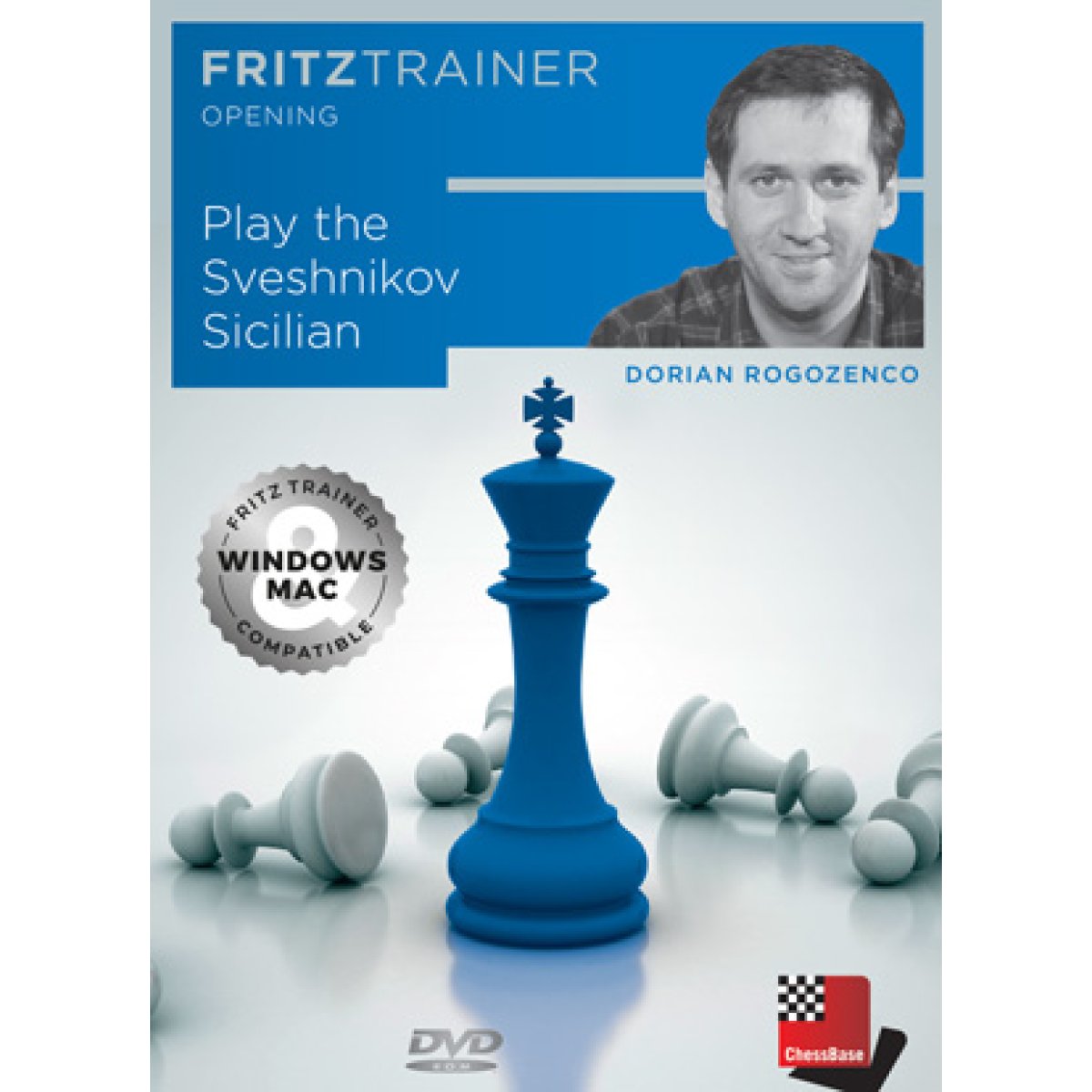
Play the Sveshnikov Sicilian.

€29.90
Tax included
Discover the Sveshnikov Sicilian Defense with Grandmaster Dorian Rogozenco in this comprehensive video course. Based on 30 years of experience, it analyzes everything from the opening moves to the main lines and variations, providing historical context, strategic ideas, and clear recommendations for Black. Includes over 5 hours of lessons, databases with annotated games, and interactive training to master this popular and dynamic opening.

FORMAT: DOWNLOAD
This product is not supplied in physical format. You will receive an email from our store with the download link and product activation code.

Quantity
In Stock

  Security policy

(edit with the Customer Reassurance module)

  Delivery policy

(edit with the Customer Reassurance module)

  Return policy

(edit with the Customer Reassurance module)

“To understand an opening, it is essential to know its historical context and grasp its dynamics well,” says Grandmaster Dorian Rogozenco in the introduction to this video course. With over 30 years of high-level experience, Rogozenco offers a comprehensive guide for Black in the modern theory of the Sveshnikov Sicilian.

The Sveshnikov Sicilian regained popularity after the 2018 World Championship match between Magnus Carlsen and Fabiano Caruana, where the champion used this opening as one of his main weapons. The starting point of the course is 1.e4 c5 2.Nf3 Nc6 3.d4 cxd4 4.Nxd4 Nf6 5.Nc3 e5. Rogozenco details both the main line and secondary variations. The course is divided into 12 parts, each with a video introduction and a database. In the introduction, the author explains historical background, strategic ideas, and offers clear recommendations for Black. In addition to the video content, the databases include games annotated with all the theoretical details needed.

• Total video duration: 5 hours and 19 minutes (in English)
• Supplements: database with extensive analysis and annotations, training through ChessBase apps to memorize the repertoire and practice key positions against Fritz at various levels

More... Less...
Included Content:
  • Fritztrainer app for Windows and Mac
  • Available for download or on DVD
  • Video course with an approximate duration of 4 to 8 hours
  • Repertoire database: saves and integrates Fritztrainer games into your own repertoire (in WebApp Opening or ChessBase)
  • Interactive exercises with video feedback: the authors present exercises and key positions, and the user must enter the solution, receiving comments and explanations
  • Example games in a ChessBase database
  • New: many Fritztrainers available for streaming on the ChessBase video portal
FritzTrainer App Features:
  • Videos can be played in the Fritztrainer app or in the ChessBase program with board graphics, notation, and function bar
  • Analysis engine can be activated at any time
  • Ability to pause the video to navigate and analyze manually in the notation
  • Input your own variations, engine analysis, and save in the game
  • Variation learning: view specific lines in ChessBase WebApp Opening with automatic playback, memorize and practice transformations (from initial to final position)
  • Active opening training: selected positions are transferred to ChessBase WebApp Fritz-online to play against Fritz and test acquired knowledge
More options: open FritzTrainer in ChessBase
  • Direct access to the database with all games and analysis
  • Easy incorporation of games into the opening reference
  • Direct evaluation with game references and playback on the analysis board
  • Saving and adding your own variations to your personal repertoire
  • Playback training
  • Active LiveBook
  • Use of all engines installed in ChessBase for analysis
  • Assisted analysis
  • Printing of notation and diagrams for study materials

Sample Video

Content

  • Chapter 1 - Introduction
  • 1.e4 c5 2.Nf3 Nc6 3.d4 cxd4 4.Nxd4 Nf6 5.Nc3 e5
  • Introduction
  • Chapter 2 - Various moves on the sixth move
  • 1.e4 c5 2.Nf3 Nc6 3.d4 cxd4 4.Nxd4 Nf6 5.Nc3 e5
  • 6.Nf5 and other sixth moves
  • Chapter 3 - 6.Nb5 d6 7.Nd5 Nxd5 8.exd5 Nb8 9.c4 and alternatives
  • 1.e4 c5 2.Nf3 Nc6 3.d4 cxd4 4.Nxd4 Nf6 5.Nc3 e5 6.Nb5 d6
  • 7.Nd5 Nxd5 8.exd5 Nb8 9.c4 and other moves on the ninth move
  • Chapter 4 - 9.a4
  • 1.e4 c5 2.Nf3 Nc6 3.d4 cxd4 4.Nxd4 Nf6 5.Nc3 e5 6.Nb5 d6
  • 7.Nd5 Nxd5 8.exd5 Nb8 9.a4
  • Chapter 5 - 7.Bg5 a6 8.Ba3 b5 9.Nd5 Be7 10.Bxf6 Bxf6 11.c4
  • 1.e4 c5 2.Nf3 Nc6 3.d4 cxd4 4.Nxd4 Nf6 5.Nc3 e5 6.Nb5 d6 7.Bg5 a6 8.Ba3 b5
  • 9.Nd5 Be7 10.Bxf6 Bxf6 11.c4
  • Chapter 6 - 11.c3
  • 1.e4 c5 2.Nf3 Nc6 3.d4 cxd4 4.Nxd4 Nf6 5.Nc3 e5 6.Nb5 d6 7.Bg5 a6 8.Ba3 b5
  • 9.Nd5 Be7 10.Bxf6 Bxf6 11.c3
  • Chapter 7 - 9.Bxf6 gxf6 10.Nd5 f5 11.Bxb5 and alternatives
  • 1.e4 c5 2.Nf3 Nc6 3.d4 cxd4 4.Nxd4 Nf6 5.Nc3 e5 6.Nb5 d6 7.Bg5 a6 8.Ba3 b5 9.Bxf6 gxf6 10.Nd5 f5
  • 11.Bxb5 and other moves on the eleventh move
  • Chapter 8 - 11.c3 Bg7 12.exf5
  • 1.e4 c5 2.Nf3 Nc6 3.d4 cxd4 4.Nxd4 Nf6 5.Nc3 e5 6.Nb5 d6 7.Bg5 a6 8.Ba3 b5 9.Bxf6 gxf6 10.Nd5 f5 11.c3 Bg7
  • 12.exf5 Bxf5
  • Chapter 9 - 12.Bd3
  • 1.e4 c5 2.Nf3 Nc6 3.d4 cxd4 4.Nxd4 Nf6 5.Nc3 e5 6.Nb5 d6 7.Bg5 a6 8.Ba3 b5 9.Bxf6 gxf6 10.Nd5 f5 11.c3 Bg7 12.Bd3
  • 12...Be6
  • Chapter 10 - 11.Bd3 Be6 12.Qh5
  • 1.e4 c5 2.Nf3 Nc6 3.d4 cxd4 4.Nxd4 Nf6 5.Nc3 e5 6.Nb5 d6 7.Bg5 a6 8.Ba3 b5 9.Bxf6 gxf6 10.Nd5 f5 11.Bd3 Be6
  • 12.Qh5
  • Chapter 11 - 12.O-O Bxd5 13.exd5 Ne7 14.Re1 and alternatives
  • 1.e4 c5 2.Nf3 Nc6 3.d4 cxd4 4.Nxd4 Nf6 5.Nc3 e5 6.Nb5 d6 7.Bg5 a6 8.Ba3 b5 9.Bxf6 gxf6 10.Nd5 f5 11.Bd3 Be6 12.O-O Bxd5 13.exd5 Ne7
  • 14.Re1 and other moves on the fourteenth move
  • Chapter 12 - 14.c3
  • 1.e4 c5 2.Nf3 Nc6 3.d4 cxd4 4.Nxd4 Nf6 5.Nc3 e5 6.Nb5 d6 7.Bg5 a6 8.Ba3 b5 9.Bxf6 gxf6 10.Nd5 f5 11.Bd3 Be6 12.O-O Bxd5 13.exd5 Ne7
  • 14.c3
More...
Less...

Sicilian Defense

The moves 1.e4 c5 define the Sicilian Defense. Black fights for the d4 square, but unlike moving the e-pawn twice, the symmetry is broken immediately, showing that Black seeks more than equality. From here, the game can take different paths. 2.Nf3 followed by 3.d4 cxd4 4.Nxd4 leads to the Open Sicilian. Before that, Black can mark the direction with 2...d6, 2...e6, or 2...Nc6. Currently, systems where White avoids an early d4 are also popular.

PTSS-PGCC