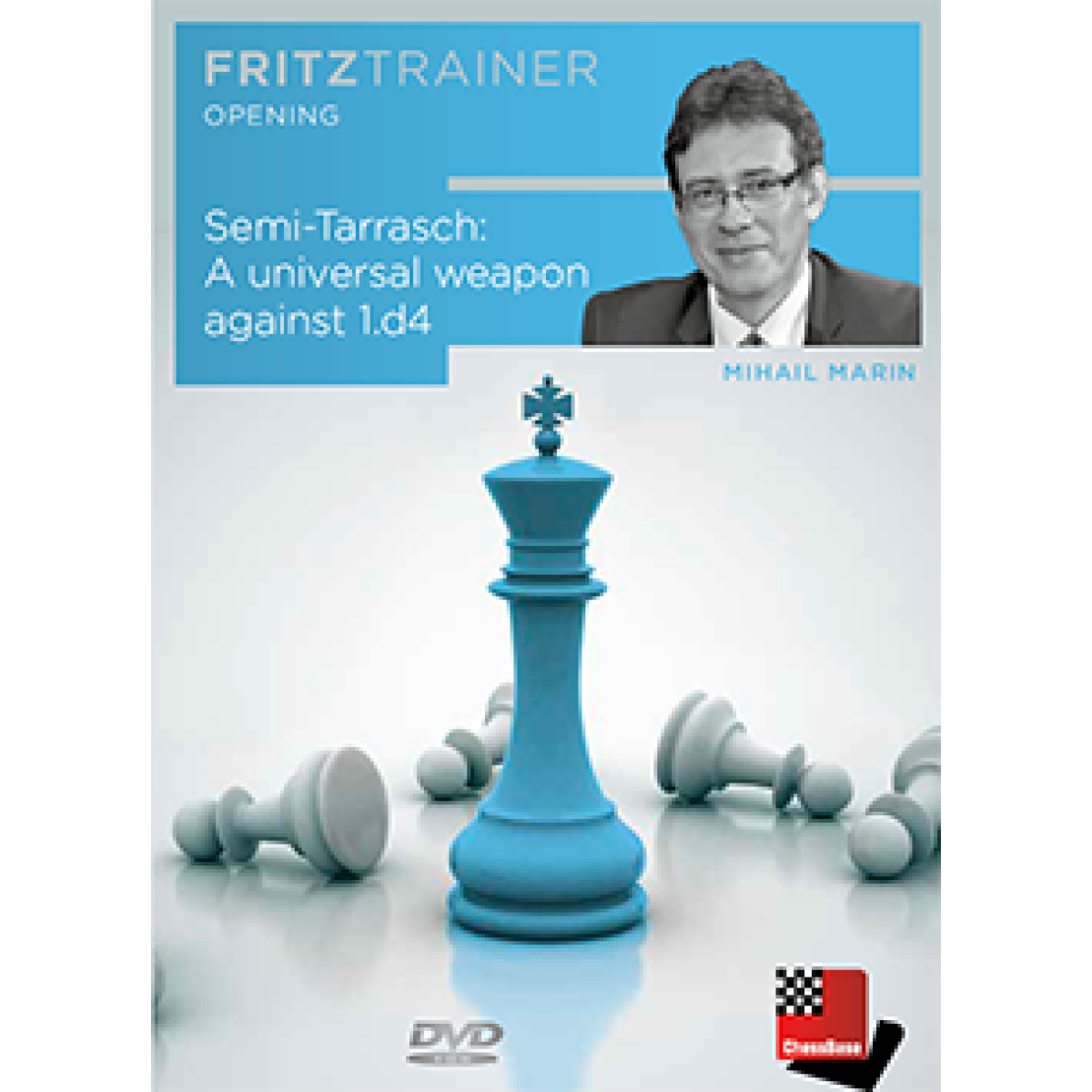

Semi-Tarrasch: A universal weapon against 1.d4
search
  • Semi-Tarrasch: A universal weapon against 1.d4

Semi-Tarrasch: A universal weapon against 1.d4

€29.90
Tax included
Discover the complete repertoire for Black with the Semi-Tarrasch Defense, a solid and dynamic option against 1.d4. This video course of over 6 hours, featuring interactive training and a database with more than 50 instructive games, guides you through the strategic ideas and key variations, offering an effective weapon to face the Queen's Gambit and symmetrical English systems, endorsed by grandmasters such as Fischer and Kramnik.

FORMAT: DOWNLOAD
This product is not supplied in physical format. You will receive an email from our store with the download link and product activation code.

Quantity
In Stock

  Security policy

(edit with the Customer Reassurance module)

  Delivery policy

(edit with the Customer Reassurance module)

  Return policy

(edit with the Customer Reassurance module)

Although the Semi-Tarrasch does not offer a complete repertoire against 1.d4 due to White's move order, it is an excellent complement to the Nimzo-Indian Defense. Additionally, it represents an effective way to avoid the strategic pressure in the Accepted Queen's Gambit and serves as a reliable weapon against the main symmetrical systems of the English Opening. The resulting structures resemble the dynamic Grünfeld Defense, but the play is usually much less forced, allowing both sides to unleash their creativity in the middlegame with greater freedom. Developing the bishop from f8 to e7 or exchanging it early with ...Bb4+ relinquishes the typical Grünfeld pressure on d4 but increases Black's options to block the d-pawn after the thematic central break d4-d5. Great players like Fischer, Korchnoi, and Kramnik have incorporated the Semi-Tarrasch into their repertoires, which supports its solidity and counterattack possibilities for Black. The author offers a complete Semi-Tarrasch repertoire for Black, explaining the key strategic ideas and providing detailed analyses against practically all important White variations.

• Video duration: 6 hours 10 min. (in English)
• Interactive training with video feedback
• Bonus: database with more than 50 instructive games
• Includes ChessBase 12 – Reader

More... Less...
Included content:
  • Fritztrainer application for Windows
  • Available for download or on DVD
  • Video course lasting approximately 4 to 8 hours
  • Repertoire database: saves and integrates Fritztrainer games into your personal repertoire (in WebApp Opening or ChessBase)
  • Interactive exercises with video feedback: the authors present exercises and key positions, the user must enter the solution. Includes explanations and corrections
  • Sample games in a ChessBase database
FritzTrainer application features:
  • Videos can be played in the Fritztrainer application or in the ChessBase program with board, notation, and function bar
  • The analysis engine can be activated at any time
  • Video pause for manual navigation and analysis in the game's notation
  • Input of own variations, engine analysis, and storage in the game
  • Variant learning: visualizes specific lines in ChessBase WebApp Opening with automatic playback, memorizes variants, and practices transformations (starting position – end position)
  • Active opening training: selected positions are transferred to ChessBase WebApp Fritz-online to play games against Fritz and put into practice what you have learned
More options: start FritzTrainer in ChessBase:
  • Open directly the database with all games and analyses
  • Easily add games to the opening reference
  • Direct evaluation with game reference and playback on the analysis board
  • Save own variations and add them to the personal repertoire
  • Repetition training
  • Active LiveBook
  • Ability to use all engines installed in ChessBase for analysis
  • Assisted analysis
  • Printing of notation and diagrams (for worksheets)

Sample video

Content

  • 01: Introduction [01:57]
  • 02: Semi-Tarrasch 1.d4 Nf6 2.c4 e6 3.Nf3 d5 4.Nc3 c5 5.cxd5 Nxd5 Presentation [11:13]
  • 03: 6.g3 - Video analysis [11:16]
  • 04: 6.g3 Nc6 7.Bg2 Be7 8.0-0 0-0 9.Nxd5 exd5 10.b3 - Video analysis [09:53]
  • 05: 6.g3 Nc6 7.Bg2 Be7 8.0-0 0-0 9.Nxd5 exd5 10.Be3 - Video analysis [05:32]
  • 06: 6.g3 Nc6 7.Bg2 Be7 8.0-0 0-0 9.Nxd5 exd5 10.dxc5 Bxc5 11.Ne1 - Video analysis [12:11]
  • 07: 6.g3 Nc6 7.Bg2 Be7 8.0-0 0-0 9.Nxd5 exd5 10.dxc5 Bxc5 11.Ng5 - Video analysis [10:17]
  • 08: 6.g3 Nc6 7.Bg2 Be7 8.0-0 0-0 9.Nxd5 exd5 10.dxc5 Bxc5 11.b3 - Video analysis [14:08]
  • 09: 6.g3 Nc6 7.Bg2 Be7 8.0-0 0-0 9.Nxd5 exd5 10.dxc5 Bxc5 11.a3 Bf5 12.b4 Bb6 13.Bb2 - Video analysis [06:08]
  • 10: 6.g3 Nc6 7.Bg2 Be7 8.0-0 0-0 9.Nxd5 exd5 10.dxc5 Bxc5 11.a3 Bf5 12.b4 Bb6 13.Ra2 - Video analysis [11:39]
  • 11: 6.g3 Nc6 7.Bg2 Be7 8.0-0 0-0 9.Nxd5 exd5 10.dxc5 Bxc5 11.Qc2 - Video analysis [13:52]
  • 12: 6.g3 Nc6 7.Bg2 Be7 8.0-0 0-0 9.Nxd5 exd5 10.dxc5 Bxc5 11.Qc2 Bb6 12.Ng5 g6 13.Qd1 - Video analysis [06:09]
  • 13: 6.g3 Nc6 7.Bg2 Be7 8.0-0 0-0 9.Nxd5 exd5 10.dxc5 Bxc5 11.Qc2 Bb6 12.Ng5 g6 13.Qd2 - Video analysis [09:38]
  • 14: 6.g3 Nc6 7.Bg2 Be7 8.0-0 0-0 9.Nxd5 exd5 10.dxc5 Bxc5 11.Bg5 - Video analysis [10:20]
  • 15: 6.g3 Nc6 7.Bg2 Be7 8.0-0 0-0 9.Nxd5 exd5 10.dxc5 Bxc5 11.Bg5 f6 12.Bd2 - Video analysis [20:03]
  • 16: 6.g3 Nc6 7.Bg2 Be7 8.0-0 0-0 9.Nxd5 exd5 10.dxc5 Bxc5 11.Bg5 f6 12.Rc1 - Video analysis [11:32]
  • 17: 6.g3 Nc6 7.Bg2 Be7 8.0-0 0-0 9.e4 - Video analysis [07:18]
  • 18: 6.g3 Nc6 7.Bg2 Be7 8.0-0 0-0 9.e4 Nxc3 10.bxc3 cxd4 11.cxd4 b6 12.Be3 - Video analysis [12:38]
  • 19: 6.g3 Nc6 7.Bg2 Be7 8.0-0 0-0 9.e4 Nxc3 10.bxc3 cxd4 11.cxd4 b6 12.Bb2 - Video analysis [12:26]
  • 20: 6.g3 Nc6 7.Bg2 Be7 8.0-0 0-0 9.e4 Nxc3 10.bxc3 cxd4 11.cxd4 b6 12.d5 - Video analysis [07:13]
  • 21: 6.g3 Nc6 7.Bg2 Be7 8.0-0 0-0 9.e4 Nxc3 10.bxc3 cxd4 11.cxd4 b6 12.d5 exd5 13.exd5 Nb4 14.Ne5 Bf6 15.Re1 - Video analysis [13:21]
  • 22: 6.g3 Nc6 7.Bg2 Be7 8.0-0 0-0 9.Rb1 - Video analysis [06:30]
  • 23: 6.e3 - Video analysis [08:15]
  • 24: 6.e3 Nc6 7.Bd3 Be7 8.0-0 0-0 9.a3 - Video analysis [12:42]
  • 25: 6.e3 Nc6 7.Bd3 Be7 8.0-0 0-0 9.Re1 - Video analysis [08:55]
  • 26: 6.e3 Nc6 7.Bc4 - Video analysis [17:58]
  • 27: 6.e3 Nc6 7.Bc4 Nxc3 8.bxc3 Be7 9.0-0 0-0 10.e4 - Video analysis [10:50]
  • 28: 6.e4 - Video analysis [09:29]
  • 29: 6.e4 Nxc3 7.bxc3 cxd4 8.cxd4 Bb4+ 9.Bd2 Bxd2 10.Qxd2 0-0 11.Bc4 Nd7 - Video analysis [10:33]
  • 30: 6.e4 Nxc3 7.bxc3 cxd4 8.cxd4 Bb4+ 9.Bd2 Bxd2 10.Qxd2 0-0 11.Bc4 Nd7 12.0-0 b6 13.Rfe1 Bb7 14.Rad1 Rc8 15.Bd3 - Video analysis [08:47]
  • 31: 6.e4 Nxc3 7.bxc3 cxd4 8.cxd4 Bb4+ 9.Bd2 Bxd2 10.Qxd2 0-0 11.Bc4 Nd7 12.0-0 b6 13.Rfe1 Bb7 14.a4 - Video analysis [13:26]
  • 32: 6.e4 Nxc3 7.bxc3 cxd4 8.cxd4 Bb4+ 9.Bd2 Bxd2 10.Qxd2 0-0 other moves on move 11 - Video analysis [10:25]
  • 33: 1.d4 Nf6 2.c4 e6 3.Nf3 d5 4.cxd5 Nxd5 5.e4 Nxc3 6.bxc3 c5 7.a3 Accepted Queen's Gambit - Video analysis [08:57]
  • 34: 1.d4 Nf6 2.c4 e6 3.Nf3 d5 4.cxd5 Nxd5 5.e4 Nxc3 6.bxc3 c5 7.a3 Qc7 - Video analysis [07:50]
More...
Less...

Queen's Gambit

Control of the center with 1.d4 is, along with 1.e4, one of the most popular ways to start a game. If Black responds symmetrically with 1...d5, after 2.c4 we have the Queen's Gambit. Usually, Black defends the pawn on d5 to maintain central presence, either with 2...e6 – Queen's Gambit Declined – or 2...c6 – Slav Defense. A third different option is 2...dxc4, the Queen's Gambit Accepted.

SAUWA1-IZXU