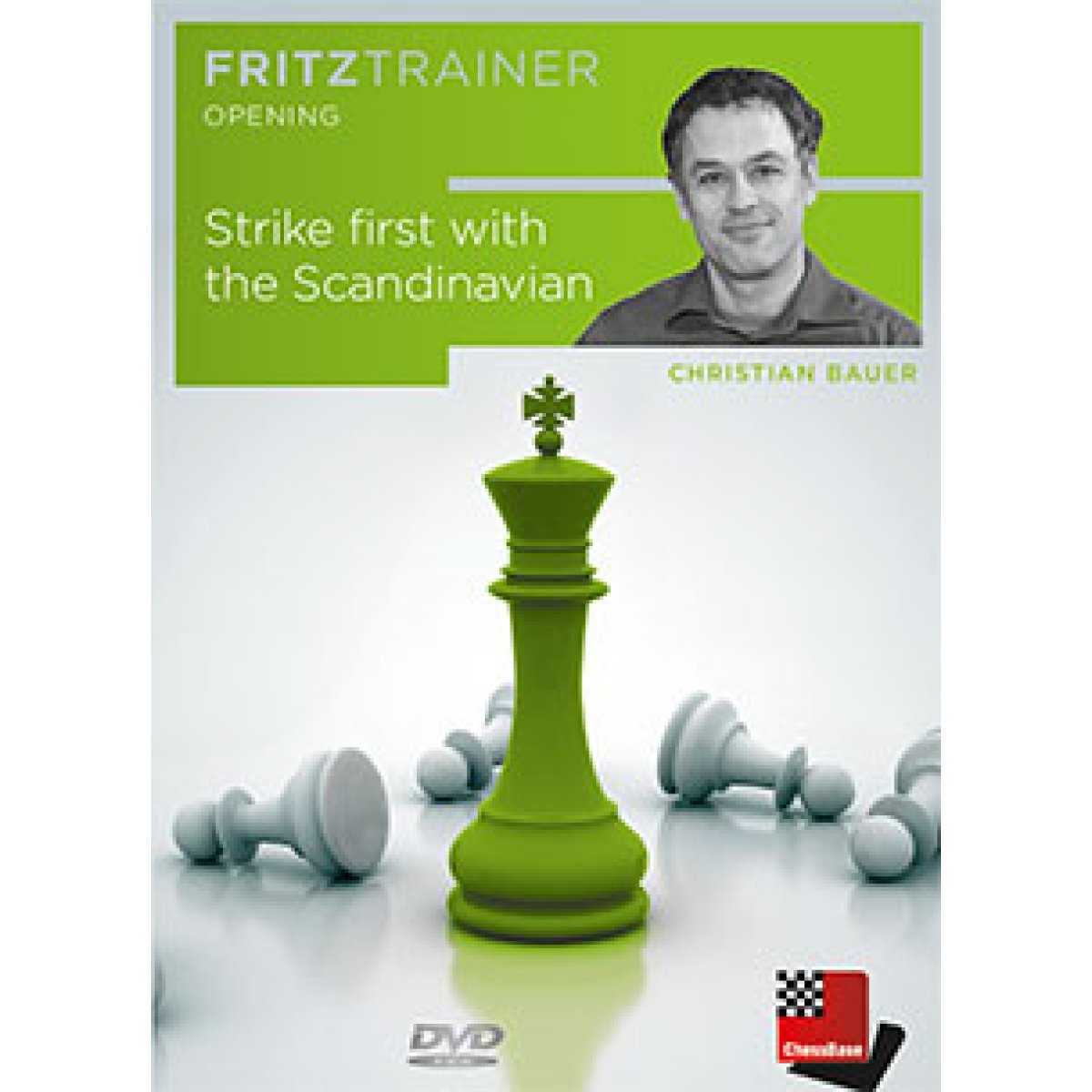


Strike first with the Scandinavian
search
  • Strike first with the Scandinavian

Strike first with the Scandinavian

€29.90
Tax included
Discover the Scandinavian Defense, an uncommon opening that challenges your opponent from the very first move with 1.e4 d5. Ideal for those looking to avoid highly theoretical lines like the Sicilian, it offers solid and flexible play with excellent control over the light squares. This interactive course of more than 5 hours includes detailed analyses, exercises with video feedback, and exclusive databases to perfect your repertoire.

FORMAT: DOWNLOAD
This product is not supplied in physical format. You will receive an email from our store with the download link and product activation code.

Quantity
In Stock

  Security policy

(edit with the Customer Reassurance module)

  Delivery policy

(edit with the Customer Reassurance module)

  Return policy

(edit with the Customer Reassurance module)

The Scandinavian Defense is an uncommon opening at the highest levels and leads your opponent into less familiar territory than, for example, the Sicilian, French, or any 1.e4 e5 system. This rarity results in slow theoretical development and avoids the need to constantly update your knowledge of the latest advancements. After 1.e4 d5, Black fights for the initiative from the very first move without any preparatory maneuvers.

Despite its poor reputation (which can work to your advantage), largely based on the loss of tempo after 1.e4 d5 2.exd5 Qxd5 3.Nc3, the Scandinavian Defense is a solid and underrated opening. It allows Black to alternate between dynamic or more restrained play, achieving a solid position and excellent control over the light squares after exchanging the dark-squared bishop for the knight on c3. Don’t hesitate—make the Scandinavian your opening weapon.

• Video duration: 5 h 11 min (English)
• Interactive training with video feedback
• Extras: database with relevant games and theory analyzed by the author
• Includes CB 12 Reader

More... Less...
Included content:
  • Fritztrainer application for Windows
  • Available for download or on DVD
  • Video course with an approximate duration of 4 to 8 hours
  • Repertoire database: save and integrate Fritztrainer games into your own repertoire (in WebApp Opening or ChessBase)
  • Interactive exercises with video feedback: the authors present exercises and key positions, the user must enter the solution. Includes additional explanations and corrections
  • Example games in ChessBase database
FritzTrainer application features:
  • Video playback in the Fritztrainer app or in the ChessBase program with board, notation, and control bar
  • Analysis engine available at any time
  • Pause video to navigate and manually analyze the game notation
  • Input of your own variations, engine analysis, and saving in the game
  • Variant learning: visualization of specific lines in the ChessBase WebApp Opening with automatic playback, memorization, and practice of transformations (initial - final position)
  • Active opening training: selected positions are transferred to the ChessBase WebApp Fritz-online to play games against Fritz and test your knowledge
More features: Launch FritzTrainer in the ChessBase program
  • Direct access to the database with all games and analyses
  • Easy addition of games to the opening reference
  • Direct evaluation with reference to games that can be replayed on the analysis board
  • Saving and adding your own variations to the personal repertoire
  • Repetitive training
  • Active LiveBook
  • Use of all engines installed in ChessBase for analysis
  • Assisted analysis
  • Printing notation and diagrams for study materials

Sample video

Content

  • Database: Analysis; Scandinavian games
  • 1.e4 d5
  • 01: Introduction [02:29]
  • 02: Overview of the variations [12:45]
  • 03: The first Scandinavian game: Morphy,P - Anderssen,A [09:03]
  • Chapter 1: 2.Nc3
  • 04: 2.Nc3 dxe4 - Video analysis [06:32]
  • 05: 2.Nc3 d4 - Video analysis [04:10]
  • Chapter 2: 2.exd5 Qxd5 3.d4 and 3.Nf3
  • 06: 3.d4 e5 - Video analysis [04:47]
  • 07: 3.Nf3 Bg4 4.Be2 Nc6 5.d4 0-0-0 6.c4 Qa5/Qf5 - Video analysis [09:08]
  • 08: 3.Nf3 Bg4 4.Be2 Nc6 5.0-0 0-0-0 - Video analysis [13:51]
  • Chapter 3: Fianchetto Variation
  • 09: 2.exd5 Qxd5 3.Nc3 Qa5 4.g3 and 4.Nf3 Nf6 5.g3 c6 - Video analysis [12:57]
  • Chapter 4: 2.exd5 Qxd5 3.Nc3 Qa5 4.Nf3
  • 10: 4...Nf6 5.d4 c6 6.Bc4/Ne5 and 4.d4 c6 5.Nf3 Bf5 6.Ne5 - Video analysis [10:50]
  • Chapter 5: 2.exd5 Qxd5 3.Nc3 Qa5 4.Bc4
  • 11: 4...Nf6 5.d3 Bg4 6.f3 - Video analysis [07:48]
  • Chapter 6: 2.exd5 Qxd5 3.Nc3 Qa5 4.d4 Nf6 5.Bc4
  • 12: 5...Bg4 6.Nge2 Nc6 and 4.Bc4 Nf6 5.Nge2 - Video analysis [19:23]
  • 13: 5...Bg4 6.f3 - Video analysis [10:21]
  • Chapter 7: 2.exd5 Qxd5 3.Nc3 Qa5 4.d4 Nf6 5.Bd2
  • 14: 5...Bg4 6.f3 Bd7/Bf5 Part 1 - Video analysis [12:31]
  • 15: 5...Bg4 6.f3 Bd7/Bf5 Part 2 - Video analysis [07:06]
  • 16: 5...c6 6.Nf3 Bg4 - Video analysis [10:58]
  • 17: 5...c6 6.Bc4 Bf5 7.Nd5 - Video analysis [10:02]
  • 18: 5...c6 6.Bc4 Qb6 - Video analysis [04:56]
  • Chapter 8: 2.exd5 Qxd5 3.Nc3 Qa5 4.d4 Nf6 5.Nf3
  • 19: 5...Nc6 6.Bd2 - Video analysis [05:10]
  • 20: 1.e4 Nc6 2.Nf3 d5 3.exd5 Qxd5 4.Nc3 Qa5 5.Bb5/d4 - Video analysis [11:18]
  • 21: 5...Bf5 6.Bc4 e6 7.Bd2 Bb4 - Video analysis [06:03]
  • 22: 5...Bg4 6.h3 Bh5 7.g4 Bg6 8.Ne5 e6 - Video analysis [08:49]
  • 23: 5...c6 6.Bc4 Bf5 7.Ne5 and 5...c6 6.Bd2 Bf5 7.Ne5 - Video analysis [11:02]
  • 24: 5...c6 6.Bc4 Bf5 7.Bd2 e6 8.Qe2 Bb4 9.0-0-0 Nbd7 and 8.0-0 - Video analysis [11:13]
  • 25: 5...c6 6.Bc4 Bf5 7.Bd2 e6 8.Ne4 Qc7 - Video analysis [09:57]
  • 26: 5...c6 6.Bc4 Bf5 7.Bd2 e6 8.Ne4 Qb6 - Video analysis [06:44]
  • 27: 5...c6 6.Bc4 Bf5 7.Bd2 e6 8.Nd5 Qd8 9.Nxf6 gxf6 10.Qe2 Bxc2 - Video analysis [10:10]
  • 28: 5...c6 6.Bc4 Bf5 7.Bd2 e6 8.Nd5 Qd8 9.Nxf6 gxf6 10.c3/Bb3 - Video analysis [14:23]
  • 29: 5...c6 6.Bc4 Bf5 7.Bd2 e6 8.Nd5 Qd8 9.Nxf6 gxf6 10.Qe2 Nd7 - Video analysis [17:55]
  • 30: 5...c6 6.Bc4 Bf5 7.Bd2 e6 8.Nd5 Qd8 9.Nxf6 gxf6 10.Bb3 Nd7 11.Qe2 - Video analysis [06:37]
  • 31: Conclusion [01:07]
  • Test
  • 32: Test 1 [02:34]
  • 33: Test 2 [01:20]
  • 34: Test 3 [01:37]
  • 35: Test 4 [00:47]
  • 36: Test 5 [01:39]
  • 37: Test 6 [03:23]
  • 38: Test 7 [01:18]
  • 39: Test 8 [01:21]
  • 40: Test 9 [01:56]
  • 41: Test 10 [01:12]
  • 42: Test 11 [01:37]
  • 43: Test 12 [01:01]
  • 44: Test 13 [01:41]
More...
Less...

Scandinavian Defense

When you face the Scandinavian Defense for the first time, the question arises whether the queen can enter the game so early. After all, White gains a tempo by developing the piece with 3.Nc3 and forces the black queen to move a second time. However, surprisingly, Black has three replies: the retreat 3...Qd8, the common 3...Qa5, and the modern 3...Qd6, favored by Sergei Tiviakov, the strongest grandmaster who regularly employs the Scandinavian.

SFWTS-WAOT