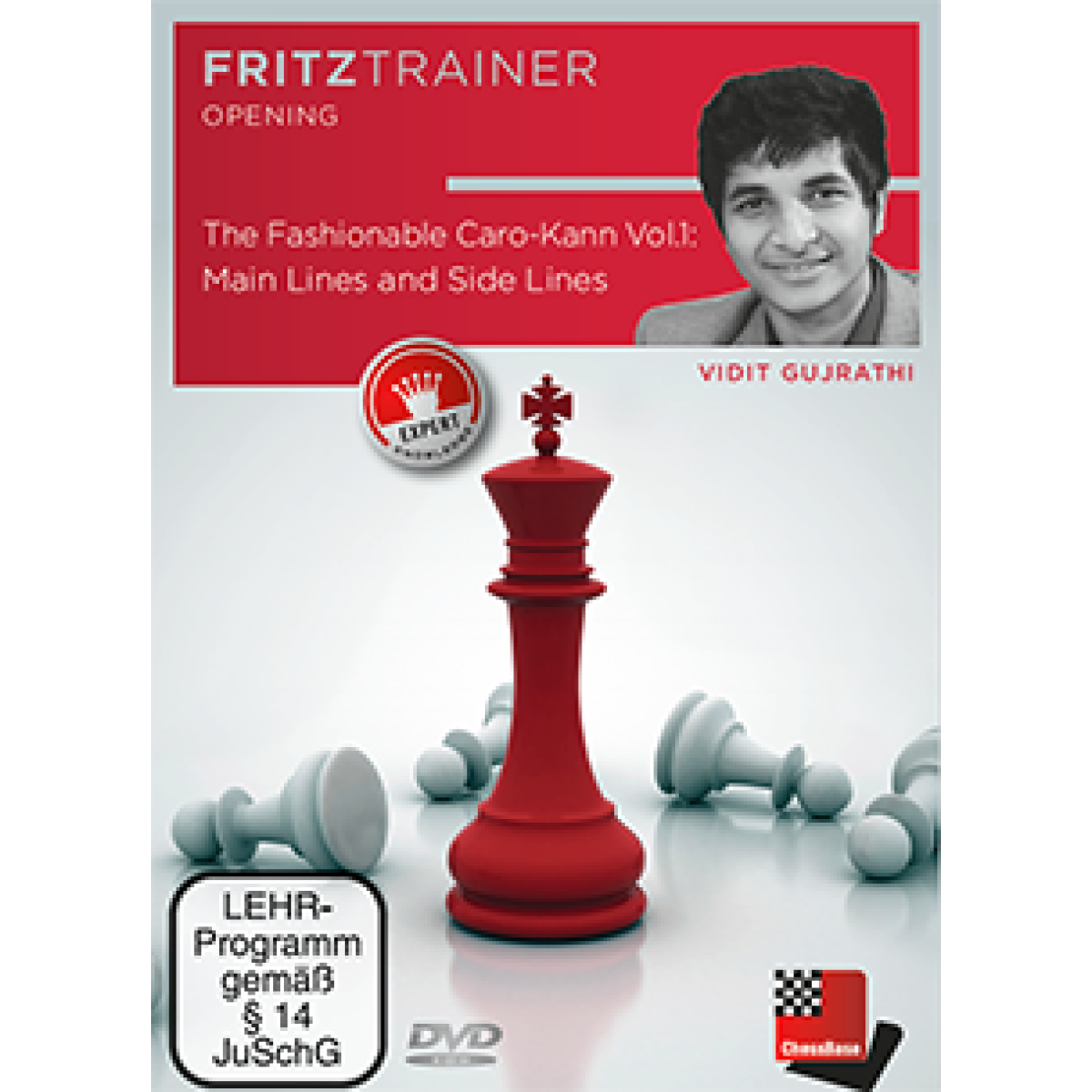


The Fashionable Caro-Kann Vol.1
search
  • The Fashionable Caro-Kann Vol.1

The Fashionable Caro-Kann Vol.1

€29.90
Tax included
Discover the Caro-Kann Defense with this comprehensive video course of over 4 hours. Learn the latest trends, main variations, and lesser-known lines, analyzed by a grandmaster who successfully uses them in top tournaments. Includes interactive training with video feedback, an exclusive database with 50 model games, and access to the Fritztrainer app to practice and deepen your repertoire. Ideal for mastering the fight for the light squares.

FORMAT: DOWNLOAD
This product is not supplied in physical format. You will receive an email from our store with the download link and product activation code.

Quantity
In Stock

  Security policy

(edit with the Customer Reassurance module)

  Delivery policy

(edit with the Customer Reassurance module)

  Return policy

(edit with the Customer Reassurance module)

The Caro-Kann Defense is a very complex opening. Black’s play is based on controlling and contesting the key light squares. It was very popular in the late 1990s and early 2000s thanks to the successes of grandmasters like Karpov, Anand, and Dreev. Recently, with the help of powerful engines, new ideas have been developed and innovative variations introduced, while others have been completely refuted. I have studied these trends and discovered new proposals for Black. I have always been fascinated by dynamic play founded on a solid strategic base, and in these DVDs I present the lines that I personally prefer and use in competition. In the recent World Rapid and Blitz Championships in Qatar, I employed many of these lines with great success, achieving important victories against grandmasters such as Vachier-Lagrave, Radjabov, Jobava, and drawing with Vishy Anand. I am sure you will learn a lot about this opening and enjoy the fight for the light squares.

Main Line 3.Nc3 dxe4 4.Nxe4 Bf5 5.Ng3 Bg6
Panov Attack 3.exd5 cxd5 4.c4 Nf6
Fantasy Variation 3.f3
King's Indian Attack 2.d3 d5 3.Nd2
Exchange Variation 3.exd5 cxd5
Two Knights Variation 2.Nc3 d5 3.Nf3 Nf6

• Video duration: 4 h 31 min (in English)
• Interactive training with video feedback
• Extra: exclusive database with author’s analysis and 50 additional model games
• Includes CB 12 reader

More... Less...
Included Content:
  • Fritztrainer application for Windows
  • Available for download or on DVD
  • Video course with approximate duration of 4 to 8 hours
  • Repertoire database: saves and integrates Fritztrainer games into your repertoire (in WebApp Opening or ChessBase)
  • Interactive exercises with video feedback: authors present exercises and key positions, the user must enter the solution. Includes explanation and error correction
  • Model games in a ChessBase database
FritzTrainer Application Features:
  • Plays videos in the Fritztrainer app or ChessBase with board graphics, notation, and function bar
  • Analysis engine activatable at any time
  • Video pause for manual navigation and analysis in game notation
  • Input of own variations, engine analysis, and saving in the game
  • Learn variations: view specific lines in ChessBase WebApp Opening with automatic playback, memorize and practice transformations (starting position - final position)
  • Active opening training: selected positions are transferred to ChessBase WebApp Fritz-online to play games against Fritz and practice the opening
More possibilities: start FritzTrainer in ChessBase:
  • Access directly the database with all games and analyses
  • Easily add games to the opening reference
  • Direct evaluation with game references and playback on the analysis board
  • Save own variations and integrate them into your personal repertoire
  • Repetition training
  • Active LiveBook
  • Use all engines installed in ChessBase for analysis
  • Assisted analysis
  • Print notation and diagrams for worksheets

Sample Video

Contents

  • 01: Introduction [04:43]
  • Main and Secondary Lines after 1.e4 c6:
  • 02: Overview of the Main Line: 2.d4 d5 3.Nd2/Nc3 dxe4 4.Nxe4 Bf5 5.Ng3 Bg6 - Video analysis [10:53]
  • 03: Secondary Lines of the Main Line: 2.d4 d5 3.Nd2/Nc3 dxe4 4.Nxe4 Bf5 5.Ng3 Bg6 6.Bc4/Nh3 - Video analysis [17:59]
  • 04: Main Line - 6.h4 Part 1: 2.d4 d5 3.Nd2/Nc3 dxe4 4.Nxe4 Bf5 5.Ng3 Bg6 6.h4 h6 7.Nf3 e6 8.Ne5/h5 - Video analysis [15:01]
  • 05: Main Line - 6.h4 Part 2 White Deviations: 2.d4 d5 3.Nd2/Nc3 dxe4 4.Nxe4 Bf5 5.Ng3 Bg6 6.h4 h6 7.Nf3 e6 8.Ne5 - Video analysis [15:34]
  • 06: Main Line - 6.h4 Part 3 Main Variation: 2.d4 d5 3.Nd2/Nc3 dxe4 4.Nxe4 Bf5 5.Ng3 Bg6 6.h4 h6 7.Nf3 e6 8.Ne5 Bh7 9.Bd3 Bxd3 10.Qxd3 Nd7 11.f4 Be7 12.Bd2 Nxe5 13.fxe5 Bxh4 14.O-O-O Bxg3 15.Qxg3 Ne7 16.Qxg7 Rg8 17.Qh7 - Video analysis [18:19]
  • 07: Main Line - 6.h4 Part 4 Main Variation: 2.d4 d5 3.Nd2/Nc3 dxe4 4.Nxe4 Bf5 5.Ng3 Bg6 6.h4 h6 7.Nf3 e6 8.Ne5 Bh7 9.Bd3 Bxd3 10.Qxd3 Nd7 11.f4 Be7 12.Bd2 Nxe5 13.fxe5 Bxh4 14.O-O-O Bxg3 15.Qxg3 Ne7 16.Qxg7 Rg8 17.Qxh6 - Video analysis [13:59]
  • 08: King's Indian Attack Part 1 - 2.d3 d5 3.Nd2 e5 4.Ngf3 Bd6 5.d4 exd4 6.exd5 cxd5 - Video analysis [08:29]
  • 09: King's Indian Attack Part 2 - 2.d3 d5 3.Nd2 e5 4.Ngf3 Bd6 5.g3 Nf6 6.Bg2 O-O 7.O-O Re8 8.Re1 Nbd7 - Video analysis [07:37]
  • 10: Introduction to the Two Knights Variation - 2.Nc3 d5 3.Nf3 - Video analysis [08:11]
  • 11: Secondary Lines of the Two Knights Variation - 2.Nc3 d5 3.Nf3 Nf6 4.e5 Ne4 5.d4/Be2 - Video analysis [15:17]
  • 12: Main Line of the Two Knights Variation Part 1: 2.Nc3 d5 3.Nf3 Nf6 4.e5 Ne4 5.Ne2 Qb6 6.d4 e6 7.Ng3 - Video analysis [15:44]
  • 13: Main Line of the Two Knights Variation Part 2: 2.Nc3 d5 3.Nf3 Nf6 4.e5 Ne4 5.Ne2 Qb6 6.d4 e6 7.Nfg1 - Video analysis [11:12]
  • 14: Update on the Main Line of the Two Knights Variation: 7.Nfg1 f6 8.f3 Ng5 9.exf6 gxf6 10.f4 Ne4 - Video analysis [14:54]
  • 15: Exchange Variation with Bd3: 2.d4 d5 3.exd5 cxd5 4.Bd3 Nc6 5.c3 Nf6/Qc7 - Video analysis [07:47]
  • 16: Panov Variation - Ending: 2.d4 d5 3.exd5 cxd5 4.c4 Nf6 5.Nc3 Nc6 6.Nf3 Bg4 7.cxd5 Nxd5 8.Qb3 Bxf3 9.gxf3 e6 10.Qxb7 Nxd4 11.Bb5+ Nxb5 12.Qc6+ Ke7 13.Qxb5 Qd7 14.Nxd5 Qxd5 15.Qxd5/Bg5 - Video analysis [16:19]
  • 17: Panov Variation - Secondary Line: 2.d4 d5 3.exd5 cxd5 4.c4 Nf6 5.Nc3 Nc6 6.Nf3 Bg4 7.Bg5 Ne4 - Video analysis [06:24]
  • 18: Panov Variation - Introduction and options of 6.Bg5: 2.d4 d5 3.exd5 cxd5 4.c4 Nf6 5.Nc3 Nc6 6.Bg5 Ne4/Be6/dxc4 - Video analysis [10:52]
  • 19: Panov Variation - Main Line 6.Bg5: 2.d4 d5 3.exd5 cxd5 4.c4 Nf6 5.Nc3 Nc6 6.Bg5 e6 - Video analysis [20:21]
  • 20: Panov Variation - Small secondary line: 2.c4 d5 3.exd5 xcd5 4.cxd5 Nf6 5.Qa4/Bb5/ - Video analysis [06:38]
  • 21: Fantasy Variation: 2.d4 d5 3.f3 e6 4.Nc3 Bb4 - Video analysis [12:21]
  • Test questions
  • 22: Test 1 [01:14]
  • 23: Test 2 [01:09]
  • 24: Test 3 [03:00]
  • 25: Test 4 [06:17]
  • 26: Test 5 [02:47]
  • 27: Test 6 [07:50]
More...
Less...

Caro-Kann Defense

The Caro-Kann Defense is named after the masters Horatio Caro (1862–1920), resident in Berlin, and Marcus Kann (1820–1886), from Austria. However, the move 1...c6 did not gain popularity until the 1920s, when greats like José Raúl Capablanca and Aaron Nimzowitsch adopted it. In 1960/61, Botvinnik was looking for a solid defense against the sacrificial attacks of Mikhail Tal for his World Championship matches and chose the Caro-Kann. Other World Champions such as Tigran Petrosian and Anatoly Karpov also incorporated 1...c6 into their repertoires.

TFCV-GDNN