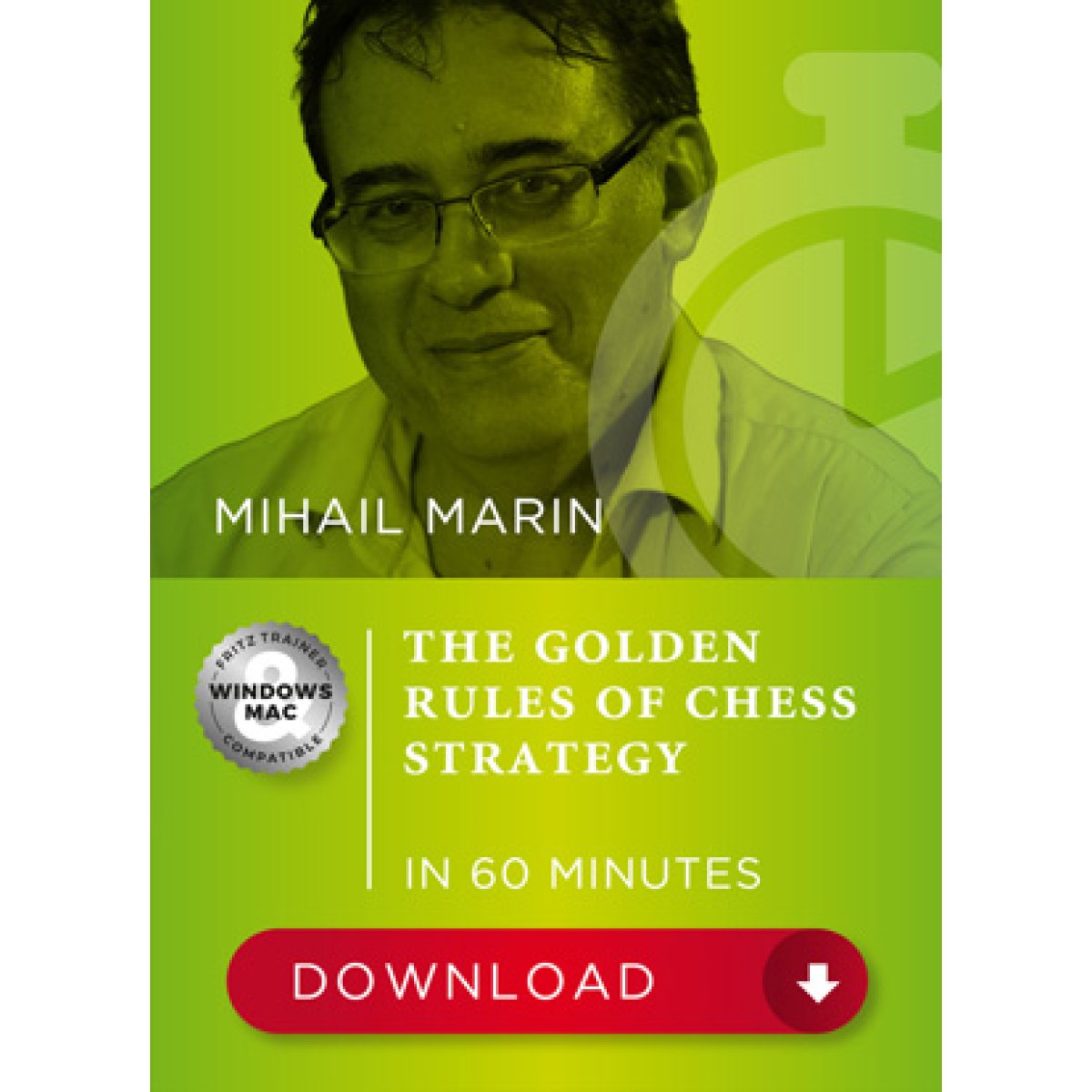


The golden rules of chess strategy
search
  • The golden rules of chess strategy

The golden rules of chess strategy

€9.90
Tax included
Discover "The Golden Rules of Chess Strategy," an essential guide to mastering positional and strategic play in the middlegame. Learn how to optimize piece placement, maintain harmony, and respond effectively to threats, based on key principles and practical examples from famous games. Ideal for players who wish to deepen their understanding and improve their level in this complex phase of chess.

FORMAT: DOWNLOAD
This product is not provided in physical format. You will receive an email from our store with the download link and product activation code.

Quantity
In Stock

  Security policy

(edit with the Customer Reassurance module)

  Delivery policy

(edit with the Customer Reassurance module)

  Return policy

(edit with the Customer Reassurance module)

This "60 Minutes" offers the reader a guide on positional and strategic play in the middlegame. Tarrasch stated: "Before the end, the gods have placed the middlegame," a phrase also known as "Between the opening and the endgame, the gods have placed the middlegame." This refers to the different levels of complexity in the phases of the game. In the opening and endgame, the rules are simpler and there is an increasing theoretical body of knowledge. However, the middlegame is much broader and often takes place in unknown territory. After analyzing numerous strategic examples over the years, I have identified the following essential rules:

  • Before starting the specific phase of your main plan, you must ensure that all pieces and pawns are in their correct places. It is necessary to assess whether any piece (including modest pawns and even the king) needs to be repositioned to achieve complete harmony.
  • In the process of reaching this situation, it is advisable to use multifunctional moves that allow switching plans according to the opponent's reaction. Defending against a combined threat is more complicated than against an individual one.
  • When facing one or several concrete threats, it is advisable to follow Steinitz's recommendation on economy of means. First, identify the real threats and discard the illusory ones. They should be neutralized without compromising our coordination and harmony. Ideally, threats are countered by indirect means, making a move that is part of our general plan, regardless of the opponent’s intentions.

All these rules are grouped under a single objective: to achieve and maintain total harmony, or perfect coordination.

More... Less...

Sample Video

Contents

  • The Golden Rules
  • Introduction
  • Optimizing piece placement to achieve overall harmony and prepare the execution of the main plan
  • Spassky-Yukhtma
  • Huzman-Carlsen
  • Capablanca-Fine (excerpt)
  • Improving the positioning of a piece to create double positional threats, that is, preparing for two different plans
  • Ding-Giri
  • Mihaljcisin-Timman
  • Maintaining overall harmony when countering (multiple) threats
  • Ribli-Bouaziz
  • Capablanca-Fine
More...
Less...
TGROCS-TCMK