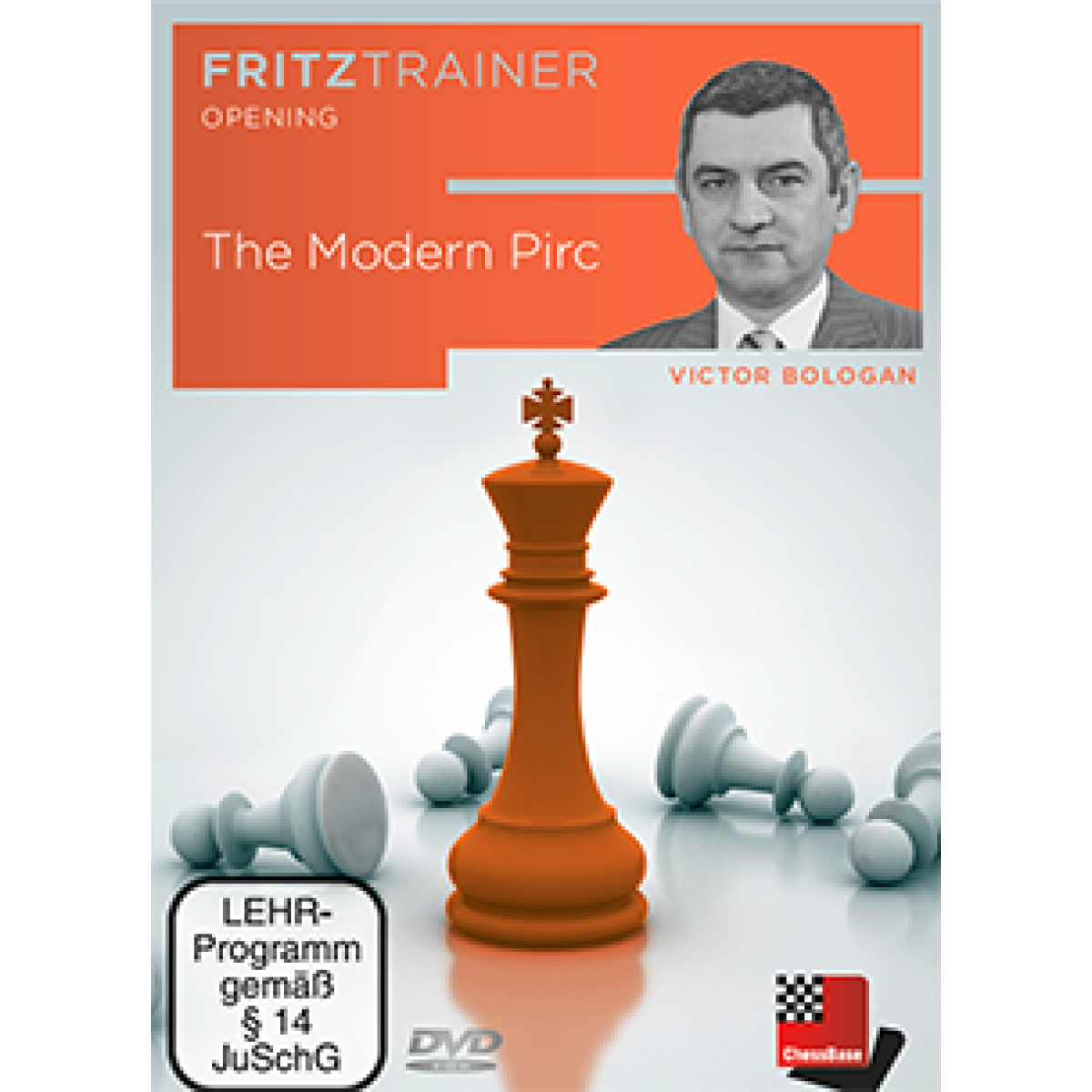

The Modern Pirc
search
  • The Modern Pirc

The Modern Pirc

€29.90
Tax included
Discover the Modern Pirc Defense with Viktor Bologan, who shares his successful experience and a complete repertoire for playing Black against 1.e4. This nearly 5-hour video course, featuring interactive training and over 50 model games, offers a flexible and rich approach that combines classical and modern ideas. Ideal for all levels, refresh your strategy and challenge your opponents right from the opening.

FORMAT: DOWNLOAD
This product is not supplied in physical format. You will receive an email from our store with the download link and product activation code.

Quantity
In Stock

  Security policy

(edit with the Customer Reassurance module)

  Delivery policy

(edit with the Customer Reassurance module)

  Return policy

(edit with the Customer Reassurance module)

Viktor Bologan has used the Pirc opening throughout his career and explains why he prefers it: “Grandmasters, international masters, or amateurs often ask me what they should play with Black against 1.e4 if they want to win. Sometimes I answer ‘Play your opening and play it well,’ but occasionally it is necessary or desirable to take the opponent out of their comfort zone and preparation. This frequently happens in open tournaments where you have to play to win with both colors. I have used the Modern Pirc all my life and it has brought me many successes. For example, at the 1997 New York Open, the strongest open tournament of that time, I won four games with Black using the Modern Pirc, which helped me win the tournament. The Modern Pirc is a blend between the Caro-Kann and the Pirc. In numerous variations, Black combines the classical ideas of the Pirc, where the fianchettoed bishop is fundamental, with the Caro-Kann strategy of fighting for the center with c6 and d5. This opening is very flexible and rich in possibilities. By studying the Modern Pirc, you will refresh your chess mind and discover many new ideas.” This DVD offers a complete repertoire for Black against e4, useful for players of all levels.

• Video duration: 4 h 42 min (in English)
• Interactive training with video feedback
• Bonus: database with more than 50 model games
• Includes CB Reader 12

More... Less...
Included content:
  • Fritztrainer application for Windows
  • Available for download or on DVD
  • Video course with approximate duration of 4 to 8 hours
  • Repertoire database: save and integrate Fritztrainer games into your own repertoire (in WebApp Opening or ChessBase)
  • Interactive exercises with video feedback: the authors present exercises and key positions, the user must enter the solution. Includes detailed explanations and error correction.
  • Model games in ChessBase database
FritzTrainer application features:
  • Videos can be played in the Fritztrainer application or in ChessBase with board, notation, and extended toolbar
  • Analysis engine can be activated at any time
  • Video pause for navigation and manual analysis in the notation
  • Input of personal variations and engine analysis, saving changes in the game
  • Learn variations: view specific lines in ChessBase WebApp Opening with automatic playback, memorize and practice the transition (starting position – final position)
  • Active opening training: selected positions are transferred to ChessBase WebApp Fritz-online to play against Fritz and test your knowledge
More options: launch FritzTrainer in ChessBase
  • Direct access to the database with all games and analyses
  • Easy incorporation of games into the opening reference
  • Direct evaluation with reference to games and playback on the analysis board
  • Saving personal variations to add them to your repertoire
  • Training through playback
  • Active LiveBook
  • Ability to use all engines installed in ChessBase for analysis
  • Assisted analysis
  • Printing of notation and diagrams for educational material

Sample video

Content

  • 01: Introduction [07:08]
  • 1.e4 g6
  • 02: 2.h4 d5 3.h5/e5/exd5 – Video analysis [11:15]
  • 03: 2.d4 Bg7 3.c3 d6 4.f4 Nf6 5.Bd3/e5 – Video analysis [09:40]
  • 04: 2.d4 Bg7 3.c4 Nc6 4.Nf3/Be3 – Video analysis [14:35]
  • 05: 2.d4 Bg7 3.h4 d5 4.e5/exd5 – Video analysis [06:49]
  • 06: 2.d4 Bg7 3.Be3 c5 4.Nc3/c3/Nf3/Qd2 – Video analysis [09:36]
  • 07: 2.d4 Bg7 3.f4 c5 4.d5/dxc5/c3/Nf3 – Video analysis [10:45]
  • 08: 2.d4 Bg7 3.Nf3 d6 4.Bc4 Nf6 5.Qe2/Nc3/e5 – Video analysis [16:32]
  • 09: 2.d4 Bg7 3.Nf3 d6 4.c3 Nf6 5.Bd3/Nbd2 – Video analysis [15:19]
  • 10: 2.d4 Bg7 3.Nc3 c6 4.h3 d6 5.f4/g3/a4/g4 – Video analysis [07:58]
  • 11: 2.d4 Bg7 3.Nc3 c6 4.Be3 d5 5.Qd2/f3/h3/e5/Nf3 – Video analysis [16:37]
  • 12: 2.d4 Bg7 3.Nc3 c6 4.Bc4 d6 5.Qf3/Bb3 – Video analysis [12:20]
  • 13: 2.d4 Bg7 3.Nc3 c6 4.h4/g3/Bf4 – Video analysis [10:07]
  • 14: 2.d4 Bg7 3.Nc3 c6 4.Nf3 d6 5.Be3/a4 – Video analysis [07:29]
  • 15: 2.d4 Bg7 3.Nc3 c6 4.Nf3 d6 5.Bc4 Nf6 6.Bb3/e5/a4/0-0 – Video analysis [13:26]
  • 16: 2.d4 Bg7 3.Nc3 c6 4.Nf3 d6 5.Bg5 Qb6 6.Rb1/Qd2 – Video analysis [07:30]
  • 17: 2.d4 Bg7 3.Nc3 c6 4.Nf3 d6 5.Be2 Nf6 6.0-0 0-0 7.Bf4 Nbd7 8.a4/Qd2/h3/Re1 – Video analysis [12:55]
  • 18: 2.d4 Bg7 3.Nc3 c6 4.Nf3 d6 5.h3 Nf6 6.a4 0-0 7.Be3 d5 8.e5/Bd3 – Video analysis [12:47]
  • 19: 2.d4 Bg7 3.Nc3 c6 4.f4 d5 5.e5 Nh6 6.Be2/Nf3/Bd3/Be3/h3 – Video analysis [21:32]
  • 20: 2.d4 Bg7 3.Nc3 c6 4.Nf3 d6 5.Be2 Nf6 6.0-0 0-0 7.a4 Nbd7 8.Be3/a5/e5/Re1 – Video analysis [10:17]
  • 21: 2.d4 Bg7 3.Nc3 c6 4.Nf3 d6 5.Be2 Nf6 6.0-0 0-0 7.h3 Nbd7 8.e5/Re1 – Video analysis [11:13]
  • Interactive positions
  • 22: Test 1 [02:25]
  • 23: Test 2 [03:27]
  • 24: Test 3 [01:28]
  • 25: Test 4 [02:49]
  • 26: Test 5 [02:06]
  • 27: Test 6 [02:36]
  • 28: Test 7 [02:24]
  • 29: Test 8 [02:46]
  • 30: Test 9 [01:52]
  • 31: Test 10 [02:02]
  • 32: Test 11 [02:10]
  • 33: Test 12 [02:01]
  • 34: Test 13 [02:13]
  • 35: Test 14 [01:22]
  • 36: Test 15 [02:18]
  • 37: Test 16 [02:43]

Pirc Defense

In the Pirc Defense we face an opening where Black does not start by moving a pawn to the fifth rank. Instead, Black plans with ...d6, ...Nf6, the bishop's fianchetto with ...g6, ...Bg7, and ...0-0 to adopt a structure similar to the King's Indian Defense, one of the most popular replies against 1.d4. The Pirc Defense or Pirc-Ufimstev dates back to the 1940s, being even more recent than the Alekhine Defense; it is named after the Yugoslav master Vasja Pirc (1907–1980) and the Soviet Kazakh master Anatoly Ufimstev (1914–2000).

TMP-KRTP