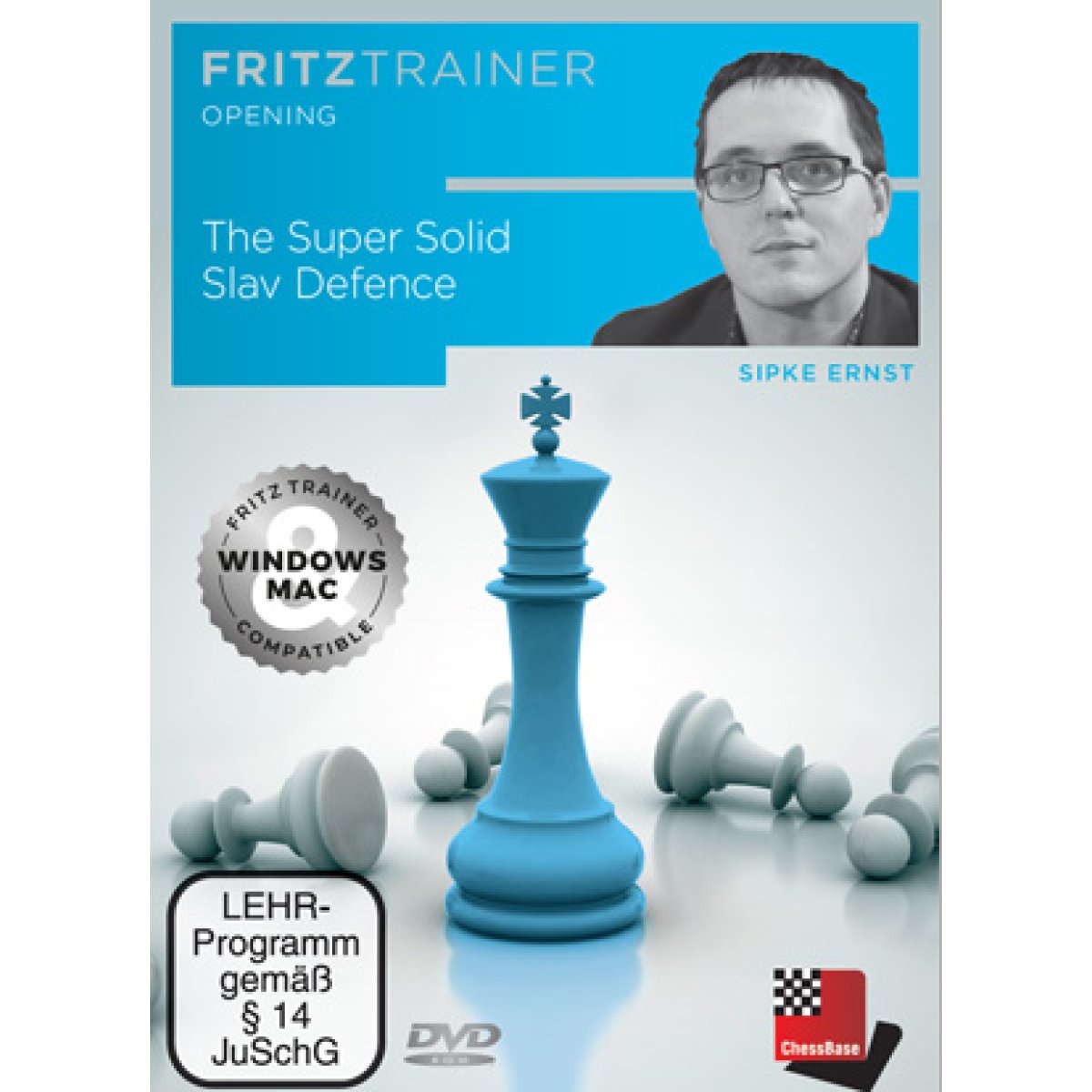


The Super Solid Slav Defence
search
  • The Super Solid Slav Defence

The Super Solid Slav Defence

€29.90
Tax included
Discover the Slav Defense, a solid and dynamic opening used by grandmasters like Carlsen and Caruana. This video course of over 6 hours guides you from the initial moves to key variations, including the Tolush-Geller Gambit and isolated pawn positions. With interactive exercises, video feedback, and practice against Fritz, you will master this strategic and versatile defense to play confidently and aim for victory.

FORMAT: DOWNLOAD
This product is not supplied in a physical format. You will receive an email from our store with the download link and product activation code.

Quantity
In Stock

  Security policy

(edit with the Customer Reassurance module)

  Delivery policy

(edit with the Customer Reassurance module)

  Return policy

(edit with the Customer Reassurance module)

By adding the Slav Defense to your repertoire, you will have a solid opening. But that doesn't mean the game is boring; on the contrary, this opening often leads to very dynamic games. It is no coincidence that top current players like Carlsen, Caruana, and Firouzja frequently use it to seek victory against their opponents.

The Slav Defense arises after the moves 1.d4 d5 2.c4 c6. This video course focuses on the line 3.Nf3 Nf6 4.Nc3 followed by dxc4, although it also thoroughly covers White’s alternatives before the main line. It explains how to handle closed positions after 4.e3, as well as how to face White’s gambit in the Tolush-Geller Variation. Moreover, after watching this course, you will feel expert in positions with an isolated queen’s pawn (IQP).

• Video duration: 6 hours 28 minutes (in English)
• Interactive training with video feedback
• Extras: training with ChessBase applications to memorize the repertoire and play key positions against Fritz at various levels

More... Less...
This includes:
  • Fritztrainer application for Windows and Mac
  • Available for download or on DVD
  • Video course with an approximate duration of 4 to 8 hours
  • Repertoire database: save and integrate Fritztrainer games into your repertoire (in WebApp Opening or ChessBase)
  • Interactive exercises with video feedback: the authors present exercises and key positions, the user must enter the solution, receiving corrections and additional explanations
  • Model games in ChessBase database
  • New: many Fritztrainer now also available for streaming on the ChessBase video portal
Features of the FritzTrainer application:
  • Videos can be played in the Fritztrainer app or in the ChessBase program with board graphics, notation, and control bar
  • The analysis engine can be activated at any time
  • Video pause for manual navigation and analysis in the game notation
  • Entry of personal variations, engine analysis, and saving inside the game
  • Learning variations: visualize specific lines in ChessBase WebApp Opening with automatic playback, memorize and practice transformations (starting position - final position)
  • Active opening training: selected positions are transferred to ChessBase WebApp Fritz-online to test your knowledge by playing against Fritz
More possibilities: start FritzTrainer inside ChessBase program
  • Direct access to the database with all games and analyses
  • Ability to easily add games to the opening reference
  • Direct evaluation with reference to games, playback on the analysis board
  • Your variations are saved and can be incorporated into your personal repertoire
  • Repetition training
  • Active live book (LiveBook)
  • All engines installed in ChessBase can be used for analysis
  • Assisted analysis
  • Printing of notations and diagrams (for worksheets)

Sample Video

Content

  • Introduction
  • Overview
  • Secondary lines
  • 1.d4 d5 2.c4 c6
  • 3.cxd5 cxd5 4.Bg5 f6 5.Bd2/Bh4
  • 3.cxd5 cxd5 4.Nc3 Nf6 5.Bf4 Nc6 Main line
  • 3.cxd5 cxd5 - Other moves
  • 3.Nc3 Nf6 4.e3 Bf5 Secondary lines
  • 3.Nc3 Nf6 4.e3 Bf5 5.cxd5 cxd5 6.Qb3 Nc6 7.Qxb7 Bd7 8.Qb3 Rb8 9.Qd1 e5 Main line
  • 3.Nf3 Nf6
  • 1.d4 d5 2.c4 c6 3.Nf3 Nf6
  • 4.e3 Bf5 Secondary lines
  • 4.e3 Bf5 5.Nc3 e6 6.Nh4 Be4 Main line
  • 4.Qc2/Qb3 dxc4 Secondary lines
  • 4.Qc2/Qb3 dxc4 5.Qxc4 Bg4 6.Nbd2 Nbd7 Main line
  • 4.g3 Bf5 5.Nc3 e6 6.Nh4/Bg2/Qb3
  • 4.Nbd2 Bf5 5.Nh4 Be4
  • 4.Nc3 dxc4
  • 1.d4 d5 2.c4 c6 3.Nf3 Nf6 4.Nc3 dxc4
  • 5.e3 b5
  • 5.e4 b5 6.e5 Tolush-Geller Gambit
  • 5.e4 b5 6.Be2 Tolush-Geller Gambit
  • 5.a4 e6 6.g3 and alternatives
  • 5.a4 e6 6.e4 Bb4 7.Qc2/Bxc4
  • 5.a4 e6 6.e4 Bb4 7.Bg5
  • 5.a4 e6 6.e4 Bb4 7.e5 Nd5 8.Bd2 b5 9.h4/Ng5/Ne4
  • 5.a4 e6 6.e4 Bb4 7.e5 Nd5 8.Bd2 b5 9.axb5 Main line
  • 5.a4 e6 6.e3 c5 7.Bxc4 Nc6 Alternatives
  • 5.a4 e6 6.e3 c5 7.Bxc4 Nc6 8.0-0 Be7 9.Qe2 cxd4 10.Nxd4
  • 5.a4 e6 6.e3 c5 7.Bxc4 Nc6 8.0-0 Be7 9.Qe2 cxd4 10.exd4 0-0 11.Be3/Bg5
  • 5.a4 e6 6.e3 c5 7.Bxc4 Nc6 8.0-0 Be7 9.Qe2 cxd4 10.exd4 0-0 11.Rd1 Nb4 12.Ne5
  • 5.a4 e6 6.e3 c5 7.Bxc4 Nc6 8.0-0 Be7 9.Qe2 cxd4 10.exd4 0-0 11.Rd1 Nb4 12.Bg5
  • Exercises
  • Description
  • Exercise 1
  • Exercise 2
  • Exercise 3
  • Exercise 4
  • Exercise 5
  • Exercise 6
  • Exercise 7
  • Exercise 8
  • Exercise 9
  • Exercise 10
  • Exercise 11
  • Exercise 12
  • Exercise 13
  • Exercise 14

Queen’s Gambit

Control of the center with 1.d4 is, along with 1.e4, one of the most popular openings. If Black responds symmetrically with 1...d5, after 2.c4 we reach the Queen’s Gambit. Usually, Black defends the pawn on d5 to maintain central presence: with 2...e6, the Orthodox Defense, or with 2...c6, the Slav Defense. Another very different option is 2...dxc4, the Queen’s Gambit Accepted.

TSSSD-JPVR