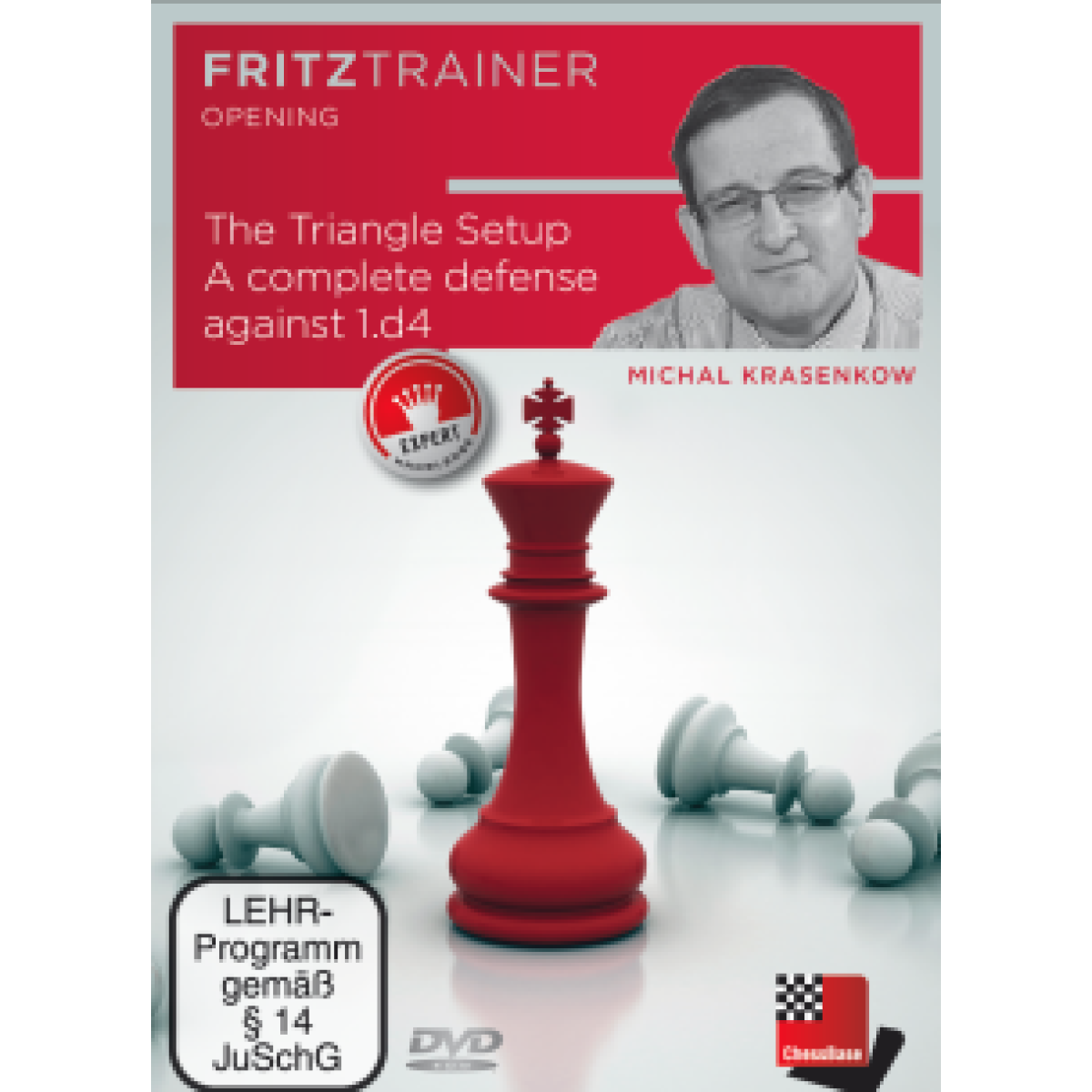


The Triangle Setup - A complete defense against 1.d4
search
  • The Triangle Setup - A complete defense against 1.d4

The Triangle Setup - A complete defense against 1.d4

€29.90
Tax included
Discover the Semi-Slav Defense with Grandmaster Michal Krasenkow in this comprehensive video course of over 5 hours. Learn the innovative approach without the early development of ...Nf6, exploring the Noteboom and Stonewall variations. Includes interactive training, a database with 75 annotated games, and detailed analysis to strengthen your play and expand your repertoire with this solid defense against 1.d4.

FORMAT: DOWNLOAD
This product is not supplied in physical format. You will receive an email from our store with the download link and product activation code.

Quantity
In Stock

  Security policy

(edit with the Customer Reassurance module)

  Delivery policy

(edit with the Customer Reassurance module)

  Return policy

(edit with the Customer Reassurance module)

The Semi-Slav Defense (1.d4 d5 followed by ...e7-e6 and ...c7-c6) is one of the most popular openings for Black. Black can choose between two completely different approaches. One involves an early development ...Ng8-f6 and leads to well-analyzed systems such as the Meran, Anti-Meran, Botvinnik, Moscow, Anti-Moscow, Westphalia, among others. The other, which avoids ...Ng8-f6 in the early stages, is presented by GM Michal Krasenkow in this DVD. Here, Black keeps the option to choose between two dynamic systems: the Noteboom variation (1.d4 d5 2.c4 e6 3.Nc3 c6 4.Nf3 dxc4) and the Stonewall (...f7-f5) if White plays an early e2-e3. By delaying ...Ng8-f6, Black allows White other possibilities, the most notable being the Slav Gambit (1.d4 d5 2.c4 e6 3.Nc3 c6 4.e4, etc.). Therefore, this structure offers a variety of interesting positions that broaden Black’s strategic and tactical understanding. This makes the Noteboom/Stonewall repertoire an excellent alternative for young players seeking to improve.

• Video duration: 5 hours 29 minutes
• Interactive training with video feedback
• Variant analysis texts by Krasenkow
• Exclusive database with 75 games commented by Grandmasters
• Includes CB 12 Reader

More... Less...
Included content:
  • Fritztrainer application for Windows
  • Available for download or on DVD
  • Video course with an approximate duration of 4 to 8 hours
  • Repertoire database: saves and integrates Fritztrainer games into your repertoire (in WebApp Opening or ChessBase)
  • Interactive exercises with video feedback: the authors present exercises and key positions for the user to enter the solution, receiving explanations and corrections
  • Example games in ChessBase database
FritzTrainer application features:
  • Watch videos in the Fritztrainer app or in ChessBase with board, notation, and function bar
  • Ability to activate the analysis engine at any time
  • Video pause for manual navigation and notation analysis
  • Enter your own variations and analyze with the engine, saving them in the game
  • Learn variations: view specific lines in ChessBase WebApp Opening with automatic playback, memorize and practice transformations (starting - ending position)
  • Active opening training: selected positions are transferred to ChessBase WebApp Fritz-online to play against Fritz and test your knowledge
More features with FritzTrainer in ChessBase:
  • Directly open the database with all games and analyses
  • Easily add games to the opening reference
  • Direct evaluation with reference to games and playback on the analysis board
  • Save and add your own variations to your personal repertoire
  • Replay training
  • Active LiveBook
  • Use all engines installed in ChessBase for analysis
  • Assisted analysis
  • Print notation and diagrams (for study materials)

Sample Video

Content

  • Database: Additional texts and games of Triangle Setup
  • The Triangle Setup - Complete defense against 1.d4
  • 01: Introduction [06:02]
  • 02: 1.d4 d5 2.c4 e6 3.Nf3 c6 4.Bg5 Be7 5.Bxe7 Qxe7 – Video analysis [08:51]
  • 03: 1.d4 d5 2.c4 e6 3.Nf3 c6 4.Nbd2 f5 – Video analysis [12:26]
  • 04: 1.d4 d5 2.c4 e6 3.Nf3 c6 4.g3 dxc4 5.Bg2 b5 Part 1 – Video analysis [11:52]
  • 05: 1.d4 d5 2.c4 e6 3.Nf3 c6 4.g3 dxc4 5.Bg2 b5 Part 2 – Video analysis [15:23]
  • 06: 1.d4 d5 2.c4 e6 3.Nf3 c6 4.Qc2 dxc4 5.Qxc4 Nf6 Part 1 – Video analysis [13:15]
  • 07: 1.d4 d5 2.c4 e6 3.Nf3 c6 4.Qc2 dxc4 5.Qxc4 Nf6 Part 2 – Video analysis [12:26]
  • 08: 1.d4 d5 2.c4 e6 3.Nf3 c6 4.Qc2 dxc4 5.Qxc4 Nf6 Part 3 – Video analysis [15:20]
  • 09: 1.d4 d5 2.c4 e6 3.Nf3 c6 4.e3 Part 1 – Video analysis [13:56]
  • 10: 1.d4 d5 2.c4 e6 3.Nf3 c6 4.e3 Part 2 – Video analysis [17:24]
  • 11: 1.d4 d5 2.c4 e6 3.Nf3 c6 4.e3 Part 3 – Video analysis [12:10]
  • 12: 1.d4 d5 2.c4 e6 3.Nf3 c6 4.e3 Part 4 – Video analysis [19:57]
  • 13: 1.d4 d5 2.c4 e6 3.Nc3 c6 4.cxd5 – Video analysis [12:20]
  • 14: 1.d4 d5 2.c4 e6 3.Nc3 c6 4.e4 – Video analysis [20:38]
  • 15: Noteboom 1.d4 d5 2.c4 e6 3.Nc3 c6 4.Nf3 dxc4 Part 1 – Video analysis [14:24]
  • 16: Noteboom 1.d4 d5 2.c4 e6 3.Nc3 c6 4.Nf3 dxc4 Part 2 – Video analysis [18:23]
  • 17: Noteboom 1.d4 d5 2.c4 e6 3.Nc3 c6 4.Nf3 dxc4 Part 3 – Video analysis [14:35]
  • 18: Noteboom 1.d4 d5 2.c4 e6 3.Nc3 c6 4.Nf3 dxc4 Part 4 – Video analysis [12:46]
  • 19: Noteboom 1.d4 d5 2.c4 e6 3.Nc3 c6 4.Nf3 dxc4 Part 5 – Video analysis [15:49]
  • 20: Noteboom 1.d4 d5 2.c4 e6 3.Nc3 c6 4.Nf3 dxc4 Part 6 – Video analysis [22:50]
  • 21: Noteboom 1.d4 d5 2.c4 e6 3.Nc3 c6 4.Nf3 dxc4 Part 7 – Video analysis [08:06]
  • 22: Noteboom 1.d4 d5 2.c4 e6 3.Nc3 c6 4.Nf3 dxc4 Part 8 – Video analysis [15:42]
  • Test positions
  • 23: Example 1 [00:46]
  • 24: Example 2 [00:48]
  • 25: Example 3 [00:44]
  • 26: Example 4 [00:22]
  • 27: Example 5 [00:53]
  • 28: Example 6 [00:18]
  • 29: Example 7 [00:17]
  • 30: Example 8 [02:06]
  • 31: Example 9 [00:34]
  • 32: Example 10 [00:39]
  • 33: Example 11 [01:24]
  • 34: Example 12 [01:34]
  • 35: Example 13 [02:36]
More...
Less...

Semi-Slav Defense

If White continues with 6.Bd3 from the position in the diagram, 6...dxc4 leads to the Meran Variation, named after the Grünfeld – Rubinstein game at the Meran tournament in 1924. Black concedes control of the strong d5 central square to rapidly develop the queenside with ...b5, ...a6, ...Bb7, and ...c5. The basic position is established after 6.Bd3 dxc4 with the sequence 7.Bxc4 b5 8.Bd3 a6 (alternatively 8...Bb7) 9.e4 c5.

Reviews

Overall, I admire the effort that Michal Krasenkow has put into this DVD, which truly offers Black a complete, easy-to-learn, solid, and accessible defense against 1.d4.
Paul Smith
TTS-ACDA1-AACO