
FORMAT: DOWNLOAD
This product is not supplied in physical format. You will receive an email from our store with the download link and product activation code.
 Security policy
(edit with the Customer Reassurance module)
 Delivery policy
(edit with the Customer Reassurance module)
 Return policy
(edit with the Customer Reassurance module)
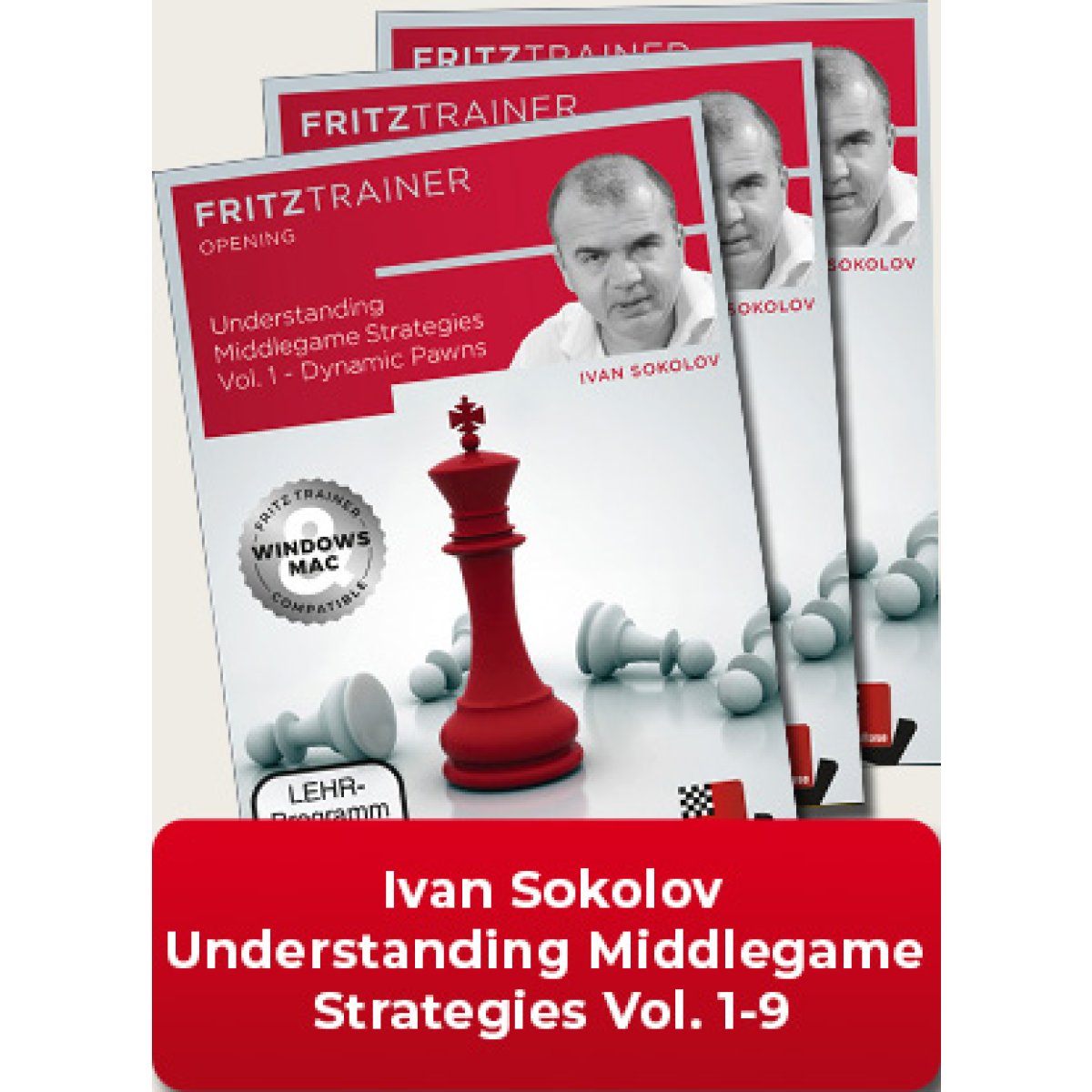
This DVD covers various dynamic decisions related to pawns. Its goal is to provide club and tournament players with fresh ideas they can apply in their practice.
This DVD explores different dynamic decisions involving pawns, designed to offer club and tournament players new ideas for their games.
The selected material aims to inspire the viewer to make similar decisions in their own games. It is organized into four chapters: 1. Minor sacrifices 2. Pawn advances 3. Voluntary creation of pawn islands 4. Dynamic ideas with g- and h-pawns. Each chapter includes model games that showcase different aspects of the topic, providing a broad perspective to identify these strategies in your play.
• Duration: 4 hours 50 minutes (English)
• Interactive training with video feedback
• Bonus: Database with additional examples
This DVD is designed to improve decision-making in the middlegame and to broaden the player's overall understanding.
It is divided into four chapters: 1. What to exchange and what to keep 2. The king on f8 defends itself 3. Open files 4. Creating a crisis. Each chapter presents model games illustrating different facets of the topic, facilitating the application of these strategies.
• Duration: 4 hours (English)
• Interactive training with video feedback
• Bonus: Database with additional examples
Throughout my career, I have found the Hedgehog structure (for both sides) to be one of the most difficult to master. With White, there is the risk of overextending or overlooking opponent pawn breaks; with Black, the danger lies in not choosing the right moment for the break or failing to generate counterplay, thus being outplayed.
The complexity is exemplified in games such as Kasparov-Kramnik, where both players made seemingly "obvious" mistakes. Another example is Charbonneau-Anand, where Anand fell into a bad position and missed his attacking chances, resulting in one of the biggest surprises at the 2006 Chess Olympiad. There are several types of Hedgehog positions, many derived from the English Opening with a fianchettoed bishop. In this course, I cover the basic Hedgehog structure, similar to the Kan Sicilian. The key is selecting the correct plan at the right moment, as the resulting positions are dynamic. I show common and some less frequent plans for both sides, highlighting typical errors and motifs to improve tournament performance.
• Duration: 4 hours (English)
• Bonus: Training with ChessBase applications to play key structures against Fritz at various levels
This course significantly improves handling of dynamic pawn positions, aimed at improving players and tournament competitors.
Isolated pawn structures can arise in many openings. Here, isolated structures from the classical Tarrasch Defense D34 are analyzed, largely inspired by games of Garry Kasparov. Studying these and related structures helps to understand these types of positions. Typical plans for both sides are shown based on instructive high-level games. "Hanging pawns" in the center, common in 1.d4 systems, require a good sense of the "moment of transformation," which may involve pawn breaks or gaining space at the cost of central squares. The double f-pawn structures in the Rauzer Sicilian variation are also analyzed, where dynamic timing and temporary pawn sacrifices are crucial. Although there are no exact rules, ideas repeat and are explained in detail.
• Duration: 5 hours 30 minutes (English)
• Bonus: Training with ChessBase applications to play key structures against Fritz at various levels
Understanding an opening does not end with theory; it is essential to grasp related ideas and structures, as well as to recognize opponent mistakes to gain an advantage. This course focuses on the Rossolimo and Maroczy structures in the Sicilian Defense.
The Rossolimo has grown in popularity by avoiding open Sicilian theory such as Sveshnikov or Kalashnikov, leading to an English Opening type position with colors reversed and an extra tempo. Although White's position is comfortable, the goal shifts to achieving an advantage. Magnus Carlsen widely uses this opening, and the course analyzes plans after 3...g6 followed by Bxc6 or 3...e6 4.Bxc6 bxc6. In the Maroczy Bind, although White has more space and Black lacks clear counterplay, there are ideas for both sides. Bent Larsen developed multiple ideas for Black still relevant today. The material is based on the classical main line of the Maroczy, highlighting main ideas and surprising strategic mistakes even in top-level games.
• Duration: 7 hours 20 minutes (English)
• Interactive training with video feedback
• Bonus: Database with model games and training with ChessBase applications to play key positions against Fritz at various levels
Understanding an opening goes beyond theory, including derived ideas and structures, as well as identifying opponent errors to gain an advantage. This course focuses on Ruy Lopez Defense structures.
Anatoly Karpov stated: "Understanding the Ruy Lopez is essential for improving in the middlegame." The course covers Karpov-style lines in the Ruy Lopez, mainly the Chigorin, Breyer, and Zaitsev variations. It offers an intensive course on common middlegame plans, material imbalances and dynamics, favorable or to-be-avoided positions for both sides, combining opening advice based on the author's experience. The goal is to enhance understanding for better results.
• Duration: 6 hours 25 minutes (English)
• Interactive training with video feedback
• Bonus: Database with model games and training with ChessBase applications to play key positions against Fritz at various levels
Many young elite players choose the "Dynamic Catalan," where against triangle or semi-Slav structures, White can sacrifice a pawn to gain immediate initiative. This sacrifice can generate long-term positional advantages and dangerous threats against Black’s king through central breaks.
Games often turn into attacking adventures for White, with multiple opportunities to sacrifice material and create impressive threats. If you choose this opening, you will take control from the start; this course will provide you with a sharp weapon for your repertoire. GM Ivan Sokolov, the course author, has played the Dynamic Catalan in high-level games against players like Caruana and Vallejo Pons, feeling comfortable with space, initiative, and king safety.
The French Defense is complex and can lead to varied middlegame types. The Winawer variation (3...Bb4) is Black’s most active choice, weakening White’s pawn structure by doubling the c-pawns.
While Black seeks to attack the weak d4 square, White usually has attacking chances on the kingside and spatial advantage. Structurally, this line can lead to closed positions after ...c4 or an open, dynamic game after the exchange dxc5. The selected games explain the most important plans in these strategically complex positions.
In the Tarrasch variation, White appears to have the advantage, but initial evaluations can be misleading, and Black has resources that create complex and interesting positions.
Victor Korchnoi, the legendary player who never became world champion, is the greatest exponent of this variation. Several of his games are included, especially from his World Championship matches in 1978 and 1981 against Karpov, considered one of the most precise players against isolated pawns, without losing a single game. French middlegames are rich and difficult, but this course improves positional understanding and precise strategic planning.


FORMAT: DOWNLOAD
This product is not supplied in physical format. You will receive an email from our store with the download link and product activation code.