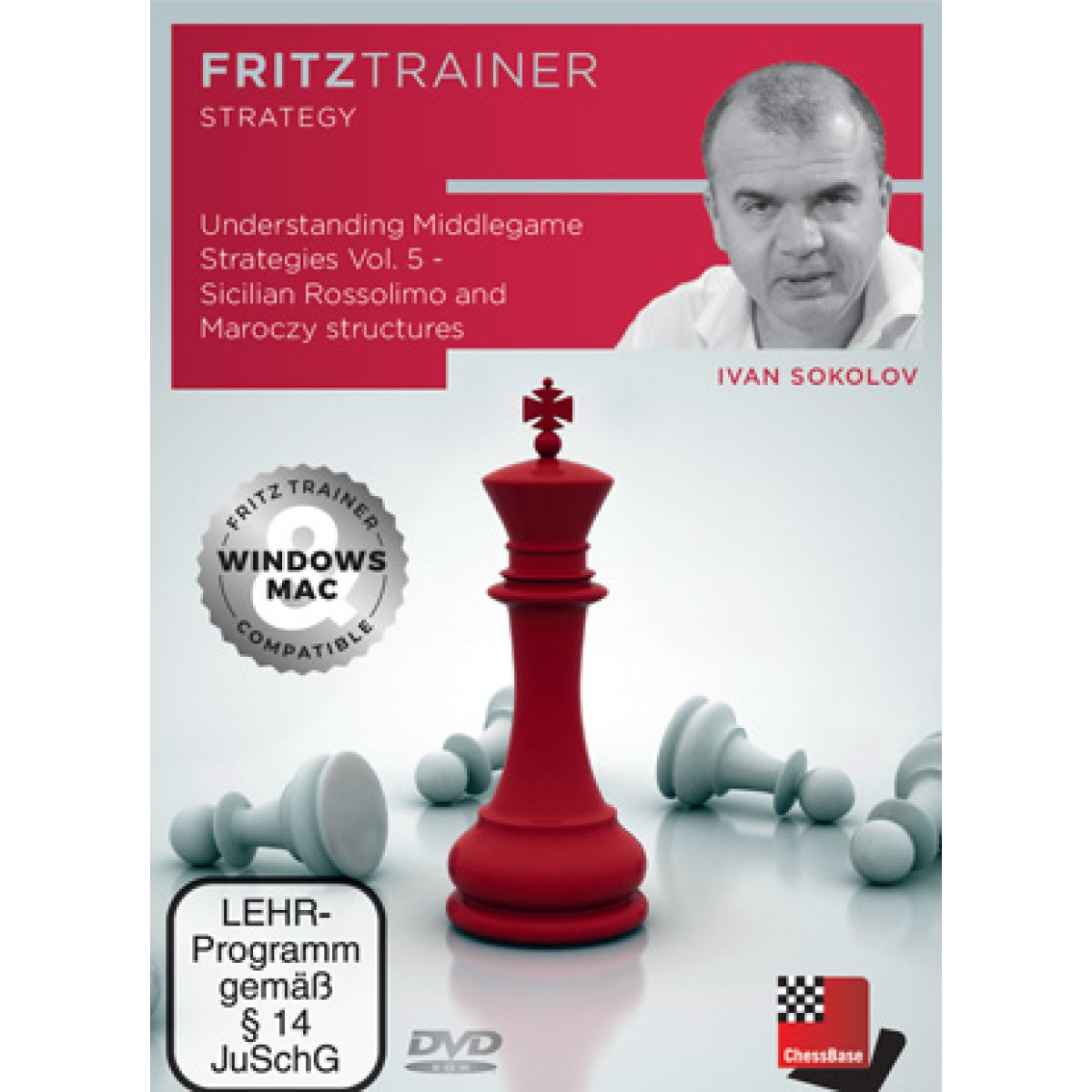


Understanding Middlegame Strategies Vol.5 - Sicilian Rossolimo and Maroczy Structures
search
  • Understanding Middlegame Strategies Vol.5 - Sicilian Rossolimo and Maroczy Structures

Understanding Middlegame Strategies Vol.5 - Sicilian Rossolimo and Maroczy Structures

€29.90
Tax included
This 7-hour video course focuses on the Rossolimo and Maroczy structures within the Sicilian Defense, offering an in-depth analysis of key ideas, plans, and strategic mistakes. It includes interactive training with video feedback, a database of model games, and practice against Fritz. Ideal for players looking to master the middlegame and capitalize on tactical advantages in these popular openings, even following the style of Magnus Carlsen.

FORMAT: DOWNLOAD
This product is not supplied in physical format. You will receive an email from our store with the download link and product activation code.

Quantity
In Stock

  Security policy

(edit with the Customer Reassurance module)

  Delivery policy

(edit with the Customer Reassurance module)

  Return policy

(edit with the Customer Reassurance module)

Understanding an opening does not end with theory. It is essential to assimilate the ideas and structures related to the early moves. Additionally, recognizing the opponent’s mistakes to gain an advantage is key in the middlegame. In this video course, we focus on the Rossolimo and Maroczy structures within the Sicilian Defense.

The Rossolimo variation has recently gained popularity by avoiding Open Sicilian theory, such as the Sveshnikov or Kalashnikov lines. Essentially, it leads to an English Opening with colors reversed (1.c4 e5 2.Nc3 Nf6 or 2...Bb4 3.g3 Bb4), with a one-move advantage. As in most reversed-color systems, we (as White) have a comfortable position thanks to that extra tempo, but our objective changes: we seek a real advantage, not just a safe position. Magnus Carlsen extensively uses this opening, making it a key element in this course. We mainly analyze plans after 3...g6 (followed by Bxc6 with recaptures ...bxc6 or ...dxc6) or 3...e6 4.Bxc6 bxc6. At first glance, White seems to have a clear advantage in the Maroczy Bind structure: more space and few counterattack options for Black. The Danish legend Bent Larsen used to face this variation with ideas that remain effective today. In this course, I present material based on the classical Maroczy Bind line, highlighting the main ideas for both sides and pointing out surprising strategic mistakes, even in elite games.

• Video duration: 7 hours and 20 minutes (in English)
• Interactive training with video feedback
• Extras: model games database and training with ChessBase applications to play key positions against Fritz at various levels

More... Less...
Included content:
  • Fritztrainer application for Windows and Mac
  • Available for download or on DVD
  • Video course with an approximate duration between 4 and 8 hours
  • Repertoire database: saves and integrates Fritztrainer games into your repertoire (in WebApp Opening or ChessBase)
  • Interactive exercises with video feedback: the authors present exercises and key positions; the user must enter the solution, receiving corrections and detailed explanations
  • Model games in ChessBase database format
  • New: many Fritztrainers also available via streaming on the ChessBase video portal
FritzTrainer application features:
  • Videos play in the Fritztrainer application or in ChessBase with board graphics, notation, and function bar
  • Analysis engine available at all times
  • Video pause for manual navigation and notation analysis
  • Input of own variations, engine analysis, and saving in the game
  • Variant learning: automatic visualization in ChessBase WebApp Opening, memorization, and practice of transformations (starting position – final position)
  • Active opening training: selected positions transfer to ChessBase WebApp Fritz-online to test knowledge by playing against Fritz
More features: launch FritzTrainer within ChessBase
  • Direct access to the database with all games and analyses
  • Easy incorporation of games into the opening repertoire
  • Direct evaluation with references to games, playback on the analysis board
  • Saving own variations to add to the repertoire
  • Reproduction training
  • Active LiveBook
  • Use of all engines installed in ChessBase for analysis
  • Assisted analysis
  • Printing notation and diagrams for worksheets

Sample video

Content

  • Introduction
  • Rossolimo Structures
  • Rossolimo: 1.e4 c5 2.Nf3 Nc6 3.Bb5
  • Video 1: 3...g6 4.O-O Bg7 5.Re1 Nf6 6.e5 Nd5 7.Nc3 Nc7 8.Bxc6 dxc6 Rozentalis vs Carlsen
  • Video 2: 3...g6 4.O-O Bg7 5.Re1 e5 6.a3 Nge7 7.b4 and 6.c3 Nge7 7.a3 O-O 8.b4 Botvinnik vs Furman/Veresov
  • Video 3a: 3...Nf6 4.Bxc6 dxc6 5.d3 and 4.e5 Nd5 5.O-O/Nc3
  • Video 3b: 3...Nf6 4.e5 Nd5 5.Nc3 Nc7 6.Bxc6 dxc6 7.h3 g6 Adams vs Kramnik
  • Video 4a: 3...g6 4.Bxc6 bxc6 5.O-O Bg7 6.Re1 Nf6/f6/e5
  • Video 4b: 3...g6 4.Bxc6 bxc6 5.d4 Vachier-Lagrave vs Carlsen
  • Video 5a: 3...g6 4.Bxc6 dxc6 5.d3 Qc7 and 5...Bg7 6.h3 Nh6/e5
  • Video 5b: 3...g6 4.Bxc6 dxc6 5.d3 Bg7 6.h3 Nf6 Caruana vs Carlsen
  • Video 5c: 3...g6 4.Bxc6 dxc6 5.d3 Bg7 6.O-O Caruana vs Carlsen
  • Video 6: 3...e6 4.Bxc6 bxc6 5.d3
  • Maroczy Structures
  • 1.e4 c5 2.Nf3 Nc6 3.d4 cxd4 4.Nxd4 g6 5.c4 Bg7 6.Be3 Nf6 7.Nc3
  • Video 1a: 7...Ng4 8.Qxg4 Nxd4 9.Qd1 Ne6 10.Qd2 d6 11.Be2 Bd7 12.O-O O-O 13.Rac1 Bc6 14.b4 Keres vs Petrosian
  • Video 1b: 7...Ng4 8.Qxg4 Nxd4 9.Qd1 Ne6 10.Qd2 d6 11.Be2 Bd7 12.O-O O-O 13.Rac1 Bc6 14.Rfd1 Keres vs Petrosian
  • Video 2: 7...Ng4 8.Qxg4 Nxd4 9.Qd1 Ne6 10.Qd2 b6 and 10.Rc1 Qa5 11.Be2/Qd2
  • Video 3: 7...Ng4 8.Qxg4 Nxd4 9.Qd1 Nc6 10.Qd2 d6/Qa5
  • Video 4: 7...O-O 8.Be2 d6 9.O-O Bd7 10.Qd2 Nxd4 11.Bxd4 Bc6 Carlsen vs Lie
  • Video 5: 6.Nc3 Nxd4 7.Qxd4 d6 8.Be2/Bg5 – ideas with a5
  • Video 6: 6.Nc3 d6 7.f3 Nxd4 8.Qxd4 Bg7 9.Be3 O-O 10.Qd2 a5 11.b3 Caruana vs Carlsen
  • Video 7: 6.Nc3 Nxd4 7.Qcd4 d6 8.f3 Bg7 9.Be3 O-O 10.Qd2 Be6 11.Rc1 Qa5 12.Nd5 Qxd2 13.Kxd2 Ending and 12.b3 Rfc8 13.g4
  • Video 8: 7...Ng4 8.Qxg4 Nxd4 9.Qd1 Ne6 10.Qd2 d6 11.Be2 Bd7 12.O-O O-O 13.Rad1 Bc6 Larsen vs Petrosian
  • Exercises
  • Description
  • Exercise 1
  • Exercise 2
  • Exercise 3
  • Exercise 4
  • Exercise 5
  • Exercise 6
  • Exercise 7
  • Exercise 8
  • Exercise 9
  • Exercise 10
  • Exercise 11
  • Exercise 12
  • Exercise 13
  • Exercise 14
  • Exercise 15
More...
Less...
UMSV-SRAMS-OMRS