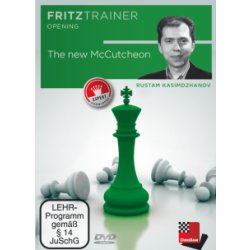


A practical repertoire against the scotch
search
  • A practical repertoire against the scotch

Un repertorio práctico contra la defensa escocesa

€9.90
Tax included
Discover a practical repertoire to neutralize the Scotch Game with expert guidance from coach Adrian Mikhalchishin. Learn clear and effective strategies to respond to 1.e4 e5 2.Nf3 Nc6 3.d4, based on analysis of classical and modern games. Ideal for players looking to strengthen their defense against this opening, revitalized since the Kasparov era.

FORMAT: DOWNLOAD
This product is not provided in physical format. You will receive an email from our store with the download link and product activation code.

Quantity
In Stock

  Security policy

(edit with the Customer Reassurance module)

  Delivery policy

(edit with the Customer Reassurance module)

  Return policy

(edit with the Customer Reassurance module)

For a long time, the Scotch Opening was considered harmless and rarely used. This changed in 1990 when Garry Kasparov successfully employed it in his World Championship match against Anatoly Karpov. But that was 25 years ago. Nowadays, there is no reason to worry if you want to play 1.e4 e5 2.Nf3 Nc6 and are looking for a line against the Scotch. In this 60-minute lesson, the renowned and successful coach Adrian Mikhalchishin offers practical and straightforward advice to neutralize and counter this opening.

Sample Video

Content

  • Repertoire for Black against the Scotch: 1.e4 e5 2.Nf3 Nc6 3.d4 exd4 4.Nxd4 Bc5
  • 01: Introduction and 5.Nf5 - Bene,V - Smilaver [07:02]
  • 02: 5.Be3 Qf6 6.Nb5 Bxe3 7.fxe3 Qh4+ - Wang,H - Harikrishna,P [03:25]
  • 03: 5.Be3 Qf6 6.c3 Nge7 7.Nc2 d6 8.Bxc5 dxc5 - Dutreeuw - Mikhalchishin; Rublevsky,S - Kobalia,M [04:49]
  • 04: 5.Be3 Qf6 6.c3 Nge7 7.Bc4 Ne5 8.Be2 Qg6 9.O-O d6 10.f3 O-O 11.Kh1 d5 12.Nd4 dxe4 13.fxe4 Ng4 and 10.f4 Qxe4 11.Bf2 Bxd4 12.cxd4 N5g6 13.g3 O-O - Nedev,T - Upton,T; Carlsen,M - Leko,P [05:38]
  • 05: 5.Be3 Qf6 6.c3 Nge7 7.Bc4 Ne5 8.Be2 Qg6 9.O-O d6 10.f4 Qxe4 11.Bf2 Bxd4 12.cxd4 N5g6 13.g3 Qf5 - Areshchenko,A - Lenic,L [02:30]
  • 06: 5.Nb3 Bb4+ 6.c3 Be7 7.Nd4/c4/f4 - Radulov,I - Keres,P; Ivanovic,B - Petrosian,T; Huebner,R - Spassky,B; Movsesian,S - Landa,K [07:07]
  • 07: 5.Nb3 Bb4+ 6.Bd2 a5 7.a3 Be7 8.Nc3/Bc3 - Sveshnikov,E - Berzinsh,R; Sveshnikov,E - Romanishin,O [06:32]
  • 08: 5.Nxc6 Qf6 6.Qd2 dxc6 7.Nc3 Bd4 8.Bc4/Nd1/Bd3 - Nataf,I - Beliavsky,A; Nataf,I - Dorfman,J; Smeets,J - Beliavsky,A; Tiviakov,S - Korneev,O [05:04]
  • 09: 5.Nxc6 Qf6 6.Qf3 dxc6 7.Nd2/Nc3/Bc4 - Huzman,A - Nunn,J; Motylev,A - Romanov,E; Rublevsky,S - Naiditsch,A [09:04]
  • 10: 5.Nxc6 Qf6 6.Qf3 dxc6 7.Bc4 - Ni Hua - Lenic,L; [01:11]
  • 11: 5.Be3 Qf6 6.c3 Nge7 7.g3 d5 - Dworakowska,J - Mikhalchishin,A; [03:09]
  • 12: 4...Qf6 5.Nb5 Bc5 6.Qe2 Bb6/Qd8 - Kogan,A - Jonkman,H; Holzke,F - Hector,J [03:49]

Scotch Opening

The opening known as the Scotch is named after a correspondence match between Edinburgh and London that took place between 1824 and 1828. In that encounter, the Scots initially played Black and lost against 3.d4, but later redeemed themselves by opening with 3.d4 as White with success. At the beginning of the 20th century, interest in this direct method of play diminished significantly, until in 1990 Garry Kasparov used it in game 14 of his World Championship match (Lyon/New York) against Anatoly Karpov, when the score was even. This revived this almost forgotten opening. Although that game ended in a draw, Kasparov repeated his "experiment" in the next game with White, this time successfully. This sparked a rise in the Scotch, which went from being considered outdated to modern and popular among top players.

APRATS-UKWU