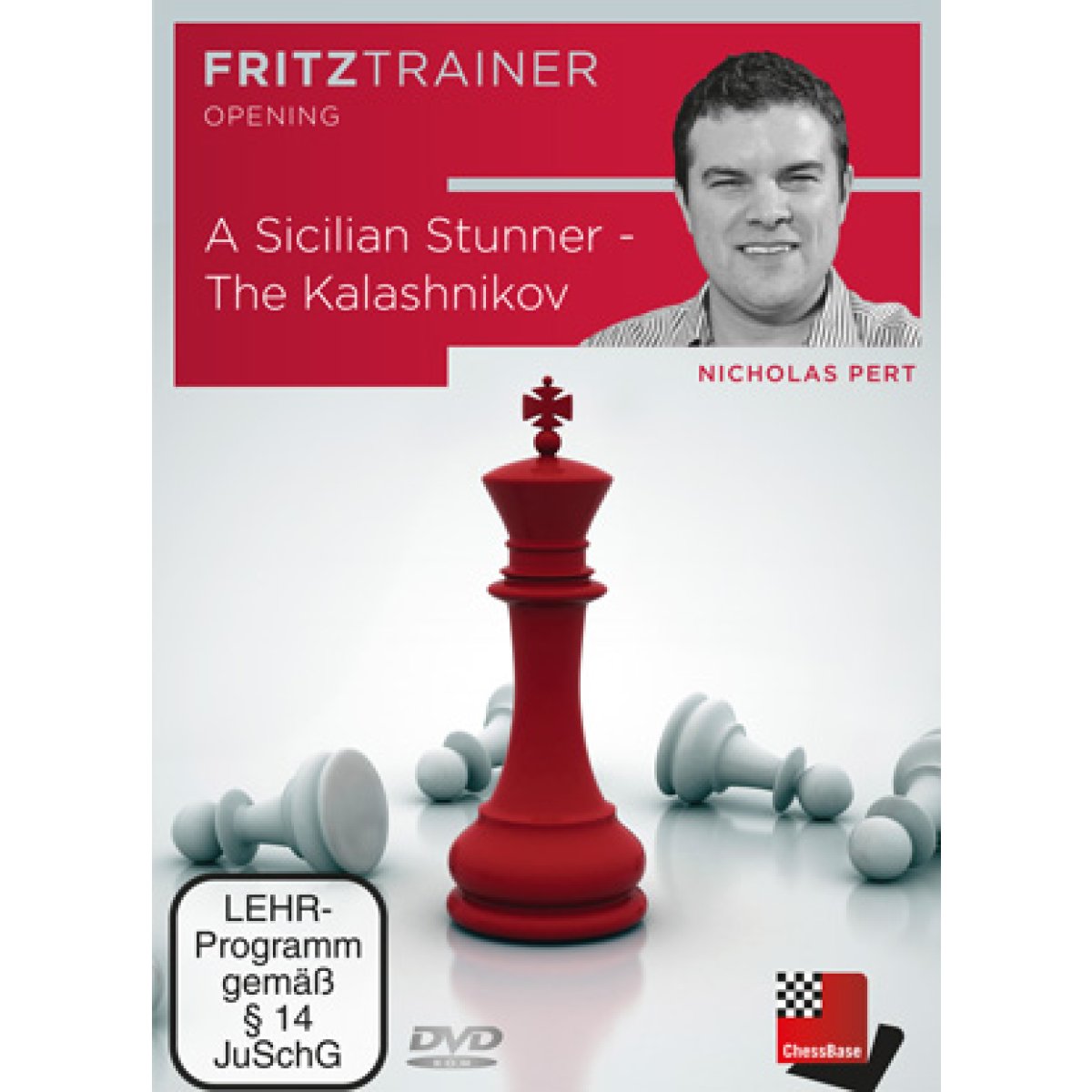

A Sicilian Stunner - The Kalashnikov
search
  • A Sicilian Stunner - The Kalashnikov

A Sicilian Stunner - The Kalashnikov

€29.90
Tax included
Discover the Kalashnikov Variation of the Sicilian Defense, a dynamic and accessible opening for Black. This 5-hour video course offers a complete repertoire from the position 1.e4 c5 2.Nf3 Nc6 3.d4 cxd4 4.Nxd4 e5, featuring deep analysis, interactive exercises, and video feedback. Perfect for players seeking active play and rapid development, with materials compatible with ChessBase and the Fritztrainer App.

FORMAT: DOWNLOAD
This product is not supplied in physical format. You will receive an email from our store with the download link and product activation code.

Quantity
In Stock

  Security policy

(edit with the Customer Reassurance module)

  Delivery policy

(edit with the Customer Reassurance module)

  Return policy

(edit with the Customer Reassurance module)

The Kalashnikov is one of my favorite openings within the main Sicilian Defense. It is closely related to the Sveshnikov but involves much less theory to learn. This increasingly popular opening is easy to adopt since Black's pieces usually develop quickly and smoothly. When I was looking for a Sicilian variation to play, this one met all the requirements. Many ideas are thematic, and Black can reach attacking positions in various lines. All variations have been carefully reviewed and, hopefully, will provide the player with the confidence to employ this opening. The starting position for this video series is 1.e4 c5 2.Nf3 Nc6 3.d4 cxd4 4.Nxd4 e5. From here, a complete repertoire for Black is offered. It includes several interactive questions to assess the viewer's knowledge of the material.

• Video duration: 5 hours (in English)
• Interactive training with video feedback
• Bonus: training chapter with repertoire and playing functions
• Includes ChessBase Reader

More... Less...
Included:
  • Fritztrainer application for Windows
  • Available for download or on DVD
  • Video course with approximate duration of 4 to 8 hours
  • Repertoire database: saves and integrates Fritztrainer games into your own repertoire (on WebApp Opening or ChessBase)
  • Interactive exercises with video feedback: the authors present exercises and key positions; the user must enter the solution, receiving comments and additional explanations, even about mistakes
  • Example games in ChessBase database
FritzTrainer application features:
  • Watch videos in the Fritztrainer app or ChessBase with board graphics, notation, and extensive control bar
  • The analysis engine can be activated at any time
  • Allows pausing the video to manually navigate and analyze the game notation
  • Input of your own variations, engine analysis, and saving in the game
  • Learn variations: view specific lines in ChessBase WebApp Opening with autoplay, memorize and practice transformation (start to end position)
  • Active opening training: selected positions transfer to ChessBase WebApp Fritz-online to play against Fritz and test what you've learned
More options: start FritzTrainer in ChessBase
  • Direct access to the database with all games and analyses
  • Ease of adding games to the opening repertoire
  • Direct evaluation with reference to games, playback on analysis board
  • Saving own variations and possibility to add them to the personal repertoire
  • Repetition training
  • Active LiveBook
  • Use of all engines installed in ChessBase for analysis
  • Assisted analysis
  • Printing of notation and diagrams for study materials

Sample Video

Contents

  • 00: Introduction [06:58]
  • Secondary lines Move 5/6
  • 1.e4 c5 2.Nf3 Nc6 3.d4 cxd4 4.Nxd4 e5
  • 01: Analysis of 5.Nf5 [09:04]
  • 02: Analysis of 5.Nb3 and 5.Nf3 [13:03]
  • 03: Analysis of 5.Nxc6 and 5.Ne2 [09:05]
  • 1.e4 c5 2.Nf3 Nc6 3.d4 cxd4 4.Nxd4 e5 5.Nb5 d6
  • 04: Analysis of 6.Bg5 [05:40]
  • 05: Analysis of 6.Bc4 [12:52]
  • 06: Analysis of 6.a4 and 6.g3 [14:24]
  • 07: Analysis of 6.N5c3 [05:35]
  • 08: Analysis of 6.Be3 [07:43]
  • 6. N1c3
  • 1.e4 c5 2.Nf3 Nc6 3.d4 cxd4 4.Nxd4 e5 5.Nb5 d6 6.N1c3 a6 7.Na3 Be7
  • 09: Analysis of 8.Be2 and 8.g3 [09:34]
  • 10: Analysis of 8.Be3
  • 11: 8.Nc4 with 10.Bd3 analysis [09:07]
  • 12: 8.Nc4 with 10.g3 analysis [07:00]
  • 13: Analysis of 8.Nd5 [14:58]
  • 6. c4
  • 1.e4 c5 2.Nf3 Nc6 3.d4 cxd4 4.Nxd4 e5 5.Nb5 d6 6.c4 Be7
  • 14: Analysis of 7.N5c3 [08:12]
  • 15: Analysis of 7.Bd3 and 7.Be3 [23:16]
  • 16: Analysis of 7.Be2 [13:23]
  • 17: Analysis of 7.b3 and 7.g3 [19:39]
  • 18: 7.N1c3 with 9.Be2 analysis [12:14]
  • 19: 7.N1c3 with 9.Nc2 analysis [23:56]
  • Additions
  • 20: 1.e4 c5 2.Nc3 Nc6 3.Nge2 analysis [11:42]
  • 21: 1.e4 c5 2.Nc3 Nc6 3.Nf3 analysis [17:18]
  • 22: Example game Sagues,V - Pert,N 0-1 [07:32]
  • Test positions
  • Quiz 1 [02:16]
  • Quiz 2 [02:15]
  • Quiz 3 [01:57]
  • Quiz 4 [02:04]
  • Quiz 5 [01:56]
  • Quiz 6 [01:42]
  • Quiz 7 [01:47]
  • Quiz 8 [02:12]
  • Quiz 9 [01:46]
  • Quiz 10 [02:28]
  • Quiz 11 [01:00]
  • Quiz 12 [01:30]
  • Quiz 13 [02:04]
  • Quiz 14 [01:57]
  • Quiz 15 [02:04]
More...
Less...

Kalashnikov Variation

In 1987, a completely new development of this system began when Evgeny Sveshnikov, creator of the Sveshnikov Sicilian (4...Nf6 5.Nc3 e5), switched to 4...e5 followed by 5...d6, a more positionally solid option. Thus, the Kalashnikov or Neo-Sveshnikov system was born. Black's main idea is to occupy the center without delay and with tempo, although the main drawback is the weakening of the d5 square. Which of these factors will prevail?

ASS-TK-GVQA