
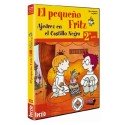
A very educational game, designed for the little ones.
In this adventure, the little ones will quickly learn how the pieces move and basic chess concepts.
An essential tool for the youngest players.
It is the continuation of Little Fritz 1, a game where the child will learn more advanced concepts than in the previous game.
 Security policy
(edit with the Customer Reassurance module)
 Delivery policy
(edit with the Customer Reassurance module)
 Return policy
(edit with the Customer Reassurance module)
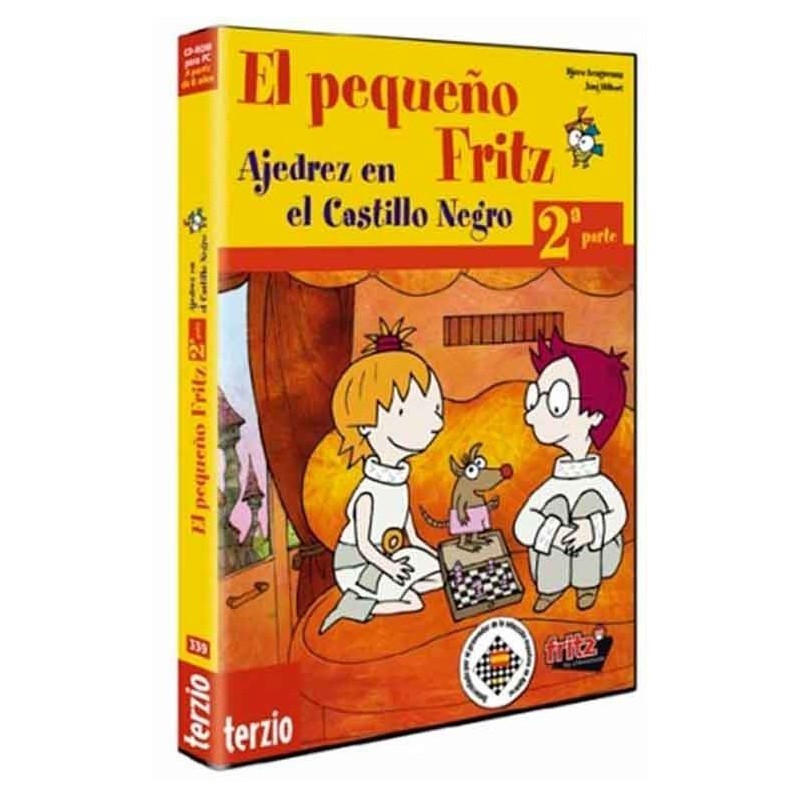
After the great success of "Little Fritz – Learn and Train Chess," the second part of the story finally arrives: "Chess in the Black Castle." It doesn’t matter whether it’s an opening or a pawn endgame, a pin or escaping a check, attacking or defending: in every case, beginners are provided with solid chess knowledge, move by move, in an instructive, easy-to-understand, and entertaining way. With the exercises, one can expand on what has just been learned and try to achieve a top spot on the leaderboards in the wide variety of chess games presented. And of course, there are many witty and humorous comments from the popular sewer rat Leo Listo.
The sequel to the award-winning chess program for children, "Little Fritz."
In this second part of the story: training in strategy, openings, and endgames.
In collaboration with renowned chess instructors for children and youth.
Recommended by the Spanish Chess Federation.
Game modules based on "Fritz," the world-famous ChessBase program.
The story
This is the second part of the adventure of Fritz and Bianca. The two children eagerly await seeing their friend and coach Leo Listo again. But the sewer rat has disappeared, and their trail leads them to the Black King’s castle.
Bianca and Fritz are watching a television program about the country’s best chess player, hoping it is their old coach, the sewer rat Leo Listo, but he only appears briefly holding a sign saying he has been kidnapped.
The Black King in a TV Chess interview about his title as the country’s best chess player.
Bianca and Fritz decide to approach the Black Castle to look for their friend Leo Listo. They use the time during the horse-drawn carriage ride to review the things they learned in the first part of the adventure.
How lucky that Bianca took notes of everything in her diary!
Along the way, they visit the Peonilandia Peasant Olympics, where they must overcome some preliminary exercises that have a subconscious relation to chess and are also very fun.
On their journey, they pass through Peonilandia, where the Peasant Olympics are taking place.
Fancy a game of pie tennis with the village baker?
With the help of the pawns from Peonilandia, they manage to cross the Wet Feet Swamp, and upon arriving at the castle, Fritz and Bianca confirm their suspicion: the Black King has locked up Leo Listo in his dungeons to take his place as the country’s best player. The attempt to free him fails, and Fritz and Bianca are also captured. Now they must try to escape from the castle, but that will only be possible once the user has improved their chess knowledge together with their friends Fritz and Bianca.
Every chess player’s dream: a recipe for the opening.
Tralari-tralara! Polichinela and his famous puppet theater contest.
What marvelous chess machines! Leo Listo almost went crazy with joy.
Hello, I’m the “bobomatic” – the perfect gadget to learn how Fool’s Mate and Scholar’s Mate work.
Friend, ghost, or invisible pieces? Here you can earn many spooky points and, on the fly, learn to play blindfold chess.
There are several simple exercises through which fundamental chess knowledge is easily learned (and also some deeper knowledge!). The goal is to learn to think by acquiring basic knowledge about opening strategy, tactical motifs like forks or pins, how to win a pawn endgame, learning attacking techniques, notation, and much more.
The map with all the game stations for better orientation.
The “elosophical” elevator. The detector measures if players have enough “elocity” to go up.
The “elosophical” flies are an unmistakable indicator of a player’s “elocity.” The more brains you have in your head, the more Elos will fly around it.
At the end of the game, there is a great chess showdown with many innovative features. Leo Listo plays his role as coach; he gives hints, issues warnings, and of course, spares no praise when the player finds a particularly good move.
Behind all the fun this work carries, there is a scrupulous and solid approach, especially regarding chess pedagogy, where no detail is overlooked, no matter how trivial it may seem. After the second part of Little Fritz, the student will play decidedly and noticeably better. Chess is not an exclusive game for people with “a lot of talent” but a perfectly accessible pastime for everyone once some basic rudiments are acquired and trained.
A very educational game, designed for the little ones.
In this adventure, the little ones will quickly learn how the pieces move and basic chess concepts.
An essential tool for the youngest players.
It is the continuation of Little Fritz 1, a game where the child will learn more advanced concepts than in the previous game.