

FORMAT: DOWNLOAD
This product is not supplied in physical format. You will receive an email from our store with the download link and the product activation code.
 Security policy
(edit with the Customer Reassurance module)
 Delivery policy
(edit with the Customer Reassurance module)
 Return policy
(edit with the Customer Reassurance module)
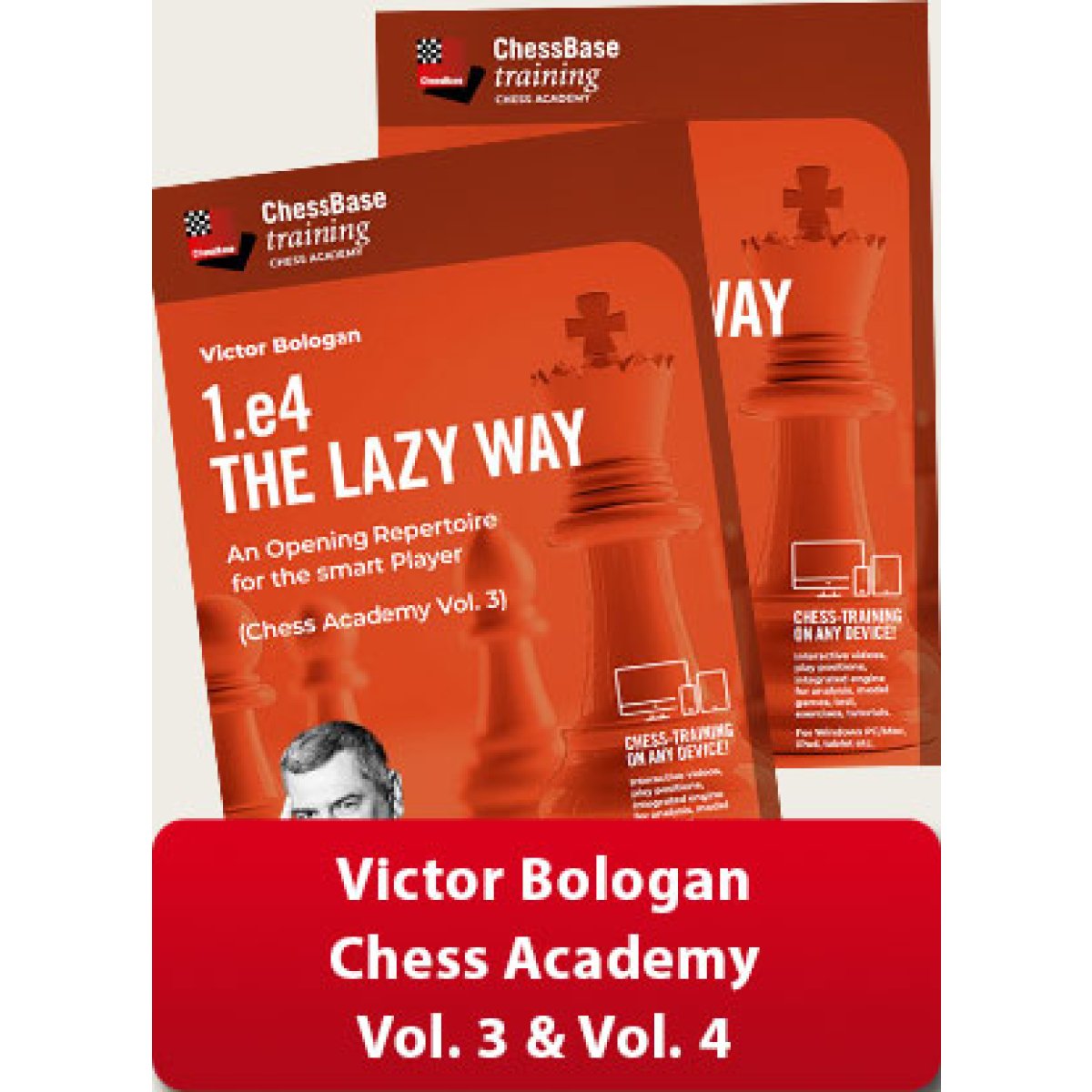
In today's fast-paced chess world, especially online where blitz and rapid games dominate, the traditional method of studying extensive opening lines can be overwhelming and even unnecessary. The real challenge is finding the right balance in your opening preparation. How deep should you go? Where should you stop? This course is based on the timeless wisdom of my legendary coach, Chebanenko, who designed repertoires for his "lazy" students—not due to lack of effort, but as a smart strategy. His philosophy: don't memorize, understand.
Free sample video: Introduction
Free sample video: 1.d4 d6 2.Nf3 Nf6 3.c4 g6 4.Nc3 Bf5 5.Nh4 Bd7
The concept is simple yet powerful: choose systems for White and Black centered around typical pawn structures and recurring piece setups. This way, you don't learn numerous distinct openings but a flexible idea applicable in many positions.
In this Black-focused course, we build our repertoire around the solid and compact d6–e5 structure:
• Against 1.e4: we play the Philidor setup, offering rich positional play and rapid piece development.
• Against 1.d4 and other closed systems: we aim for flexible development, placing our dark-squared bishop on e7 or g7, while keeping an eye on the central break with ...e5.
This setup is effective, easy to learn, resilient, and surprisingly complex for opponents unfamiliar with its nuances. I've used it throughout my life—in blitz, rapid, and even classical tournaments—with good results.
In fact, my recent success in a Fischer Random tournament was mainly due to mastering pawn structures and strategic flexibility, not memorized lines.
With this course (and the complementary White repertoire), you will not only get a practical, low-maintenance opening solution but also develop a deeper understanding of chess that will allow you to:
• React confidently in unfamiliar positions
• Make better decisions based on ideas, not memorized moves
• Save time without losing competitiveness
Learn smartly. Play smartly. Let’s build your opening repertoire in a "lazy" way—based on lasting understanding, not short-term memory.
How much time should we really spend memorizing long opening lines? In today's context of rapid and blitz games, it's crucial to develop a practical, flexible, and easy-to-remember repertoire that still retains power and richness of ideas. That is the essence of this series: a repertoire for the "lazy" (but smart) player, inspired by coach Chebanenko, who taught openings based on typical ideas and repeatable patterns rather than endless theory.
Free sample video: Introduction
Free sample video: 2...d5 3.Nd2 c5 4.Ngf3 Nc6 5.g3 Bd6
In this course, we analyze a repertoire for White after 1.e4. I move away from traditional lines like 1.e4 e5 2.Nf3 Nc6 3.Bc4 and recommend a modern, strategic approach centered on an early d3. These quiet systems avoid heavy theory and allow steering the game into familiar territory. Against the Caro-Kann, the modest setup with Nf3 and d3 is unpleasant for the opponent, and it is a system I frequently use with good results.
In the Sicilian, we focus on closed-style positions where understanding beats memorization. Against the French, the reliable King's Indian Attack (with Nbd2) offers a harmonious, thematic way to face 1...e6. These ideas have been employed at the highest level, even by Magnus Carlsen, demonstrating their pragmatism and solidity.
Recently, I succeeded with these setups in a Fischer Random tournament. What helped me most was not memorized theory but a deep understanding of pawn structures, flexibility, and sound decision-making in new positions. That is the real value of this repertoire: developing positional sense, not just mechanical recall.
By the end of this second course, you will have a complete, idea-based repertoire for 1.e4, ready for any time control and opponent. Combined with the volume on 1...d6 as Black, you will have a universal system for both colors that is effective, simple, and surprisingly powerful.


FORMAT: DOWNLOAD
This product is not supplied in physical format. You will receive an email from our store with the download link and the product activation code.