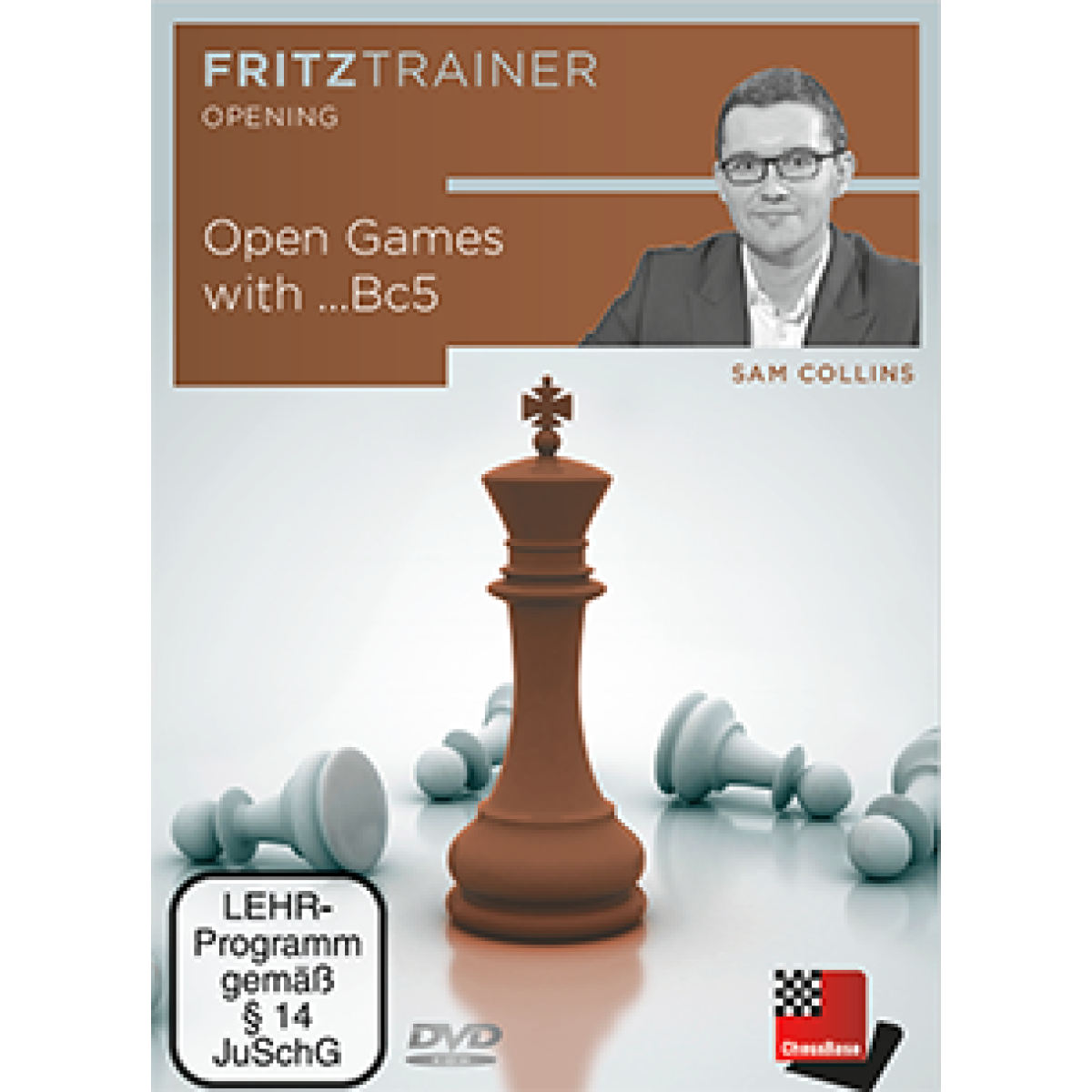

Open Games with ...Bc5
search
  • Open Games with ...Bc5

Open Games with ...Bc5

€29.90
Tax included
Master open openings with this comprehensive guide based on the active development of the bishop to c5 after 1.e4 e5. Learn to handle key lines such as the Ruy López, Italian, Scotch, and King's Gambit, facing common tactical and strategic challenges. With over 5 hours of video, interactive exercises, and a database of 1600 model games, improve your repertoire and play a classic and aggressive defense confidently as Black.

FORMAT: DOWNLOAD
This product is not supplied in physical format. You will receive an email from our store with the download link and product activation code.

Quantity
In Stock

  Security policy

(edit with the Customer Reassurance module)

  Delivery policy

(edit with the Customer Reassurance module)

  Return policy

(edit with the Customer Reassurance module)

Experienced coaches often recommend playing openings with similar pawn structures to facilitate the transfer of ideas between variations. With this purpose, Sam Collins has created a repertoire based on systems with ...Bc5 after 1.e4 e5. These lines (focused on 3...Bc5 against the Ruy López and the Italian, the Four Knights Spanish with 4...Bc5, 3...Bb4+ 4.c3 Bc5 against the Scotch, and 2...Bc5 against the King's Gambit) share common goals: actively developing the bishop outside the pawn chain, fighting for control of the key d4 square, and supporting attacks on the kingside. They also face similar challenges, such as the risk of the bishop becoming blocked by pawns on c3 and d4, the tactic Nxe5!, and the threat of pinning the kingside knight with Bg5. This DVD prepares players to face these lines with confidence and delve into an active and classical approach against 1.e4.

• Video duration: 5 h 13 min (in English)
• Interactive training with video feedback
• Extra: Database with more than 1600 model games
• Includes CB 12 Reader

More...Less...
Included content:
  • Fritztrainer application for Windows
  • Available for download or DVD
  • Video course with an approximate duration of 4 to 8 hours
  • Repertoire database: saves and integrates Fritztrainer games into your own repertoire (in WebApp Opening or ChessBase)
  • Interactive exercises with video feedback: authors present exercises and key positions; the user must enter the solution with explanations and error corrections
  • Model games in ChessBase database
FritzTrainer application features:
  • Video playback in the Fritztrainer app or in ChessBase with board, notation, and function bar
  • Analysis engine activatable at any time
  • Video pause for manual navigation and notation analysis
  • Entry of personal variations, engine analysis, and saving in the game
  • Learning variations: visualizes specific lines in ChessBase WebApp Opening with automatic playback and transformation practice (starting position – final position)
  • Active opening training: selected positions are transferred to ChessBase WebApp Fritz-online to play against Fritz and test what you've learned
More options: launch FritzTrainer from ChessBase
  • Direct access to the database with all games and analyses
  • Ability to easily add games to the opening reference
  • Direct evaluation with game reference and replay on analysis board
  • Saving and adding personal variations to the personal repertoire
  • Reproduction training
  • Active LiveBook
  • Use of all engines installed in ChessBase for analysis
  • Assisted analysis
  • Printing notation and diagrams for study materials

Sample video

Table of contents

  • 01: Introduction [09:31]
  • Spanish - 1.e4 e5 2.Nf3 Nc6 3.Bb5 Bc5
  • 02: 4.Nxe5 Nxe5 5.d4 - video analysis [06:55]
  • 03: 4.0-0 Nd4 and various 5th moves - video analysis [11:51]
  • 04: 4.0-0 Nd4 5.Nxd4 Bxd4 6.c3 Bb6 and various 7th moves - video analysis [12:22]
  • 05: 4.0-0 Nd4 5.Nxd4 Bxd4 6.c3 Bb6 7.d4 c6 8.Bc4 d6 and various 9th moves - video analysis [14:48]
  • 06: 4.0-0 Nd4 5.Nxd4 Bxd4 6.c3 Bb6 7.d4 c6 8.Ba4 d6 and various 9th moves - video analysis [13:21]
  • 07: 4.0-0 Nd4 5.Nxd4 Bxd4 6.c3 Bb6 7.d4 c6 8.Ba4 d6 9.Na3 Nf6 and various 10th moves - video analysis [08:33]
  • 08: 4.0-0 Nd4 5.Nxd4 Bxd4 6.c3 Bb6 7.d4 c6 8.Ba4 d6 9.Na3 Nf6 10.Bg5 - video analysis [23:07]
  • 09: 4.c3 Nf6 5.0-0 0-0 6.d3 d5 or 4.c3 Nf6 5.d3 d5 Introduction - video analysis [18:59]
  • 10: 4.c3 Nf6 5.0-0 0-0 6.d3 d5 7.Nbd2 dxe4 - video analysis [08:32]
  • 11: 4.c3 Nf6 5.d4 Introduction - video analysis [19:31]
  • 12: 4.c3 Nf6 5.d4 exd4 6.e5 Ne4 7.0-0 d5 - video analysis [08:18]
  • 13: 4.c3 Nf6 5.0-0 0-0 6.d4 Bb6 7.Re1 - video analysis [06:41]
  • 14: 4.c3 Nf6 5.0-0 0-0 6.d4 Bb6 7.dxe5 - video analysis [08:40]
  • 15: 4.c3 Nf6 5.0-0 0-0 6.d4 Bb6 7.Bg5 d6 8.Bxc6 - video analysis [05:46]
  • 16: 4.c3 Nf6 5.0-0 0-0 6.d4 Bb6 7.Bg5 d6 8.a4 - video analysis [08:00]
  • 17: 4.c3 Nf6 5.0-0 0-0 6.d4 Bb6 7.Bg5 d6 8.Qd3 - video analysis [10:05]
  • Italian - 1.e4 e5 2.Nf3 Nc6 3.Bc4 Bc5
  • 18: 4.c3 Nf6 5.d4 exd4 - video analysis [19:33]
  • 19: Various 4th moves - video analysis [11:20]
  • 20: 4.c3 Nf6 5.d3 a6 - video analysis [12:40]
  • 21: 4.b4 Bb6 5.a4 a6 - video analysis [05:38]
  • Four Knights - 1.e4 e5 2.Nf3 Nc6 3.Nc3 Nf6
  • 22: Spanish 4.Bb5 Bc5 - video analysis [09:35]
  • 23: Scotch and others: 4.d4 exd4 5.Nxd4 Bb4 and 4.Be2 d5 and 4.g3 d5 - video analysis [10:58]
  • Scotch: 1.e4 e5 2.Nf3 Nc6 3.d4
  • 24: 3...exd4 4.Nxd4 Bb4 5.c3 Bc5 - video analysis [07:21]
  • King's Gambit: 1.e4 e5 2.f4
  • 25: 2...Bc5 3.Nf3 d6 - video analysis [12:06]
  • Vienna: 1.e4 e5 2.Nc3 Nf6
  • 26: 3.g3 Nc6 4.Bg2 Bc5 or 3.Bc4 Nc6 or 3.f4 d5 - video analysis [05:30]
  • Center: 1.e4 e5 2.d4 exd4
  • 27: 3.Qxd4 Nc6 4.Qe3 Nf6 or 3.c3 d5 or 3.Nf3 Nc6 4.c3 d5 - video analysis [11:05]
  • Interactive positions
  • 28: Test 1 [01:40]
  • 29: Test 2 [01:42]
  • 30: Test 3 [01:08]
  • 31: Test 4 [01:13]
  • 32: Test 5 [00:55]
  • 33: Test 6 [01:07]
  • 34: Test 7 [01:04]
  • 35: Test 8 [01:08]
  • 36: Test 9 [01:12]
  • 37: Test 10 [00:56]
More...
Less...

Openings

After 1.e4 e5 the so-called open openings arise. Previously this sequence was almost obligatory and thus began some of the most famous games in history, such as the Immortal and Evergreen games. Nowadays, beginners usually learn these openings first, and only in them does the Scholar's mate appear (2.Qh5 Nc6 3.Bc4 Nf6 4.Qxf7 mate). At the same time, 1...e5 is considered the most solid continuation and dominates high-level chess.

OGW.-UMAN