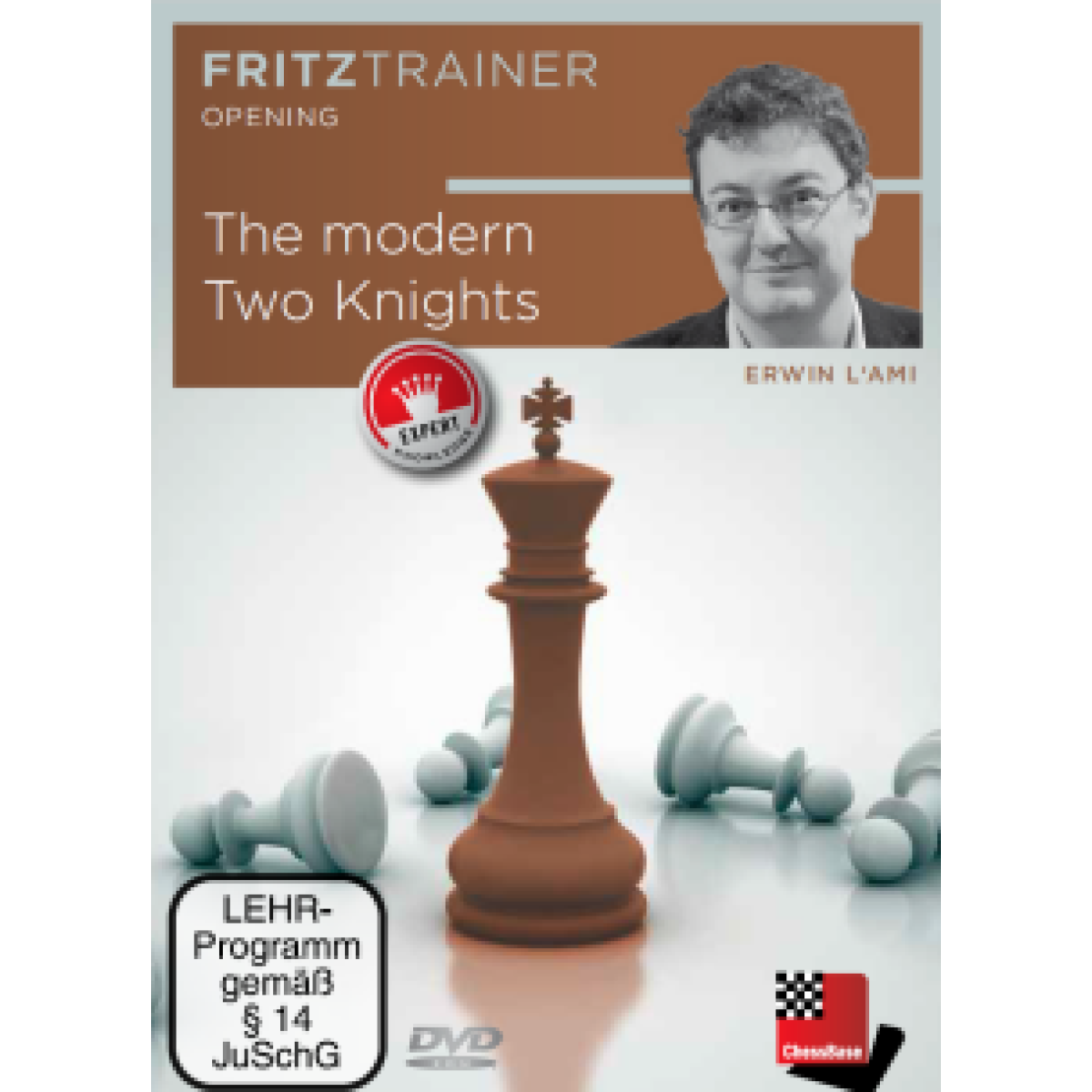


The modern Two Knights
search
  • The modern Two Knights

The modern Two Knights

€29.90
Tax included
Discover the Two Knights Defense, one of the most classic and dynamic chess openings. This comprehensive video course of over 4 hours offers a detailed analysis of the key variations, accompanied by databases with model games and interactive exercises with feedback. Ideal for players who wish to master this sharp opening, with exclusive material for advanced training and practice.

FORMAT: DOWNLOAD
This product is not provided in physical format. You will receive an email from our store with the download link and product activation code.

Quantity
In Stock

  Security policy

(edit with the Customer Reassurance module)

  Delivery policy

(edit with the Customer Reassurance module)

  Return policy

(edit with the Customer Reassurance module)

The Two Knights Defense is one of the oldest openings in chess history. The tactical positions arising after the moves 1.e4 e5 2.Nf3 Nc6 3.Bc4 Nf6 4.Ng5 d5 5.exd5 have fascinated players for decades. World champions such as Wilhelm Steinitz and Bobby Fischer have contributed to its development, and more recently, Nigel Short has popularized it. In the main lines, Black sacrifices a pawn, leading to very interesting consequences. This DVD is aimed at players on both sides, offering an objective overview of all relevant theoretical lines. Additionally, it includes a database with model games and an interactive section with memory markers and tactics so viewers can test what they have learned.

• Video duration: 4 h 27 min
• Interactive training with video feedback
• Exclusive database with over 90 essential games and full analysis of the variations by L’Ami
• Includes CB 12 Reader

More... Less...
Included content:
  • Fritztrainer application for Windows
  • Available for download or on DVD
  • Video course with an approximate duration of 4 to 8 hours
  • Repertoire database: saves and integrates Fritztrainer games into your own repertoire (in WebApp Opening or ChessBase)
  • Interactive exercises with video feedback: the authors present exercises and key positions, the user must enter the solution. Includes video feedback (also on errors) and additional explanations
  • Model games in a ChessBase database
FritzTrainer application features:
  • Videos can be played in the Fritztrainer application or in the ChessBase program with board graphics, notation, and control bar
  • The analysis engine can be activated at any time
  • Video pause for manual navigation and analysis in the game notation
  • Input of your own variations, engine analysis, and saving them in the game
  • Variation learning: view specific lines in ChessBase WebApp Opening with automatic playback, memorize variations, and practice transformation (starting position - final position)
  • Active opening training: selected positions are transferred to ChessBase WebApp Fritz-online. In a match against Fritz, you can test and actively play the new opening
More options: start FritzTrainer in the ChessBase program
  • The database with all games and analyses can be opened directly
  • Games can be easily added to the opening reference
  • Direct evaluation with game reference; games can be replayed on the analysis board
  • Own variations are saved and can be added to the personal repertoire
  • Replay training
  • Active LiveBook
  • All engines installed in ChessBase can be used for analysis
  • Assisted analysis
  • Printing of notations and diagrams (for worksheets)

Sample video

Content

  • Databases: Two Knights analysis; Model games – Two Knights
  • Two Knights: 1.e4 e5 2.Nf3 Nc6 3.Bc4 Nf6 4.Ng5 d5 5.exd5
  • 01: Introduction [07:03]
  • 02: 5...Nxd5 6.Nxf7 [13:48]
  • 03: 5...Nxd5 6.d4 [11:29]
  • 04: 5...Nd4 [11:31]
  • 05: 5...b5 [10:31]
  • 06: 5...Na5 – Introduction [08:51]
  • 07: 5...Na5 6.Bb5+ c6 7.dxc6 bxc6 8.Qf3 cxb5 [09:45]
  • 08: 5...Na5 6.Bb5+ c6 7.dxc6 bxc6 8.Qf3 Be7 [10:42]
  • 09: 5...Na5 6.Bb5+ c6 7.dxc6 bxc6 8.Be2 h6 9.Nh3 [12:46]
  • 10: Two Knights 4.Ng5 – 5...Na5 6.Bb5+ c6 7.dxc6 bxc6 8.Be2 h6 9.Nf3 [11:30]
  • 11: Two Knights 4.Ng5 – 5...Na5 6.Bb5+ c6 7.dxc6 bxc6 8.Bd3 Ng4 [08:30]
  • 12: 5...Na5 6.Bb5+ c6 7.dxc6 bxc6 8.Bd3 Nd5 9.h4 Be7 10.Qf3 f5 Bxf5 Rf8 12.Qh5 [08:22]
  • 13: 5...Na5 6.Bb5+ c6 7.dxc6 bxc6 8.Bd3 Nd5 9.h4 Be7 10.Qf3 f5 11.Bxf5 Rf8 12.g4 [09:42]
  • 14: 5...Na5 6.Bb5+ c6 7.dxc6 bxc6 8.Bd3 Nd5 9.Nf3 [16:53]
  • 15: Theoretical overview [17:39]
  • 16: Model game 1 – Mayet,C – Lange,M [16:55]
  • 17: Model game 2 – Ciocaltea,V – Nezhmetdinov,R [08:45]
  • 18: Model game 3 – Van der Wiel,J – Spassky,B [11:18]
  • 19: Model game 4 – Naiditsch,A – Carlsen,M [18:47]
  • 20: Conclusion [01:13]
  • Memory markers
  • 21: Memory markers 1 [03:31]
  • 22: Memory markers 2 [01:51]
  • 23: Memory markers 3 [01:48]
  • 24: Memory markers 4 [02:34]
  • 25: Memory markers 5 [02:28]
  • 26: Memory markers 6 [02:22]
  • 27: Memory markers 7 [01:11]
  • 28: Memory markers 8 [02:34]
  • 29: Memory markers 9 [01:46]
  • 30: Memory markers 10 [01:58]
  • Tactics
  • 31: Tactics 1 [01:49]
  • 32: Tactics 2 [01:38]
  • 33: Tactics 3 [01:13]
  • 34: Tactics 4 [01:51]
  • 35: Tactics 5 [01:57]
  • 36: Tactics 6 [02:19]
  • 37: Tactics 7 [01:36]
  • 38: Tactics 8 [01:49]
  • 39: Tactics 9 [02:39]
  • 40: Tactics 10 [03:07]
More...
Less...

Open Openings

After 1.e4 e5, the so-called open openings arise. This move order was almost obligatory in the past and was the start of some of the most famous games in chess history, such as the Immortal and Evergreen games. Nowadays, beginners mainly learn to play open openings, and only in this family does the Scholar’s mate appear (2.Qh5 Nc6 3.Bc4 Nf6 4.Qxf7 mate). At the same time, 1...e5 is considered the most solid continuation within these openings and dominates high-level chess.

TMTK-RLKA