

Chess Classics - games you must know
search
  • Chess Classics - games you must know

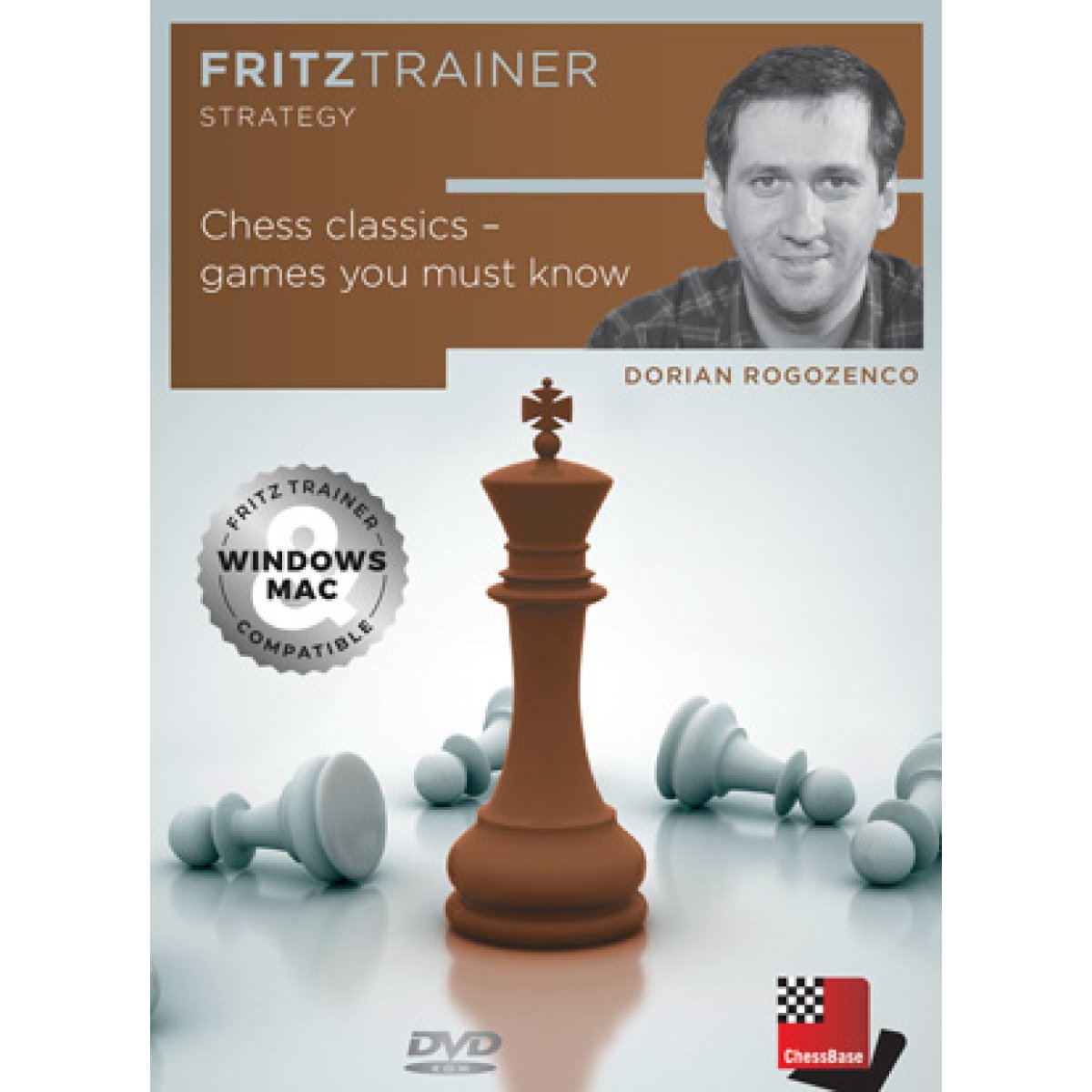
Chess Classics - games you must know

€29.90
Tax included
Discover "Chess Classics - games you must know," a video course featuring 33 classic chess games from the 18th century up to World War II. Learn from the grandmasters and master essential strategic and tactical ideas. With over 8 hours of content in English, interactive exercises, and a database to improve your play. Ideal for enthusiasts and players looking to deepen their chess understanding.

FORMAT: DOWNLOAD
This product is not supplied in physical format. You will receive an email from our store with the download link and product activation code.

Quantity
In Stock

  Security policy

(edit with the Customer Reassurance module)

  Delivery policy

(edit with the Customer Reassurance module)

  Return policy

(edit with the Customer Reassurance module)

This video course offers a selection of 33 classic chess games, played from the 18th century up to the beginning of World War II. From François-André Danican Philidor to Mikhail Botvinnik, these emblematic games, contested by the best players of their time, are true treasures of chess history. They are an essential part of chess culture and every developing player or chess enthusiast should know them. As the author explains in the introductory video, knowing the classic games enriches the overall understanding of chess and helps improve one's own playing strength.

Most of the videos compile selected material from the “Chess Classics” section of ChessBase Magazine issues 160-209, complemented with new content created especially for this course. In addition to the 33 complete games, the author presents important classic fragments, each offering very instructive strategic or tactical ideas.

• Total video duration: more than 8 hours (in English)
• Thematic keywords to facilitate training

More... Less...
This includes:
  • Fritztrainer application for Windows and Mac
  • Available for download or on DVD
  • Video course with an approximate duration of 4 to 8 hours
  • Repertoire database: saves and integrates Fritztrainer games into your repertoire (in WebApp Opening or ChessBase)
  • Interactive exercises with video feedback: the author presents exercises and key positions the user must solve, with detailed explanations even in case of errors
  • Example games in ChessBase database format
  • New: many Fritztrainers are also available for streaming through the ChessBase video portal
Features of the FritzTrainer application:
  • Video playback with board, notation, and function bar inside the Fritztrainer or ChessBase app
  • Activation of the analysis engine at any time
  • Pause video for manual navigation and analysis in the game notation
  • Input of personal variations, engine analysis, and saving within the game
  • Learning variations: visualizes specific lines in ChessBase WebApp Opening with automatic playback, memorization, and practice of transformations (starting position – ending position)
  • Active opening training: selected positions transfer to ChessBase WebApp Fritz-online to play against Fritz and test acquired knowledge
More options when starting FritzTrainer in ChessBase:
  • Direct access to the database with all games and analyses
  • Easy incorporation of games into the opening repertoire
  • Direct evaluation with game references, playback on the analysis board
  • Saving personal variations to add them to the repertoire
  • Reproduction training
  • Active LiveBook
  • Use of all engines installed in ChessBase for analysis
  • Assisted analysis
  • Printing of notation and diagrams for teaching material

Sample Video

Content

  • Introduction
  • Fragments
  • Fragments 1
  • Fragments 2
  • 1783-1883
  • Von Bruehl – Philidor, 1783 (Piece exchange, prophylaxis)
  • De Labourdonnais – McDonnell, 1834 (Opposite-colored bishops, initiative, isolated queen’s pawn, king attack)
  • McDonnell – De Labourdonnais, 1834 (Pair of bishops, mate on the first rank, tactical creativity, queen sacrifice)
  • Anderssen – Kieseritzky, 1851 (The Immortal Game) (Deflection, tactical creativity, queen sacrifice)
  • Anderssen – Dufresne, 1852 (The Evergreen Game) (Positional pawn sacrifice, decoy, double check, queen sacrifice)
  • Morphy – Duke of Brunswick, 1858 (Pin, queen sacrifice)
  • Anderssen – Zukertort, 1869 (Plan, positional pawn sacrifice, king attack, decoy, queen sacrifice)
  • Zukertort – Blackburne, 1883 (Opposite-colored bishops, pair of bishops, prophylaxis, plan, deflection, pin, discovered attack)
  • 1883-1899
  • Englisch – Steinitz, 1883 (Piece exchange, pair of bishops, plan, advantage conversion)
  • Steinitz – Sellman, 1885 (Blockade, open file, weak squares)
  • Steinitz – Chigorin, 1892 (Plan, advantage conversion)
  • Steinitz – Von Bardeleben, 1895 (Isolated queen’s pawn, positional pawn sacrifice, calculation)
  • Pillsbury – Lasker, 1896 (Prophylaxis, king attack, calculation, defender elimination, tactical creativity)
  • Chigorin – Lasker, 1899 (Pair of bishops, prophylaxis, plan)
  • 1908-1914
  • Rubinstein – Teichmann, 1908 (Plan, attack against the king, decoy)
  • Rubinstein – Salwe, 1908 (Centralization, piece exchange, good bishop – bad bishop, blockade, prophylaxis, plan, advantage conversion, weak pawn, weak squares, pin)
  • Tarrasch – Schlechter, 1911 (Opposite-colored bishops, pair of bishops, prophylaxis, advantage conversion)
  • Nimzowitsch – Salwe, 1911 (Centralization, pair of bishops, blockade, weak squares, king attack)
  • Rubinstein – Schlechter, 1912 (Centralization, open file, plan)
  • Tarrasch – Teichmann, 1912 (Centralization, good bishop – bad bishop, plan, weak squares)
  • Lasker Ed. – Thomas, 1912 (Decoy, double check, queen sacrifice)
  • Nimzowitsch – Capablanca, 1914 (Open file, positional pawn sacrifice)
  • Lasker – Capablanca, 1914 (Centralization, prophylaxis, open file, plan, weak pawn, weak squares, positional pawn sacrifice)
  • 1923-1938
  • Saemisch – Nimzowitsch, 1923 (Plan, king attack)
  • Alekhine – Rubinstein, 1923 (Initiative, mate on the first rank, pin)
  • Bogoljubow – Capablanca, 1924 (Piece exchange, good bishop – bad bishop, plan, weak pawn)
  • Reti – Yates, 1924 (Plan)
  • Reti – Alekhine, 1925 (Calculation, deflection, discovered attack, tactical creativity)
  • Johner – Nimzowitsch, 1926 (Plan, king attack, decoy, pin)
  • Alekhine – Nimzowitsch, 1930 (Open file, pin)
  • Botvinnik – Vidmar, 1936 (Initiative, plan, isolated queen’s pawn, deflection, defender elimination, pin)
  • Botvinnik – Alekhine, 1938 (Piece exchange, open file, weak squares)
  • Botvinnik – Capablanca, 1938 (Plan, positional pawn sacrifice, king attack, calculation, deflection, pin)
  • Themes
  • Centralization
  • Piece exchange
  • Good bishop – bad bishop
  • Opposite-colored bishops
  • Pair of bishops
  • Blockade
  • Prophylaxis
  • Open file
  • Initiative
  • Plan
  • Advantage conversion
  • Weak pawn
  • Weak squares
  • Isolated queen’s pawn
  • Positional pawn sacrifice
  • King attack
  • Calculation
  • Deflection
  • Decoy
  • Defender elimination
  • Mate on the first rank
  • Pin
  • Double check
  • Discovered attack
  • Tactical creativity
  • Queen sacrifice
CC-GYMK-ZZJO