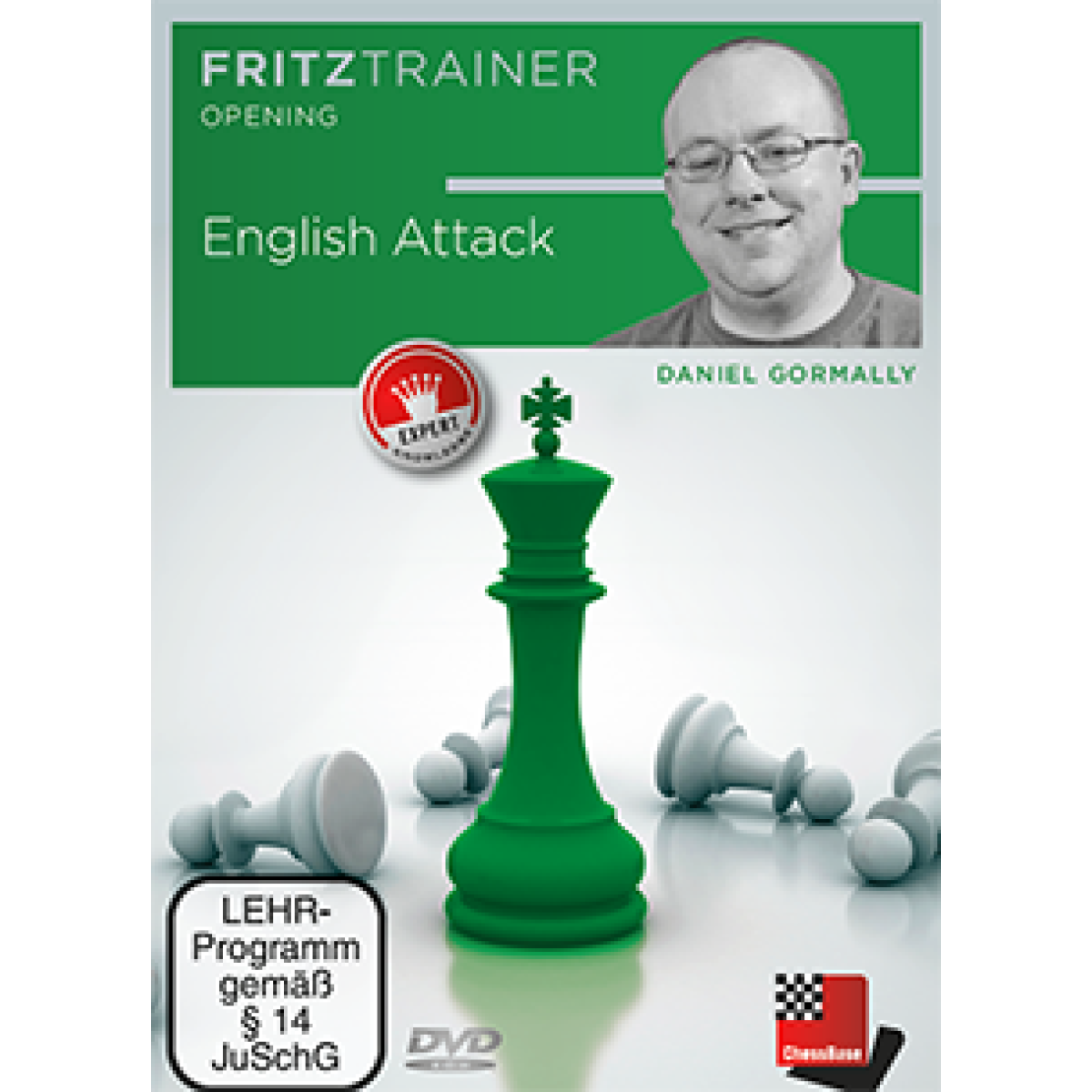

English Attack
search
  • English Attack

English Attack

€29.90
Tax included
Discover the English Attack against the Najdorf and Scheveningen defenses with Grandmaster Daniel Gormally. This comprehensive video course (7 hours) combines strategy and tactics to master this aggressive Sicilian opening, used by legends like Kasparov and Anand. It includes interactive exercises, analysis of classic games, and a database with 50 essential games. Improve your repertoire and chess understanding with this powerful attacking weapon.

FORMAT: DOWNLOAD
This product is not supplied in physical format. You will receive an email from our store with the download link and product activation code.

Quantity
In Stock

  Security policy

(edit with the Customer Reassurance module)

  Delivery policy

(edit with the Customer Reassurance module)

  Return policy

(edit with the Customer Reassurance module)

The English Attack against the Najdorf and Scheveningen variations is one of the most exciting and entertaining lines in modern chess. Developed in the 1980s by the prominent English players John Nunn and Nigel Short, this opening has been employed by legends such as Garry Kasparov and Vishy Anand, and is currently also favored by the new generation of players like Fabiano Caruana and Alexander Grischuk. In this instructional DVD, English Grandmaster Daniel Gormally, known for his aggressive style, explains the main lines of this fascinating system. Gormally demonstrates that the English Attack is not a one-dimensional approach, although in many variations White launches a decisive attack on the kingside. This DVD shows how to combine strategic ideas with an offensive style to turn the English Attack into a lethal weapon against the Sicilian Defense. According to Gormally, adding the English Attack to your repertoire will improve your results immediately. This opening rewards effort, offers more interesting positions than anti-Sicilian lines, and furthermore, enhances overall chess understanding.

• Video duration: 7 hours (in English)
• Interactive training with video feedback
• Database with 50 essential games and their analyses
• Includes CB 12 Reader

More... Less...
Included content:
  • Fritztrainer application for Windows
  • Available for download or on DVD
  • Video course with approximately 4 to 8 hours duration
  • Repertoire database: save and integrate Fritztrainer games into your repertoire (in WebApp Opening or ChessBase)
  • Interactive exercises with video feedback: the authors present exercises and key positions; the user must enter the solution, receiving corrections and additional explanations
  • Example games in ChessBase database
FritzTrainer application features:
  • Videos can be played in the Fritztrainer application or in the ChessBase program with board, notation, and function bar
  • Analysis engine activatable at any time
  • Video pause for manual navigation and notation analysis
  • Entry of own variations with engine analysis and storage
  • Learning of variations: views specific lines in ChessBase WebApp Opening with automatic playback; memorizes and practices transformations (starting position – ending position)
  • Active opening training: selected positions are transferred to ChessBase WebApp Fritz-online to play against Fritz and test the acquired knowledge
More possibilities: start FritzTrainer from ChessBase
  • Database with all games and analyses directly accessible
  • Ability to add games to the opening repository
  • Direct evaluation with game references and playback on analysis board
  • Saving own variations to expand the repertoire
  • Replay training
  • Active LiveBook
  • Use of all engines installed in ChessBase for analysis
  • Assisted analysis
  • Printing of notation and diagrams for study materials

Sample video

Content

  • 01: Introduction [04:34]
  • 02: 6...e6 7.f3 b5 8.g4 h6 9.Qd2 Bb7 10.0-0-0 Game 1 - Nunn,J - Leroy,A [20:51]
  • 03: 6...e6 7.f3 b5 8.g4 h6 9.Qd2 Bb7 10.h4 Game 2 - Anand,V - Ftacnik,L [16:25]
  • 04: 6...e6 7.f3 Nc6 8.Qd2 Be7 9.0-0-0 0-0 10.g4 Nxd4 11.Bxd4 b5 12.g5 Nd7 13.h4 Bb7 Game 3 - Haslinger,S - Gormally,D [11:03]
  • 05: 6...e6 7.f3 Nc6 8.Qd2 Be7 9.0-0-0 0-0 10.g4 Nxd4 11.Bxd4 b5 12.g5 Nd7 13.h4 b4 Game 4 - Fischer,R - Spassky,B [13:16]
  • 06: 6...e6 7.f3 Nc6 8.Qd2 Be7 9.0-0-0 0-0 10.g4 Nxd4 11.Qxd4 Game 5 - Morozevich,A - Rowson,J [11:09]
  • 07: 6...e5 7.Nb3 Be6 8.f3 h5 Game 6 - Caruana,F - Gelfand,B [22:46]
  • 08: 6...e5 7.Nb3 Be6 8.f3 h5 9.Qd2 Nbd7 10.g4 b5 Game 7 - Inarkiev,E - Nepomniachtchi,I [19:28]
  • 09: 6.f3 Qb6 7.Nb3 e6 8.Bf4 Game 8 - Anand,V - Ponomariov,R [12:50]
  • 10: 6...e5 7.Nb3 Be6 8.f3 Be7 9.Qd2 Nbd7 10.g4 0-0 11.0-0-0 Rc8 Game 9 - Grischuk,A - Ftacnik,L [18:52]
  • 11: 6...e5 7.Nb3 Be6 8.f3 Be7 9.Qd2 Nbd7 10.g4 0-0 11.0-0-0 b5 12.Rg1 Game 10 - Saric,I - Vachier Lagrave,M [18:03]
  • 12: 6...e5 7.Nb3 Be6 8.f3 Be7 9.Qd2 Nbd7 10.g4 0-0 11.0-0-0 b5 12.g5 Game 11 - Saric,I - Wojtaszek,R [21:15]
  • 13: 6...e5 7.Nb3 Be6 8.f3 Be7 9.Qd2 0-0 10.0-0-0 b5 11.g4 b4 Game 12 - Tiviakov,S - Gormally,D [14:10]
  • 14: 6...e5 7.Nb3 Be6 8.f3 Be7 9.Qd2 0-0 10.0-0-0 Nbd7 Game 13 - Adair,J - Gormally,D [16:40]
  • 15: 6...e5 7.Nb3 Be6 8.f3 Be7 9.Qd2 0-0 10.0-0-0 a5 Game 14 - Motylev,A - Li,S [16:07]
  • 16: 6...e6 7.f3 b5 8.Qd2 b4 9.Na4 Nbd7 10.0-0-0 Game 15 - Leko,P - Topalov,V [21:04]
  • 17: 6...e6 7.f3 b5 8.Qd2 b4 9.Na4 Nbd7 10.g4 Game 16 - Zhou,Y - Gormally,D [21:06]
  • 18: 6...e6 7.f3 b5 8.Qd2 Nbd7 9.g4 h6 10.0-0-0 Bb7 11.h4 b4 12.Na4 Game 17 - Dominguez Perez,L - Amanov,M [19:03]
  • 19: 6...e6 7.f3 b5 8.Qd2 Nbd7 9.g4 Nb6 10.Qf2 Nfd7 11.0-0-0 Bb7 12.Bd3 Rc8 13.Nce2 Be7 Game 18 - Bologan,V - Moreno Carnero,J [16:21]
  • 20: 6...e6 7.f3 b5 8.Qd2 Nbd7 9.0-0-0 Bb7 10.g4 Nb6 11.Qf2 Nfd7 12.Bd3 Rc8 13.Nce2 Qc7 Game 19 - Motylev,A - Parligras,M [14:07]
  • 21: 6...e6 7.f3 b5 8.Qd2 Nbd7 9.g4 h6 10.0-0-0 b4 Game 20 - Morozevich,A - Vachier-Lagrave,M [12:32]
  • 22: 6...e6 7.f3 b5 8.Qd2 Nbd7 9.0-0-0 Bb7 10.g4 Rc8 11.g5 Nh5 Game 21 - Gormally,D - Kevlishvili,R [14:23]
  • Positions for testing
  • 23: Position 1 [04:49]
  • 24: Position 2 [04:39]
  • 25: Position 3 [04:18]
  • 26: Position 4 [07:23]
  • 27: Position 5 [04:16]
  • 28: Position 6 [03:59]
  • 29: Position 7 [05:30]
  • 30: Position 8 [04:28]
  • 31: Position 9 [03:49]
  • 32: Position 10 [04:29]
  • 33: Position 11 [02:26]
  • 34: Position 12 [02:46]
  • 35: Position 13 [03:22]

Najdorf Variation

It is surprising that the most important system in the Sicilian Defense begins with the seemingly inactive move 5...a6. Although the rook pawn advance does not develop pieces, it fulfills key functions: it prevents White's minor pieces from occupying the b5 square and prepares a counterattack on the queenside with ...b7-b5. In certain situations, the threat of ...b4 forces the knight on c3 to retreat, increasing pressure on the e4 pawn. Seen this way, 5...a6 is the prelude to the attack against White's center. The popularity of the Najdorf Variation — named after the Polish-Argentine Grandmaster Miguel Najdorf (1910–1997) — grew in the 1950s. World champions such as Petrosian, Tal, and Fischer employed it, and Kasparov also stood out for his precise handling of its sharp lines.

EA-XWNG