

1...d6 universal - Minimal Prep, Maximum Understanding
search
  • 1...d6 universal - Minimal Prep, Maximum Understanding

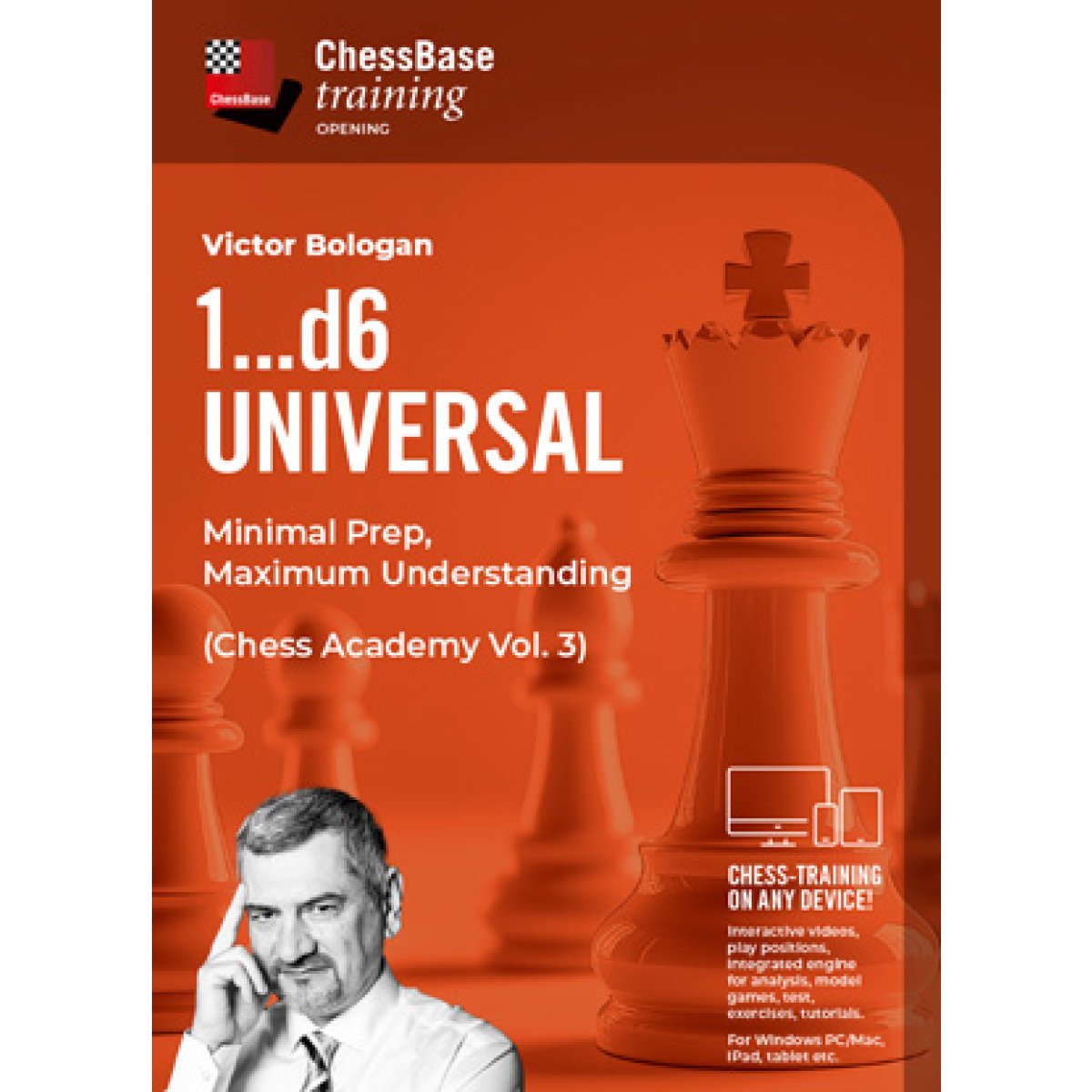
1...d6 universal - Minimal Preparation, Maximum Understanding

€39.90
Tax included

Discover an innovative approach to your openings with this course based on the Chebanenko philosophy: forget memorization and learn to understand. With a solid repertoire for Black focused on the d6–e5 structure, you will master flexible and effective systems against 1.e4 and 1.d4. Ideal for rapid and classical games, it offers practical preparation, interactive exercises, and in-depth analysis to play with confidence and creativity.

FORMAT: DOWNLOAD
This product is not supplied in physical format. You will receive an email from our store with the download link and product activation code.

Quantity
In Stock

  Security policy

(edit with the Customer Reassurance module)

  Delivery policy

(edit with the Customer Reassurance module)

  Return policy

(edit with the Customer Reassurance module)

In modern chess, especially online where rapid games dominate, studying long opening lines can be overwhelming and often unnecessary. The real challenge is to find the right balance in your opening preparation: how deep should you study? Where should you stop? This course is based on the wisdom of my legendary coach Chebanenko, who designed repertoires for his "lazy" students—not due to their attitude, but because of their smart method. His philosophy is clear: don’t memorize, understand.

Free sample video: Introduction

Free sample video: 1.d4 d6 2.Nf3 Nf6 3.c4 g6 4.Nc3 Bf5 5.Nh4 Bd7

The concept is simple yet effective: choose systems for White and Black centered around typical pawn structures and recurring piece configurations. This way, you don’t learn dozens of different openings but a flexible idea applicable to many positions.

In this first course dedicated to Black, the repertoire is built around the solid and compact d6–e5 structure:
• Against 1.e4: we use the Philidor setup, which offers deep positional play and quick development.
• Against 1.d4 and closed systems: we aim for flexible development with the dark-squared bishop on e7 or g7, maintaining central control with ...e5.

This scheme is effective, easy to learn, resilient, and surprisingly complex for those unfamiliar with its nuances. I have used it my whole life in blitz, rapid, and classical tournaments, and it has always given me good results.

In fact, my recent success in a Fischer Random tournament was largely due to my understanding of structures and strategic flexibility, not memorizing variations.

With this course (and the upcoming repertoire for White) you will not only have a practical and easy-to-maintain solution but also develop a deep understanding of chess that will allow you to:
• Respond confidently in new positions
• Make better decisions based on ideas, not memorized moves
• Save time without losing competitiveness
Learn smartly. Play smartly. Let’s build your "lazy" repertoire—with lasting understanding, not fleeting memory.

More...Less...
This includes:
  • FritzTrainer for 4 platforms: applications for Windows, Mac, ChessBase books, and ChessBase VideoStream
  • Delivery via download or postal mail (card with serial number)
  • Video course with an approximate duration of 4 to 8 hours
  • Repertoire database: save and integrate FritzTrainer games into your repertoire (in WebApp Opening or ChessBase)
  • Interactive exercises with video feedback: authors present exercises and key positions; users must input the solution, receiving video comments and additional explanations
  • All videos, tasks, tests, and texts included in the ChessBase books
  • Example games as a ChessBase database
FritzTrainer application features:
  • Video playback in the FritzTrainer app or ChessBase with board, notation, and control bar
  • Ability to activate the analysis engine at any time
  • Video pause for manual navigation and notation analysis
  • Input of personal variations and engine analysis, saved within the game
  • Variant learning: view specific lines in ChessBase WebApp Opening with automatic playback; memorize and practice transformations (start position – end position)
  • Active opening training: selected positions sent to ChessBase WebApp Fritz-online to play against Fritz and test your knowledge
More options: launch FritzTrainer in ChessBase:
  • Direct opening of the database with all games and analysis
  • Easy incorporation of games into your opening repertoire
  • Direct evaluation with references to games, playback of analysis on the board
  • Saving and adding personal variations to the repertoire
  • Playback training
  • Active LiveBook
  • Use of all engines installed in ChessBase for analysis
  • Assisted analysis
  • Printing notation and diagrams for study materials
New ChessBase product installer:
  • The CB brochure contains all necessary information to install the product on your computer
  • Does not include a DVD but holds a valuable place in your collection
  • Includes detailed instructions and serial number to activate the product
  • No DVD drive required for installation
  • Eco-friendly brochure, without plastic

Sample Video

Contents

  • Introduction
  • King’s Indian type setups with 1.d4 and 2.c4
  • 1.d4 d6 2.c4 e5
  • 1.d4 d6 2.c4 e5 3.Nf3 e4 4.Ng5 f5 5.Nc3 c6
  • Secondary variations in 1.d4 d6 2.c4 e5 3.Nf3 e4 4.Ng5 f5
  • 1.d4 d6 2.c4 e5 3.Nf3 e4 4.Ng1/Nfd2
  • 1.d4 d6 2.c4 e5 3.Nc3 exd4
  • 1.d4 d6 2.c4 e5 3.d5
  • 1.d4 d6 2.c4 e5 3.e3 Nd7 4.Nc3 g6
  • 1.d4 d6 2.c4 e5 3.dxe5 dxe5 4.Qxd8 Kxd8
  • 1.d4 d6 2.Nf3 Nf6
  • 1.d4 d6 2.Nf3 Nf6 3.c4 g6 4.Nc3 Bf5 5.Nh4 Bd7
  • 1.d4 d6 2.Nf3 Nf6 3.c4 g6 4.Nc3 Bf5 5.e3 Bg7
  • 1.d4 d6 2.Nf3 Nf6 3.c4 g6 4.Nc3 Bf5 5.g3 Ne4
  • 1.d4 d6 2.Nf3 Nf6 3.c4 g6 4.Nc3 Bf5 5.Qb3 b6
  • 1.d4 d6 2.Nf3 Nf6 3.c4 g6 4.Nc3 Bf5 5.h3 Ne4
  • Secondary variations in 1.d4 d6 2.Nf3 Nf6 3.c4 g6 4.Nc3 Bf5 5
  • Philidor type setups with 1.e4 and 2.d4
  • 1.e4 d6 2.d4 Nf6 3.Nc3 e5 4.Nf3 Nbd7 5.Bc4 Be7 6.O-O O-O 7.a4 c6 8.h3 h6 9.Re1 Re8 secondary variations on move 10
  • 1.e4 d6 2.d4 Nf6 3.Nc3 e5 4.Nf3 Nbd7 5.Bc4 Be7 6.O-O O-O 7.a4 c6 8.h3 h6 9.Re1 Re8 10.Ba2 exd4
  • 1.e4 d6 2.d4 Nf6 3.Nc3 e5 4.Nf3 Nbd7 5.Bc4 Be7 6.O-O O-O 7.a4 c6 8.h3 h6 9.Re1 Re8 10.Be3 exd4
  • 1.e4 d6 2.d4 Nf6 3.Nc3 e5 4.Nf3 Nbd7 5.Bc4 Be7 6.O-O O-O 7.a4 c6 8.h3 h6 9.Re1 Re8 10.a5 Bf8
  • Secondary variations in 1.e4 d6 2.d4 Nf6 3.Nc3 e5 4.Nf3 Nbd7 5.Bc4 Be7 6.O-O O-O 7.a4 c6
  • Secondary variations on moves 7 and 8
  • 1.e4 d6 2.d4 Nf6 3.Nc3 e5 6.a4
  • 1.e4 d6 2.d4 Nf6 3.Nc3 e5 concrete lines with dxe5, Bxf7, Ng5
  • 1.e4 d6 2.d4 Nf6 3.Nc3 e5 4.Nf3 Nbd7 5.h3/g4
  • 1.e4 d6 2.d4 Nf6 3.Nc3 e5 4.Nf3 Nbd7 5.Rg1 c6 6.g4 h6 7.Be3 Be7
  • 1.e4 d6 2.d4 Nf6 3.Nc3 e5 4.Nf3 Nbd7 5.Rg1 c6 6.g4 h6 7.h4 exd4
  • Secondary variations
  • Early endgames after 1.e4 and 2.d4
  • Additional variations and practice
  • Repertoire training
  • Large databases and extras
1U-MPMU-SWQG