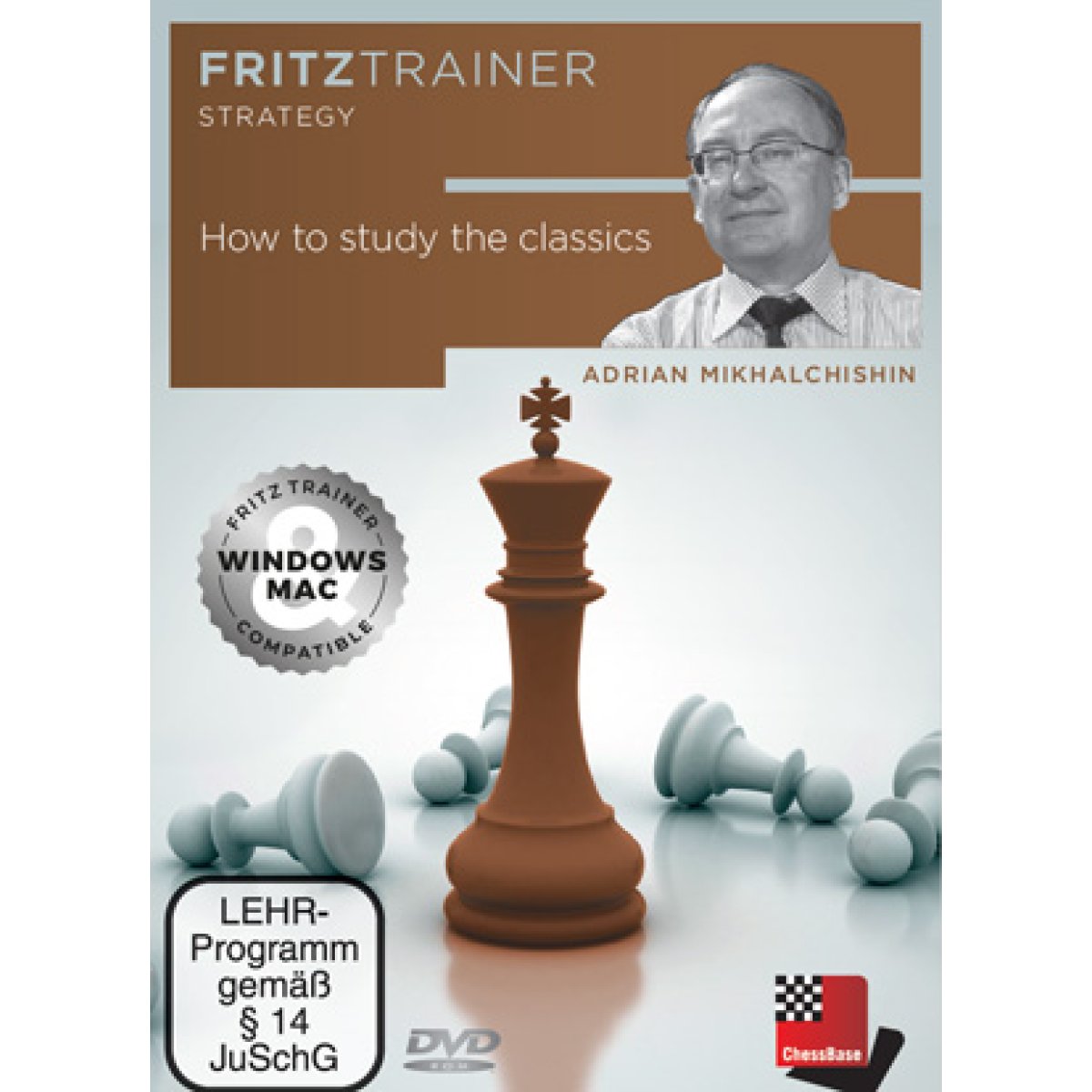

How to study the classics
search
  • How to study the classics

How to study the classics

€29.90
Tax included
Discover how to study classic games to improve your play with this interactive course of over 5 hours. Based on examples from grandmasters, you will learn typical plans, middlegame and endgame techniques, as well as tactical and strategic methods. It includes exercises with video feedback, a game database, and active training to master openings and key positions. Ideal for players who want to deepen their understanding and effectively apply classical ideas.

FORMAT: DOWNLOAD
This product is not supplied in physical format. You will receive an email from our store with the download link and product activation code.

Quantity
In Stock

  Security policy

(edit with the Customer Reassurance module)

  Delivery policy

(edit with the Customer Reassurance module)

  Return policy

(edit with the Customer Reassurance module)

The teaching of chess is based on studying games played by great players of the past. Many typical attacking techniques, analogous plans, and correct ways to play different endgames first appeared in their games. Numerous books on endgames and endgame techniques have been written based on these games. Even in openings, the great Alexander Alekhine stated that theory is simply the practice of the masters.

Every developing player must study these examples, as they will face similar positions and problems in their practice. The more they know about these positions, the better they can apply the necessary ideas appropriately. Of course, there are many basic positions in endgames and precise variations in openings that must be memorized. However, most of the game in endgames and middlegames consists of knowing typical plans and recurring tactical motifs that can be used for various purposes, whether to attack the opponent’s king or to carry out plans more quickly and effectively. Every young player should study them, and this is only possible by reviewing the games of grandmasters.

Vladimir Kramnik commented that when he decided to compete for the World Championship, he devoted an entire year to analyzing all the world championship games. In general, we should study the classics in two ways:

  1. As explained in books on endgames and middlegames, studying important themes based on selected games from grandmasters.
  2. Each great player had their own specialty—for example, Rubinstein was a master of the "exchange technique," Botvinnik excelled in "centralization," and Alekhine was the best at developing initiative in the opening. For each, there are highly instructive examples where they applied their favorite methods.

There is a problem: in the chess world, there are few good books on middlegame, so young players have difficulty studying the classics. Although there are many tactical methods and abundant literature about them, we will show some examples that demonstrate how the best players have developed these tactical methods and typical plans in classical structures over the years.

• Video duration: Over 5 hours (in English)
• Interactive training with video feedback
• Bonus: database with more classical games

More... Less...
This includes:
  • Fritztrainer application for Windows and Mac
  • Available for download or on DVD
  • Video course with an approximate duration between 4 and 8 hours
  • Repertoire database: save and integrate Fritztrainer games into your own repertoire (in WebApp Opening or ChessBase)
  • Interactive exercises with video feedback: the authors present exercises and key positions, the user must enter the solution, receiving comments and additional explanations
  • Example games in ChessBase database
  • New: many Fritztrainers now also available for streaming on the ChessBase video portal
Features of the FritzTrainer application:
  • Videos can be played in the Fritztrainer application or in the ChessBase program with board graphics, notation, and function bar
  • The analysis engine can be activated at any time
  • Pause video for manual navigation and analysis in the game notation
  • Input of own variations, engine analysis, and storing them in the game
  • Learning variations: visualization of specific lines in ChessBase WebApp Opening with automatic playback, memorization, and transformation practice (starting position – final position)
  • Active opening training: selected positions are transferred to ChessBase WebApp Fritz-online to play against Fritz and test your knowledge
More options: launch FritzTrainer in the ChessBase program
  • Open the database directly with all games and analyses
  • Easily add games to the opening reference
  • Direct evaluation with reference to the game, playback on the analysis board
  • Save own variations and add them to the personal repertoire
  • Repetition training
  • Active LiveBook
  • Use of all engines installed in ChessBase for analysis
  • Assisted analysis
  • Printing of notation and diagrams (for study materials)

Sample video

Content

  • Introduction
  • How to use the classics in your games
  • Game 1: Mikhalshichin - Bronstein, 1980
  • Game 2: Olafsson - Fischer, 1958
  • Game 3: Mikhalchishin - Beliavsky, 1981
  • Games 4 and 5: Vidmar - Tarrasch, 1906 and Mikhalchishin - Lalic, 1985
  • Strategic handling of maneuvers
  • Flank attack
  • Dynamic counterattack in classical openings
  • Sacrifice on e6 in the Sicilian
  • Sacrifice on b5 in the Sicilian
  • Rook transfer
  • Strategic handling of typical pawn structures
  • Attack in the King's Indian
  • Preventive strategy in development
  • The knight on e5
  • Central strategy with pawn on d5 Part 1
  • Central strategy with pawn on d5 Part 2
  • Center opening in Maroczy structures Part 1
  • Center opening in Maroczy structures Part 2
  • Miscellaneous
  • Endgames with bishop pair
  • Central structure change Part 1
  • Central structure change Part 2
  • Central structure change Part 3
  • Central structure change Part 4
  • Central structure change Part 5
  • Exploitation of weak squares Part 1
  • Exploitation of weak squares Part 2
  • Modern attack in the French Defense Part 1
  • Modern attack in the French Defense Part 2
  • Exercises 1-10
  • Exercise 01
  • Exercise 02
  • Exercise 03
  • Exercise 04
  • Exercise 05
  • Exercise 06
  • Exercise 07
  • Exercise 08
  • Exercise 09
  • Exercise 10
  • Exercises 11-20
  • Exercise 11
  • Exercise 12
  • Exercise 13
  • Exercise 14
  • Exercise 15
  • Exercise 16
  • Exercise 17
  • Exercise 18
  • Exercise 19
  • Exercise 20
  • Exercises 21-31
  • Exercise 21
  • Exercise 22
  • Exercise 23
  • Exercise 24
  • Exercise 25
  • Exercise 26
  • Exercise 27
  • Exercise 28
  • Exercise 29
  • Exercise 30
  • Exercise 31
  • Bonus
  • Analysis
  • More classics
  • Exercises
More...
Less...
HTSTC-ORRK