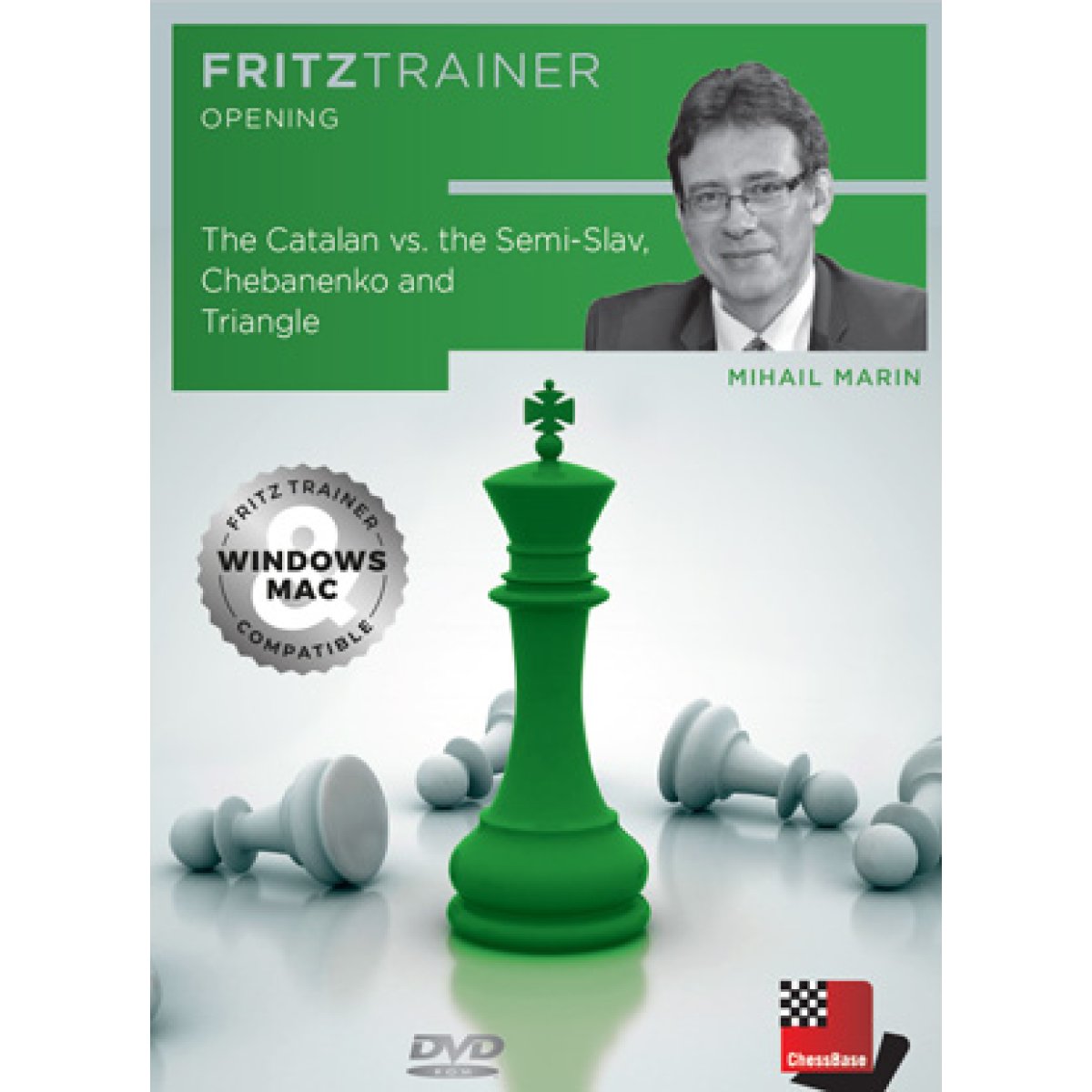


The Catalan vs. the Semi-Slav, Chebanenko and Triangle
search
  • The Catalan vs. the Semi-Slav, Chebanenko and Triangle

The Catalan vs. the Semi-Slav, Chebanenko and Triangle

€29.90
Tax included
Discover a dynamic repertoire to face the Catalan with the Semi-Slav Defense, Chebanenko system, and Slav triangle. This 6-hour video course offers solid and flexible strategies for Black, including interactive exercises with feedback and a database of model games. Ideal for active players seeking to maintain the initiative and expand their opening resources. Compatible with the Fritztrainer app and ChessBase.

FORMAT: DOWNLOAD
This product is not provided in physical format. You will receive an email from our store with the download link and product activation code.

Quantity
In Stock

  Security policy

(edit with the Customer Reassurance module)

  Delivery policy

(edit with the Customer Reassurance module)

  Return policy

(edit with the Customer Reassurance module)

The Semi-Slav Defense, the Chebanenko system, and the Slav Triangle are solid and versatile weapons for Black. The repertoire presented in this DVD addresses these variations in a direct and challenging way.

To avoid falling into the typical passive position of the Catalan, Black must step out of their comfort zone and accept the pawn sacrifice on c4. White's compensation usually manifests as faster development and a spatial advantage in the center, leading to a style of play with neo-romantic undertones. In some analyses, it is difficult to demonstrate an objective advantage for White, although Black’s path to a safe position is not easy either. In over-the-board games, White has excellent chances to maintain the initiative for a long time. A compact and promising repertoire for active players.

• Video duration: 6 hours (in English)
• Interactive training with video feedback
• Bonus: training with ChessBase applications to memorize the repertoire and play key positions against Fritz at different levels
• Database with model games

More... Less...
Included content:
  • Fritztrainer application for Windows and Mac
  • Available for download or on DVD
  • Video course with an approximate duration of 4 to 8 hours
  • Repertoire database: save and integrate Fritztrainer games into your own repertoire (in WebApp Opening or ChessBase)
  • Interactive exercises with video feedback: the authors present exercises and key positions for the user to input the solution, with additional explanations and error correction
  • Example games in ChessBase database
  • New: many Fritztrainers also available via streaming on the ChessBase video portal
Features of the FritzTrainer application:
  • Videos play in the Fritztrainer application or in ChessBase with board, notation, and function bar
  • The analysis engine can be activated at any time
  • You can pause the video to navigate and manually analyze the game notation
  • Input your own variations, engine analysis, and save within the game
  • Variant learning: view specific lines in ChessBase WebApp Opening with autoplay, memorize and practice transformations (initial to final position)
  • Active opening training: selected positions transfer to ChessBase WebApp Fritz-online to play games against Fritz and test your new knowledge
More options: start FritzTrainer in ChessBase:
  • Database with all games and analysis directly accessible
  • Easy incorporation of games into your opening reference
  • Direct evaluation with reference to games; playback on analysis board
  • Save your own variations to add to your personal repertoire
  • Playback training
  • Active LiveBook
  • Ability to use all engines installed in ChessBase for analysis
  • Assisted analysis
  • Printing notation and diagrams for study material

Sample video

Contents

  • Introduction
  • Semi-Slav 5...dxc4 6.Bg2 b5
  • 1.d4 d5 2.c4 c6 3.Nf3 Nf6 4.Nc3 e6 5.g3 dxc4 6.Bg2 b5
  • 7.Ne5 - Introduction
  • 7.Ne5 Nd5 8.e4 Secondary variations
  • 7.Ne5 Nd5 8.e4 Nxc3 9.bxc3 Bb7/Bd6/Qc7/a6
  • 7.Ne5 Nd5 8.e4 Nxc3 9.bxc3 Be7
  • 7.Ne5 a6 8.0-0 Bb7 9.b3 cxb3
  • 7.Ne5 a6 8.0-0 Bb7 9.b3 b4
  • 7.Ne5 Qb6 8.0-0 Bb7 9.b3 cxb3/Bb4
  • 7.Ne5 Qb6 8.0-0 Bb7 9.b3 cxb3 10.axb3 Nbd7
  • Semi-Slav 5...dxc4 6.Bg2 Nbd7 7.0-0 b5
  • 1.d4 d5 2.c4 c6 3.Nf3 Nf6 4.Nc3 e6 5.g3 dxc4 6.Bg2 Nbd7 7.0-0 b5
  • Introduction
  • 8.e4 b4
  • 8.e4 Be7
  • 8.e4 Bb7 9.e5 Nd5 10.Ng5 N7b6
  • 8.e4 Bb7 9.e5 Nd5 10.Ng5 Nxc3
  • 8.e4 Bb7 9.e5 Nd5 10.Ng5 Be7 11.Qh5 Bxg5
  • 8.e4 Bb7 9.e5 Nd5 10.Ng5 Be7 11.Qh5 g6
  • 8.e4 Bb7 9.e5 Nd5 10.Ng5 Be7 11.Qh5 g6 12.Qh6 Bf8 13.Qh3 Be7
  • 8.e4 Bb7 9.e5 Nd5 10.Ng5 Be7 11.Qh5 g6 12.Qh6 Bf8 13.Qh3 Be7 14.Nce4 h6 15.b3
  • 8.e4 Bb7 9.e5 Nd5 10.Ng5 h6 11.Nxe6 fxe6 12.Qh5+ Ke7
  • 8.e4 Bb7 9.e5 Nd5 10.Ng5 h6 11.Nxe6 fxe6 12.Qh5+ g6
  • Semi-Slav 5...dxc4 6.Bg2 Nbd7 7.0-0 Be7 8.e4 0-0 9.Bf4
  • 1.d4 d5 2.c4 c6 3.Nf3 Nf6 4.Nc3 e6 5.g3 dxc4 6.Bg2 Nbd7 7.0-0 Be7 8.e4 0-0 9.Bf4
  • Secondary variations
  • 9...b5 10.d5 cxd5
  • 9...b5 10.d5 Qb6
  • 9...Nh5
  • 9...Re8 10.a4 Secondary variations
  • 9...Re8 10.a4 b6 11.Qe2 a5
  • 9...Re8 10.a4 b6 11.Qe2 Ba6
  • 6...Bb4
  • Closed Semi-Slav
  • 1.d4 d5 2.c4 c6 3.Nf3 Nf6 4.Nc3 e6 5.g3
  • 5...Be7
  • 5...Bd6
  • Chebanenko system 4...a6 5.g3
  • 1.d4 d5 2.c4 c6 3.Nf3 Nf6 4.Nc3 a6 5.g3
  • 5...dxc4 6.Bg2 g6/b5
  • 5...Bf5/Bg4/g6
  • 5...b5
  • Triangle and Classical Slav
  • 1.d4 d5 2.c4 c6 3.Nf3
  • 3...e6 4.g3 dxc4 5.Bg2 b5 6.Ne5 Bb7 7.0-0 f6
  • 3...e6 4.g3 dxc4 5.Bg2 b5 6.Ne5 Bb7 7.0-0 Nd7
  • 3...e6 4.g3 dxc4 5.Bg2 b5 6.Ne5 Bb7 7.0-0 Ne7
  • 3...Nf6 4.Nc3 dxc4 5.g3
  • Exercises 01-10
  • Exercise 01
  • Exercise 02
  • Exercise 03
  • Exercise 04
  • Exercise 05
  • Exercise 06
  • Exercise 07
  • Exercise 08
  • Exercise 09
  • Exercise 10
  • Exercises 11-21
  • Description
  • Exercise 11
  • Exercise 12
  • Exercise 13
  • Exercise 14
  • Exercise 15
  • Exercise 16
  • Exercise 17
  • Exercise 18
  • Exercise 19
  • Exercise 20
  • Exercise 21
More...
Less...

Slav Defense

In the Slav Defense, Black protects the d5 pawn with 2...c6. Unlike 2...e6, this move does not block the light-squared bishop (Bc8) and allows recapturing on d5 with a pawn after 3.cxd5, thus maintaining strong central control. The Slav Defense is recognized as a safe and solid response to the Queen's Gambit, popular both in elite tournaments and amateur competitions.

TCVTSCAT-RGDT