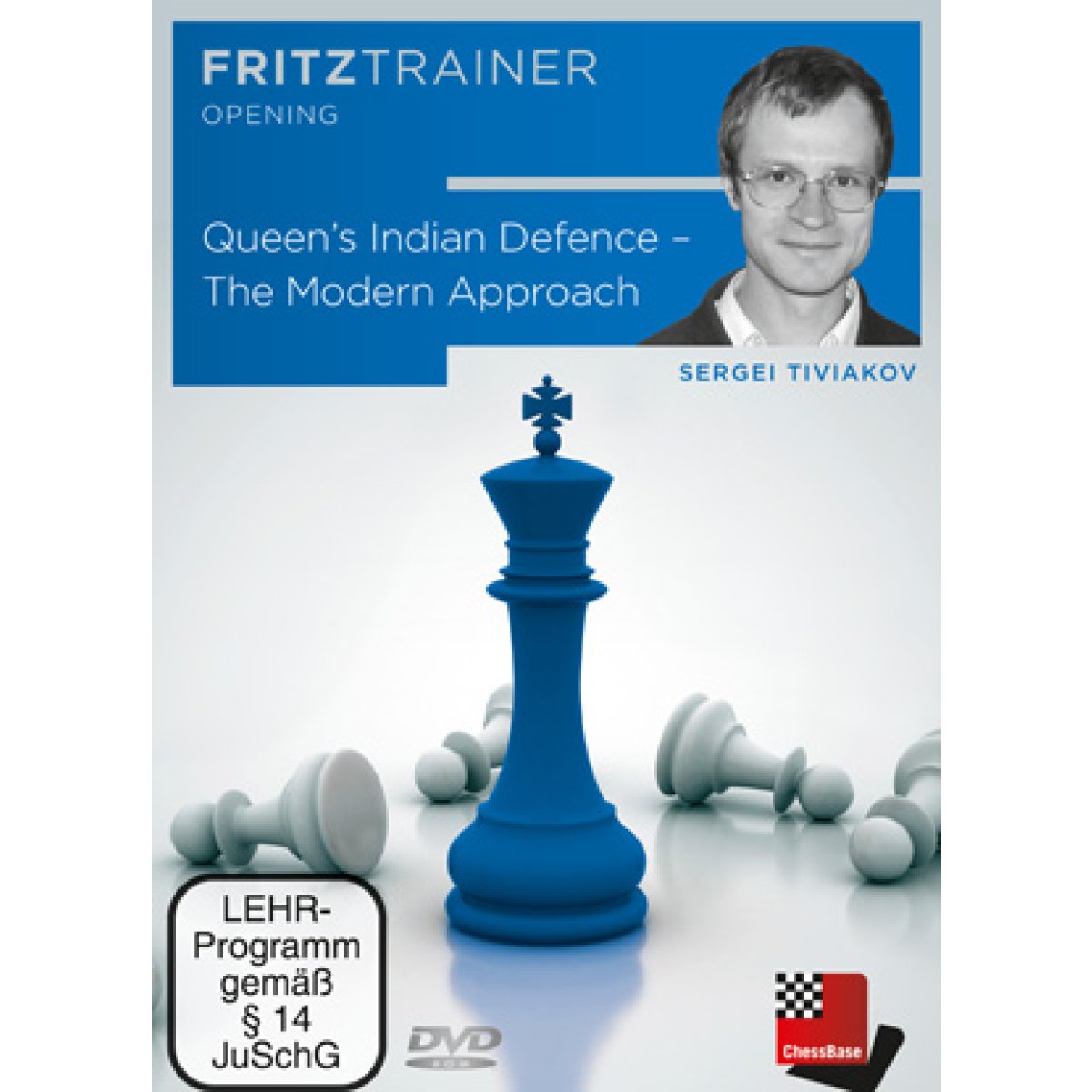


Queen's Indian Defence - The Modern Approach
search
  • Queen's Indian Defence - The Modern Approach

Queen's Indian Defence - The Modern Approach

€29.90
Tax included
Discover the complete repertoire for Black with the Queen's Indian Defense in this course of over 9 hours, taught by Grandmaster Sergei Tiviakov. Based on his experience and own games, the DVD offers deep analysis and interactive training with exercises and video feedback. It includes a database with model games and access to the Fritztrainer App for a dynamic and comprehensive learning experience.

FORMAT: DOWNLOAD
This product is not provided in physical format. You will receive an email from our store with the download link and product activation code.

Quantity
In Stock

  Security policy

(edit with the Customer Reassurance module)

  Delivery policy

(edit with the Customer Reassurance module)

  Return policy

(edit with the Customer Reassurance module)

It has been eight years since the release of the DVD "No Fear of 1.d4 (Volume 1)", where Sergei Tiviakov explained, among other topics, how to play the Queen's Indian Defense with the black pieces. Now it is time to update enthusiasts with the latest novelties and trends in this highly relevant defense. In his new DVD, Sergei Tiviakov presents a complete repertoire for Black in the Queen's Indian Defense. The grandmaster details everything needed after 1.d4 Nf6 2.c4 e6 3.Nf3 b6, with unprecedented depth and thoroughness: of the more than 9 total hours, 6 hours are dedicated exclusively to White’s most popular continuation, 4.g3. The content is mainly based on the author's own games and his accumulated experience with this defense. Additionally, the DVD includes an exclusive collection of all Sergei Tiviakov’s games with the Queen's Indian Defense (half of them previously unpublished) and a commented selection of notable games. Join the path of the Queen's Indian Defense with this excellent work by Sergei Tiviakov!

• Total video duration: 10 hours (in English)
• Interactive training with video feedback
• Additional content: database with model games
• Includes ChessBase Reader

More... Less...
Included content:
  • Fritztrainer application for Windows
  • Available for download or on DVD
  • Video course with approximate duration of 4 to 8 hours
  • Repertoire database: save and integrate Fritztrainer games into your own repertoire (in WebApp Opening or ChessBase)
  • Interactive exercises with video feedback: the authors present exercises and key positions, the user must enter the solution. Video feedback (including mistakes) and additional explanations are provided.
  • Example games in ChessBase database
FritzTrainer application features:
  • Videos play in the Fritztrainer application or ChessBase program with board graphics, notation, and an extensive control bar
  • The analysis engine can be activated at any time
  • Video pauses for manual navigation and analysis in the game notation
  • Input of personal variations, engine analysis, and saving within the game
  • Learning variations: view specific lines in ChessBase WebApp Opening with autoplay, memorize variations, and practice transformations (starting position - final position)
  • Active opening training: selected positions are transferred to ChessBase WebApp Fritz-online so you can test your knowledge by playing against Fritz and practicing the opening
More options: launch FritzTrainer from ChessBase
  • The database with all games and analyses can be opened directly
  • Games can be easily added to the opening reference
  • Direct evaluation linked to the game, which can be replayed on the analysis board
  • Personal variations are saved and can be added to the personal repertoire
  • Reproduction training
  • Active LiveBook
  • All engines installed in ChessBase can be used for analysis
  • Assisted analysis
  • Printing of notation and diagrams (for study material)

Sample video

Content

  • 01: Introduction [03:27]
  • Secondary variations for Black
  • 01: 4...c6/Be7/Na6 - Analysis [15:05]
  • 02: 4...Bb4 5.Nbd2 Bb7 - Analysis [29:36]
  • 03: 4...Bb4 5.Bd2 Be7 6.Bg2 c6 - Analysis [11:45]
  • 04: 4...Bb4 5.Bd2 Be7 6.Nc3 c6 - Analysis [08:27]
  • 05: 4...Bb4 5.Bd2 Be7 6.Nc3 Bb7 - Analysis [33:33]
  • Main line 4...Bb7
  • 01: 4...Bb7 5.Bg2 c6/Na6 and Be7 6.d5/Qc2 - Analysis [12:42]
  • 02: 4...Bb7 5.Bg2 Be7 6.Nc3 0-0 - Analysis [17:22]
  • 03: 4...Bb7 5.Bg2 Be7 6.0-0 c6 Secondary variations and 7.Nc3 d5 Secondary variations - Analysis [25:32]
  • 04: 4...Bb7 5.Bg2 Be7 6.0-0 c6 7.Nc3 d5 Main lines - Analysis [26:42]
  • 05: 4...Bb7 5.Bg2 Be7 6.0-0 0-0 Secondary variations - Analysis [15:24]
  • 06: 4...Bb7 5.Bg2 Be7 6.0-0 0-0 7.Re1 Na6 - Analysis [30:00]
  • 07: 4...Bb7 5.Bg2 Be7 6.0-0 0-0 7.d5 exd5/Na6 - Analysis [43:37]
  • 08: 4...Bb7 5.Bg2 Be7 6.0-0 0-0 7.Nc3 Na6 8.a3 Ne4 - Analysis [20:46]
  • 09: 4...Bb7 5.Bg2 Be7 6.0-0 0-0 7.Nc3 Na6 8.b3 Ne4/d5 - Analysis [13:14]
  • 10: 4...Bb7 5.Bg2 Be7 6.0-0 0-0 7.Nc3 Na6 8.Qc2 d5 and 8.Qa4 Qc8 - Analysis [06:39]
  • 11: 4...Bb7 5.Bg2 Be7 6.0-0 0-0 7.Nc3 Na6 8.Bd2 c5 and 8.Bf4/Bg5 Ne4 - Analysis [25:50]
  • 12: 4...Bb7 5.Bg2 Be7 6.0-0 0-0 7.Nc3 Na6 8.d5 Bb4 - Analysis [15:31]
  • 13: 4...Bb7 5.Bg2 Be7 6.0-0 0-0 7.Nc3 Na6 8.Ne5 Bxg2 - Analysis [11:34]
  • Secondary variations for White
  • 01: 4.Nc3 Bb7 5.a3 g6 6.Qd3 d5/Bg7 - Analysis [13:32]
  • 02: 4.Nc3 Bb7 5.a3 g6 6.e3/g3 Bg7 - Analysis [20:44]
  • 03: 4.Nc3 Bb7 5.a3 g6 6.d5 Bg7 - Analysis [09:45]
  • 04: 4.Nc3 Bb7 5.a3 g6 6.Bf4/Bg5 Bg7 - Analysis [14:04]
  • 05: 4.Nc3 Bb7 5.a3 g6 6.Qc2 Bxf3/d5 - Analysis [11:51]
  • 06: 4.Nc3 Bb7 Secondary variations - Analysis [17:07]
  • 07: 4.e3 Bb7 5.Bd3 d5 and 5.Nc3 Bb4 - Analysis [50:24]
  • 08: 4.Bf4 Bb7 5.e3 Bb4+ - Analysis [11:06]
  • 09: 4.Bg5 Bb7 5.e3 h6 6.Bh4 Be7 - Analysis [04:44]
  • 10: 4.Nbd2 Bb7 - Analysis [01:14]
  • 11: Conclusion [01:27]
  • Test
  • 01: Test 1 [07:40]
  • 02: Test 2 [05:59]
  • 03: Test 3 [04:32]
  • 04: Test 4 [03:58]
  • 05: Test 5 [05:25]
  • 06: Test 6 [04:23]
  • 07: Test 7 [04:35]
  • 08: Test 8 [03:02]
  • 09: Test 9 [03:31]
  • 10: Test 10 [01:47]
  • 11: Test 11 [03:10]
  • 12: Test 12 [02:40]
  • 13: Test 13 [03:37]
  • 14: Test 14 [02:31]
  • 15: Test 15 [02:53]
  • 16: Test 16 [02:35]
  • 17: Test 17 [01:37]
  • 18: Test 18 [02:14]
  • 19: Test 19 [02:02]
  • 20: Test 20 [01:54]
More...
Less...

Queen's Indian Defense

White usually avoids the pin on their queen's knight by developing the king's knight first after 2...e6 with 3.Nf3. Next, 3...b6 leads to the starting position of the Queen's Indian Defense, so called because of the fianchetto of the bishop on the queenside. The Bb7 and Nf6 aim to control the central squares d5 and e4, while the deployment of the c- and d-pawns in the center remains flexible.

QID-TMA-GZYF