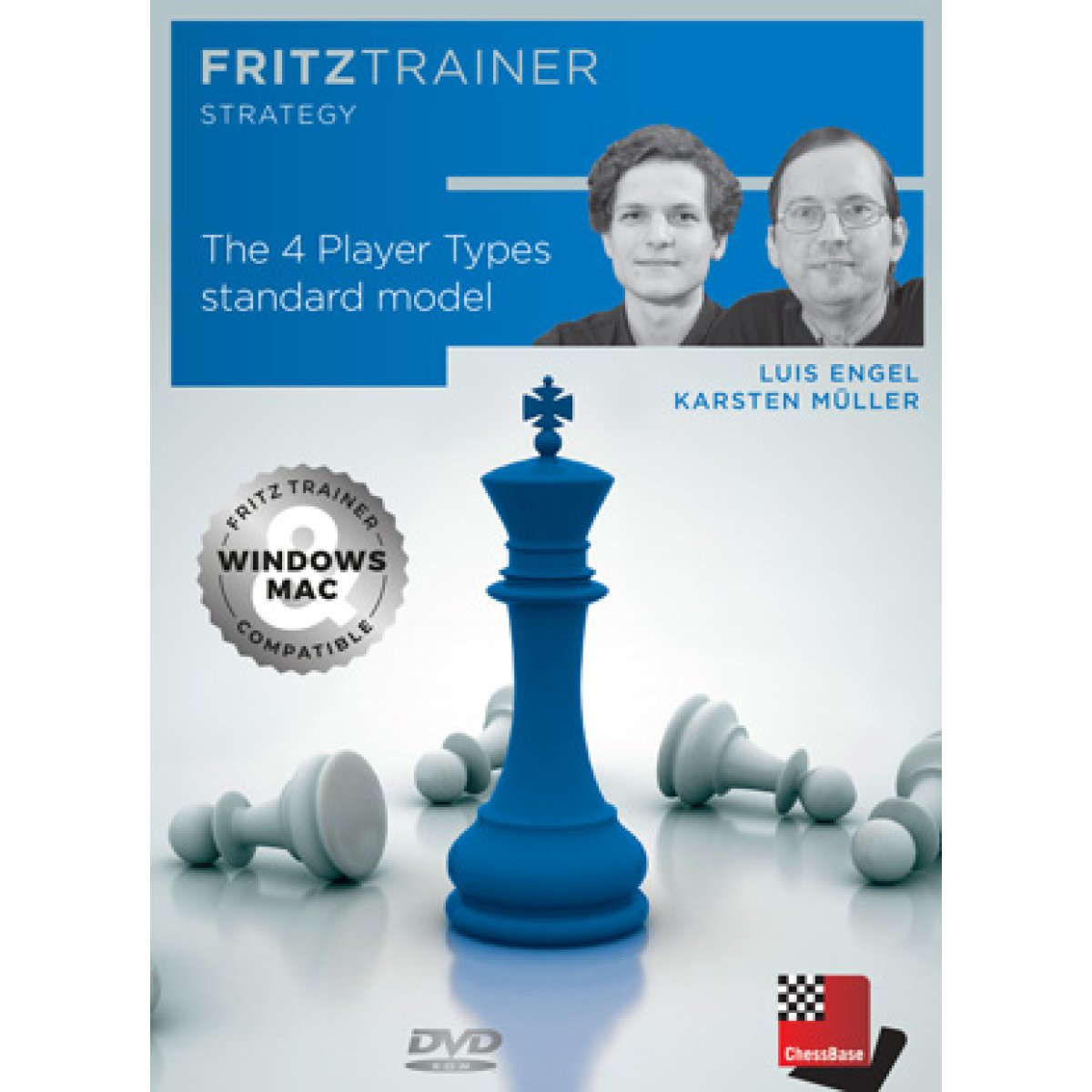
The 4 Player Types Standard Model - Discover Your Strengths and Weaknesses and Those of Your Opponen
€29.90
Tax included
Discover the four types of chess players — activists, pragmatists, theorists, and reflectors — with Grandmasters Karsten Müller and Luis Engel. Based on Lars Bo Hansen's model, this interactive course of nearly 7 hours helps you identify your own and your opponents' strengths and weaknesses, improving your preparation and playing style with practical examples and exercises featuring video feedback.
FORMAT: DOWNLOAD This product is not provided in physical format. You will receive an email from our store with the download link and product activation code.
Playing styles in chess are a topic of great importance and frequent debate. Grandmasters Dr. Karsten Müller and Luis Engel adopt a model proposed by GM Lars Bo Hansen based on four types of players: ‘activists’, ‘pragmatics’, ‘theorists’, and ‘reflectors’. Their strengths and weaknesses are explained through numerous examples, allowing the reader to identify with one of these profiles.
“When preparing for a forthcoming opponent... certain character traits always influence me, which I try to associate with that player. ... Here it is useful and time-saving to deduce the type of player and their strong and weak points by observing the openings they use, or to anticipate the likelihood of them choosing certain variations according to their known characteristics. These and other reflections are systematically collected and presented in this work. The classification into four prototypical natures is extremely useful for solving issues related not only to game preparation but also for defining one’s own characteristics as a chess player. Furthermore, this work offers amateurs and enthusiasts a valuable guide to forming an opinion about different players.” (Excerpts from the foreword by GM Vincent Keymer)
• Video duration: 6 hours 50 minutes (in English) • Includes interactive training with video feedback
More...Less...
Included content:
Fritztrainer application for Windows and Mac
Available for download or on DVD
Video course with an approximate duration of 4 to 8 hours
Repertoire database: save and integrate Fritztrainer games into your own repertoire (in WebApp Opening or ChessBase)
Interactive exercises with video feedback: the authors present exercises and key positions for the user to input solutions, with detailed explanations and corrections
Model games in ChessBase database
New: many Fritztrainers also available for streaming on the ChessBase video portal
FritzTrainer application features:
Video playback in the Fritztrainer app or ChessBase program with board, notation, and function bar
Analysis engine available at all times
Video pause for navigation and manual analysis in notation
Input of own variations, engine analysis, and saving within the game
Variation learning: automatic playback of specific lines in ChessBase WebApp Opening, memorization and practice of transformations (starting position – ending position)
Active opening training: selected positions transferred to ChessBase WebApp Fritz-online to play against Fritz and test acquired knowledge
More functions: launch FritzTrainer in the ChessBase program
Direct opening of the database with all games and analyses
Easy incorporation of games into the opening repertoire
Direct evaluation with reference to games, playback on analysis board
Saving own variations and adding them to personal repertoire
Reproduction training
Active LiveBook
Use of all engines installed in ChessBase for analysis
Assisted analysis
Printing of notation and diagrams for study material
Sample video
Content
Introduction
Activists – Strengths
Characteristics of activists
Hyperactivists
Activists’ strengths – Sacrifices for direct king attack
Discover the four types of chess players — activists, pragmatists, theorists, and reflectors — with Grandmasters Karsten Müller and Luis Engel. Based on Lars Bo Hansen's model, this interactive course of nearly 7 hours helps you identify your own and your opponents' strengths and weaknesses, improving your preparation and playing style with practical examples and exercises featuring video feedback.
FORMAT: DOWNLOAD This product is not provided in physical format. You will receive an email from our store with the download link and product activation code.

 Security policy
 Delivery policy
 Return policy