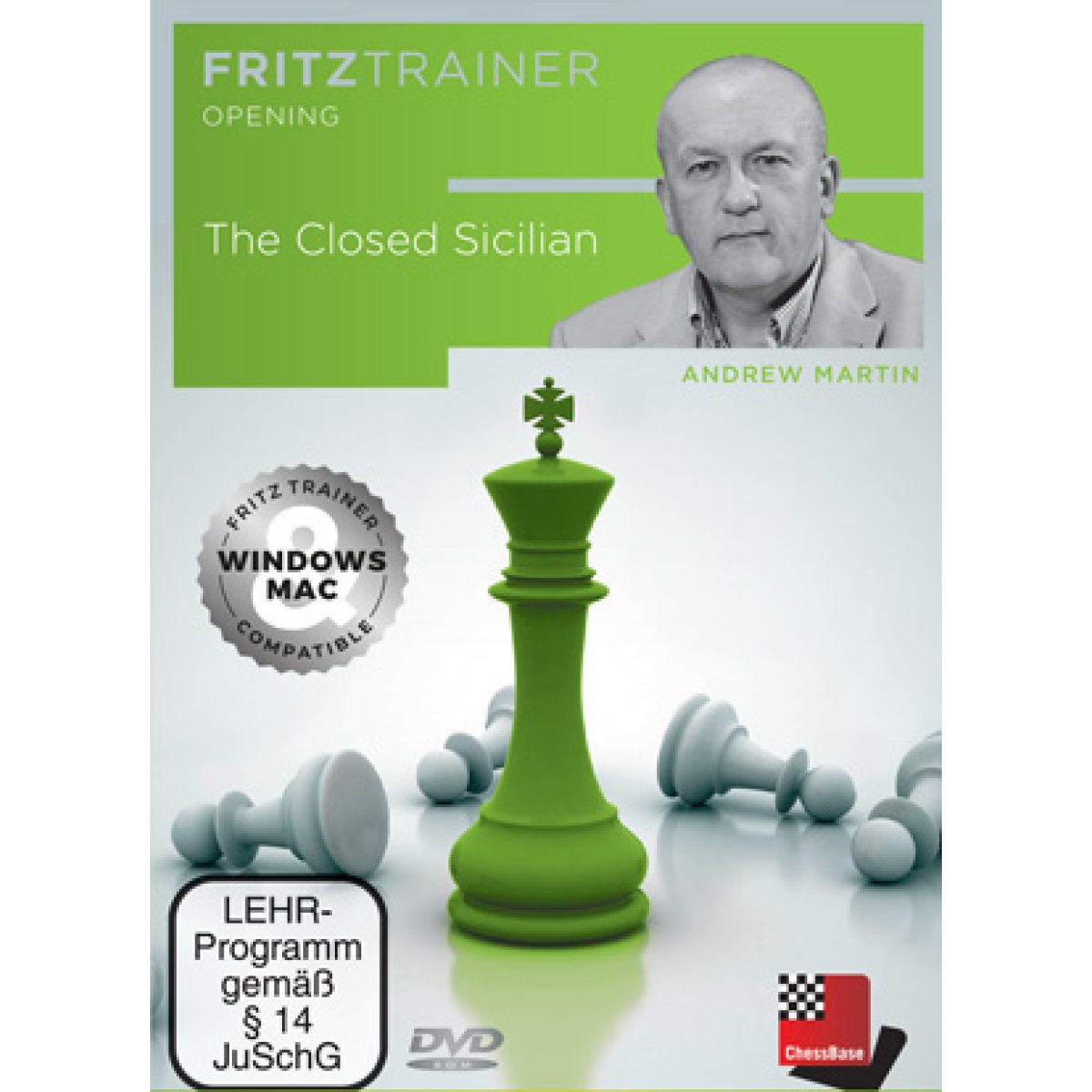


The Closed Sicilian
search
  • The Closed Sicilian

The Closed Sicilian

€29.90
Tax included
Discover the Closed Sicilian, a solid and strategic option for players who prefer to avoid open theory and seek clear plans with attacking chances on the kingside. This 5-hour video course guides you through the main practical variations and systems, featuring interactive training and detailed analysis. Ideal for club players who want to face the Sicilian Defense with a versatile and effective repertoire.

FORMAT: DOWNLOAD
This product is not provided in physical format. You will receive an email from our store with the download link and product activation code.

Quantity
In Stock

  Security policy

(edit with the Customer Reassurance module)

  Delivery policy

(edit with the Customer Reassurance module)

  Return policy

(edit with the Customer Reassurance module)

Do you have an exceptional memory and enjoy tactical positions whose analyses can change with just a few clicks? Then the main lines of the Open Sicilian are for you. But if you belong to the 99% of chess players who don't fit this profile and start with 1.e4, the Closed Sicilian is an interesting alternative. It offers White plans that are easy to understand, the possibility of a kingside attack, and a low risk of being tactically outplayed in the opening.

In this video course, I will introduce you to various variations grouped under the Closed Sicilian, although each has its own identity. You will have variety to choose from. First, we will analyze the main lines, where I will recommend a practical system for White. Then we will look at the move 2.d3, which allows the additional option of c2-c3 instead of Nc3. Finally, we will study the unexpected 2.Be2!?, with which White tries to transform the game into an inverted version of the Dutch Defense. Each of these weapons has its own value and together form a powerful arsenal for club players facing the Sicilian. The Closed Sicilian remains a solid and promising option for White, avoiding very sharp theory and ensuring a complex middlegame with ample chances for victory. We begin with this positive idea.

• Video duration: 5 hours (in English)
• Interactive training with video feedback
• Extra: training with ChessBase apps to memorize the repertoire and play key positions against Fritz at various levels

More... Less...
Included content:
  • Fritztrainer application for Windows and Mac
  • Available for download or on DVD
  • Video course with approximate duration of 4 to 8 hours
  • Repertoire database: saves and integrates Fritztrainer games into your own repertoire (in WebApp Opening or ChessBase)
  • Interactive exercises with video feedback: the authors present exercises and key positions; the user must enter the solution, receiving explanations and corrections
  • Example games in a ChessBase database
  • New: many Fritztrainers now also available for streaming on the ChessBase video portal
Features of the FritzTrainer application:
  • Videos play within the Fritztrainer application or the ChessBase program with board, notation, and function bar
  • The analysis engine can be activated at any time
  • Ability to pause the video to navigate and manually analyze the notation
  • Entry of own variations, engine analysis, and saving within the game
  • Variant learning: visualizes specific lines with automatic playback in ChessBase WebApp Opening, memorizes and practices transformations (initial position – final position)
  • Active opening training: selected positions transfer to ChessBase WebApp Fritz-online to test and play the opening against Fritz
More options: launch FritzTrainer from the ChessBase program
  • The database with all games and analyses can be opened directly
  • Games can easily be added as a reference in opening repertoires
  • Direct evaluation with reference to games and playback on the analysis board
  • Own variations are saved and can be incorporated into the personal repertoire
  • Training with playback
  • Active use of LiveBook
  • All engines installed in ChessBase can be launched for analysis
  • Assisted analysis
  • Printing of notation and diagrams for working materials

Sample Video

Content

  • Introduction
  • Closed Sicilian: 1.e4 c5 2.Nc3
  • Introduction
  • 2...Nc6 3.g3 g6 4.Bg2 Bg7 5.d3 d6 6.Be3 e6 7.Qd2 Nge7: Adams vs Ward
  • 2...Nc6 3.g3 g6 4.d3 Bg7 5.Be3 d6 6.Qd2 Rb8 7.Bg2 b5: Klinger vs Schumi
  • 2...Nc6 3.g3 g6 4.Bg2 Bg7 5.d3 d6 6.Be3 Rb8 7.Qd2 e6: Short vs Hossain
  • 2...Nc6 3.g3 g6 4.Bg2 Bg7 5.d3 e6 6.Be3 d6 7.Qd2 Nge7: Dragomir vs Pachia
  • 2...e6 3.g3 Nc6 4.Bg2 g6 5.d3 Bg7 6.Be3 d6 7.Qd2 Nd4 8.Nd1 e5: Stripunsky vs Van Wely
  • 2...Nc6 3.g3 g6 4.Bg2 Bg7 5.d3 d6 6.Be3 e6 7.Qd2: Artemiev vs Zierk
  • 2...Nc6 3.g3 g6 4.Bg2 Bg7 5.d3 d6 6.Be3 e5 7.Nh3: Artemiev vs Carlsen
  • 2...d6 3.g3 Nc6 4.Bg2 g6 5.d3 Bg7 6.Be3 e5 7.Nh3: Carlsen vs Wojtaszek
  • 2...Nc6 3.g3 g6 4.Bg2 Bg7 5.d3 d6 6.Be3 Nf6 7.h3 0-0 8.Qd2: Hjartarson vs Castaneda
  • 2...Nc6 3.g3 g6 4.d3 Bg7 5.Be3 d6 6.Qd2: Stukopin vs Li
  • 2...Nc6 3.g3 g6 4.Bg2 Bg7 5.d3 e5 6.Be3 d6 7.Qd2: Chandler vs Kovalev
  • 2...Nc6 3.g3 g6 4.Bg2 Bg7 5.d3 d6 6.Nge2: Utegaliev vs Pranav
  • 2...e6 3.g3 d5 4.Bg2 Nf6 5.d3: Alekseenko vs Goryachkina
  • 2...d6 3.g3 Nf6 4.Bg2 Nc6 5.d3 e6 6.f4 Be7 7.Nf3 Qc7 8.0-0: Sigurjonsson vs Petersen
  • Summary
  • The Great Strangulation: 1.e4 c5 2.d3
  • 2...Nc6 3.g3 g6 4.Bg2 Bg7 5.f4 d6 6.Nf3 Nf6 7.0-0 0-0: Korchnoi vs Karpov
  • 2...Nc6 3.g3 g6 4.Bg2 Bg7 5.f4 d6 6.Nf3 e6 7.0-0 Nge7 8.c3 0-0: McShane vs Khalifman
  • 2...g6 3.g3 Bg7 4.Bg2 Nc6 5.f4 d6 6.Nf3 e6 7.0-0 Nge7 8.c3 b6: Movsesian vs Danchevski
  • 2...g6 3.g3 Bg7 4.Bg2 Nc6 5.f4 d6 6.Nf3 e5 7.0-0 Nge7 8.c3 0-0: Marin vs Tolnai
  • 2...g6 3.g3 Bg7 4.Bg2 Nc6 5.f4 d6 6.Nf3 Bg4 7.h3 Bxf3 8.Qxf3 Nf6: Fedorov vs Arvola
  • 2...d5 3.Nd2 Nc6 4.g3 Nf6 5.Bg2 e6 6.f4 dxe4 7.dxe4 Be7: Fedorov vs Kurochkin
  • 2..e6 3.g3 d5 4.Nd2 Nc6 5.Bg2 g6 6.f4 Bg7 7.Ne2 Nge7: Kuzmicz vs Robak
  • Summary
  • 1.e4 c5 2.Be2
  • 2...Nc6 3.f4 g6 4.Nf3 Bg7 5.d3 d6 6.0-0 Bg4: Jones vs Bates
  • 2...Nc6 3.d3 g6 4.f4 Bg7 5.Nf3 d6 6.0-0 e6 7.c3 Nge7: Kovalev vs Klekowski
  • 2...d6 3.f4 Nc6 4.Nf3 g6 5.0-0 Bg7 6.d3 Nf6 7.Qe1 Bg4: Paravyan vs Kotanjian
  • 2...Nc6 3.f4 d5 4.d3 dxe4 5.dxe4 Qxd1 6.Bxd1 Nf6/e5: Kupreichik vs Magerramov/Kovalev vs Vakhidov
  • 2...Nc6 3.f4 d5 4.d3 g6 5.Nf3 Nf6 6.e5 Nh5 7.0-0 Ng7: Wei Yi vs Giri
  • 2...Nc6 3.f4 g6 4.Nf3 Bg7 5.0-0 d6 6.d3 f5: Ider vs Rakotomaharo
  • 2...Nc6 3.f4 g6 4.Nf3 Bg7 5.0-0 d6 6.d3 Nf6: Fedoseev vs Yu
  • 2...Nc6 3.f4 e6 4.Nf3 Nf6 5.d3 d5 6.e5 Nd7 7.0-0 g6: Narciso Dublan vs Plaskett
  • Summary
  • Exercises
  • Description
  • Exercise 1
  • Exercise 2
  • Exercise 3
  • Exercise 4
  • Exercise 5
  • Exercise 6
  • Exercise 7
  • Exercise 8
  • Exercise 9
  • Exercise 10
  • Exercise 11
  • Exercise 12
  • Exercise 13
  • Exercise 14

Sicilian Defense

The moves 1.e4 c5 characterize the Sicilian Defense. Black fights for the d4 square, but by not immediately moving the e-pawn, symmetry is broken and Black indicates that they are not just seeking equality. The game can continue through different branches, where 2.Nf3 followed by 3.d4 cxd4 4.Nxd4 leads to the Open Sicilian. Before that, Black decides the direction with 2...d6, 2...e6, or 2...Nc6. Currently, systems in which White avoids an early d4 are also popular.

TCS-CXLA