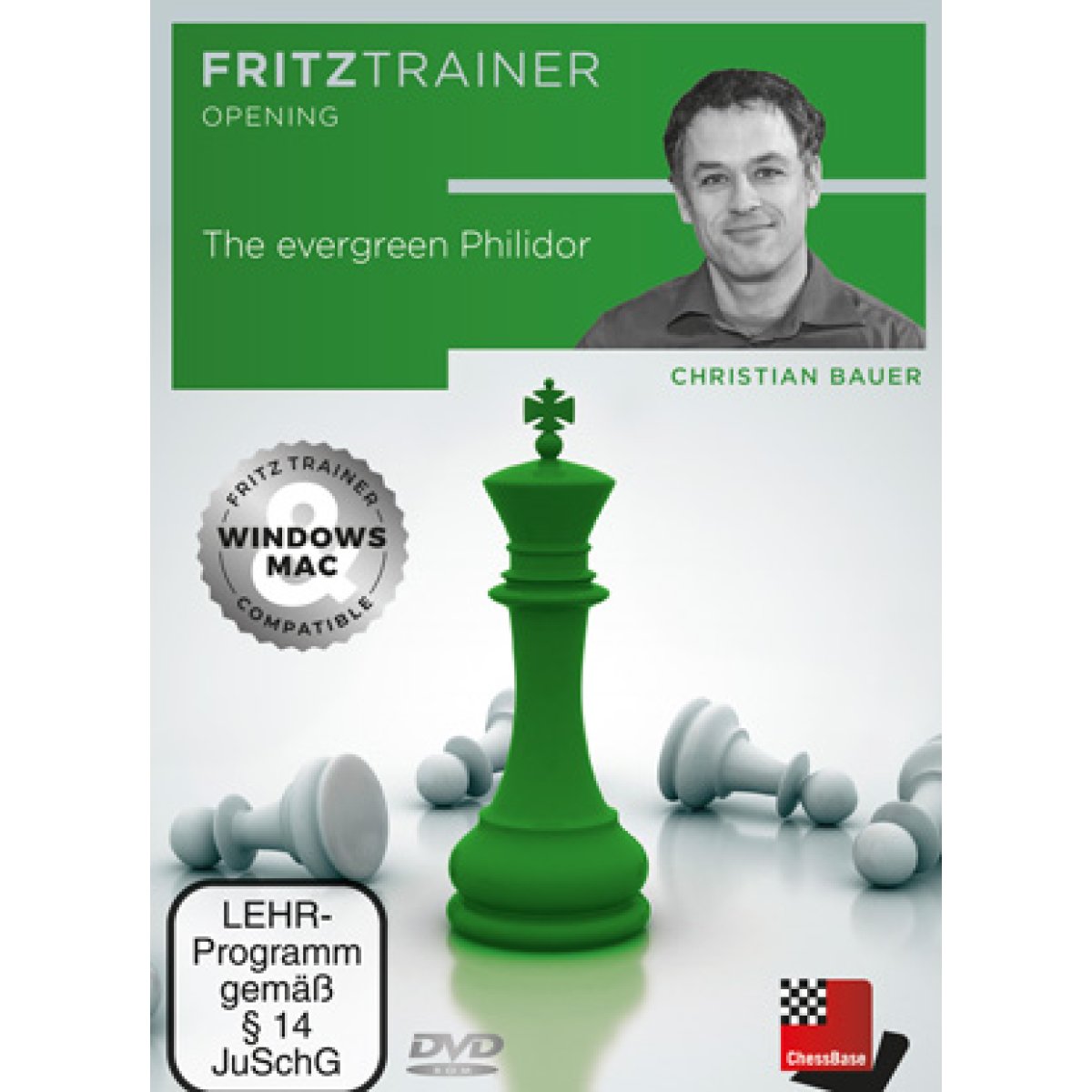


The evergreen Philidor
search
  • The evergreen Philidor

El Philidor perenne

€39.90
Tax included
Discover the Philidor Defense with Grandmaster Christian Bauer in this nearly 7-hour video course. Explore its main variations and the subtle maneuvers of the middlegame in semi-closed positions. Includes interactive training, analysis with Fritz, and exercises with video feedback, to master this solid opening and surprise your opponent with classic and modern strategies.

FORMAT: DOWNLOAD
This product is not provided in physical format. You will receive an email from our store with the download link and product activation code.

Quantity
In Stock

  Security policy

(edit with the Customer Reassurance module)

  Delivery policy

(edit with the Customer Reassurance module)

  Return policy

(edit with the Customer Reassurance module)

The Philidor Defense has a long tradition. In its early days, when theory was almost non-existent, players with good tactical vision often opted for an early, though dubious, ...f5 (3...f5). Another unreliable line arises after 3...exd4 4.Nxd4 Nf6 5.Nc3 g6, where Black fianchettoes the kingside bishop. On the other hand, the Antoshin Variation (3...exd4 4.Nxd4 Nf6 5.Nc3 Be7 6.Bc4 0-0) proves to be more solid. Despite its passive appearance, it can lead to dynamic games, especially if White castles long. However, the Hanham Variation (3...Nf6 4.Nc3 Nbd7 5.Bc4 Be7) remains the most stable setup for Black.

This video course analyzes the various move sequences leading to the main positions of the Philidor Defense, as well as relevant White deviations. In the resulting middlegame, characterized by subtle maneuvers in a semi-closed position, White will feel uncomfortable. Let Grandmaster Christian Bauer guide you into the fascinating world of the Philidor Defense.

  • Video duration: 6 hours and 59 minutes (in English)
  • Interactive training with video feedback
  • Training via ChessBase applications – memorize the opening and practice key positions by facing Fritz at various levels
More... Less...
Included content:
  • Fritztrainer application for Windows and Mac
  • Available for download or on DVD
  • Video course approximately 4 to 8 hours long
  • Repertoire database: save and integrate Fritztrainer games into your personal repertoire (in WebApp Opening or ChessBase)
  • Interactive exercises with video feedback: authors present exercises and key positions, users input the solution, with explanations and corrections in video
  • Example games in ChessBase database
  • New: many Fritztrainers also available for streaming on the ChessBase video portal
FritzTrainer application features:
  • Videos can be played in the Fritztrainer application or in ChessBase with board graphics, notation, and function bar
  • Analysis engine activatable at any time
  • Video pause for manual navigation and analysis in the game notation
  • Input of personal variations, engine analysis, and saving them within the game
  • Variation learning: view specific lines in ChessBase WebApp Opening with automatic playback, memorize and practice transformations (starting position – final position)
  • Active opening training: selected positions are transferred to ChessBase WebApp Fritz-online, where you can test your knowledge by playing against Fritz
More options: start FritzTrainer in ChessBase:
  • Direct access to the database with all games and analyses
  • Easy incorporation of games into your opening repertoire
  • Direct evaluation with references to games, ability to replay them on the analysis board
  • Saving and adding personal variations to your personal repertoire
  • Repetition training
  • Active LiveBook
  • Ability to use all engines installed in ChessBase for analysis
  • Assisted analysis
  • Printing notation and diagrams for educational materials

Sample video

Contents

  • Introduction
  • Chapter 1: 1.e4 e5 2.Nf3 d6
  • 1.e4 e5 2.Nf3 d6
  • Secondary variations
  • 3.d4 Nf6 4.dxe5 Nxe4
  • 3.d4 exd4 4.Qxd4/Bc4
  • 3.d4 exd4 4.Nxd4 Nf6 5.Nc3 g6 6.Be3 Bg7
  • 3.d4 exd4 4.Nxd4 Nf6 5.Nc3 Be7 6.g3
  • 3.d4 exd4 4.Nxd4 Nf6 5.Nc3 Be7 6.Be2
  • 3.d4 exd4 4.Nxd4 Nf6 5.Nc3 Be7 6.Bf4
  • 3.d4 exd4 4.Nxd4 Nf6 5.Nc3 Be7 6.Bc4
  • Chapter 2: 1.e4 d6 2.d4 Nf6
  • 1.e4 d6 2.d4 Nf6
  • 3.f3
  • 3.Bd3 e5 4.c3 d5 5.dxe5
  • 3.Nc3 e5 4.dxe5 dxe5 5.Qxd8 Kxd8
  • 3.Nc3 Nbd7 4.f4 e5
  • 3.Nc3 Nbd7 4.g4 h6
  • 3.Nc3 e5 4.Nf3 Nbd7 5.Rg1
  • 3.Nc3 e5 4.Nf3 Nbd7 5.g4
  • 3.Nc3 e5 4.Nf3 Nbd7 5.Bc4 Be7 6th alternative moves
  • 3.Nc3 e5 4.Nf3 Nbd7 5.Bc4 Be7 6.0-0 0-0 7.Qe2
  • 3.Nc3 e5 4.Nf3 Nbd7 5.Bc4 Be7 6.0-0 0-0 7.Re1 c6 8.a4 a5
  • 3.Nc3 e5 4.Nf3 Nbd7 5.Bc4 Be7 6.0-0 0-0 7.Re1 c6 8.a4 b6
  • 3.Nc3 e5 4.Nf3 Nbd7 5.Bc4 Be7 6.0-0 0-0 7.Re1 c6 8.a4 alternatives
  • Exercises 1-10
  • Exercise 1
  • Exercise 2
  • Exercise 3
  • Exercise 4
  • Exercise 5
  • Exercise 6
  • Exercise 7
  • Exercise 8
  • Exercise 9
  • Exercise 10
  • Exercises 11-20
  • Exercise 11
  • Exercise 12
  • Exercise 13
  • Exercise 14
  • Exercise 15
  • Exercise 16
  • Exercise 17
  • Exercise 18
  • Exercise 19
  • Exercise 20
More...
Less...

Philidor Defense

François-André Danican Philidor (1726–1795) is the name associated with the 2...d6 defense, in which Black adopts a different approach to protect the king’s pawn against e5 openings, where it is usually defended with 2...Nc6. In the Philidor system, the queen’s pawn supports the e5 pawn via the queen’s knight placed on d7, preventing pins by Bb5. Black continues development with ...Nf6, ...Be7, and ...0-0 without interruption, completing a solid structure with ...c6 and ...Qc7. The objective is to maintain control over the e5 square.

TEP-ZJFV