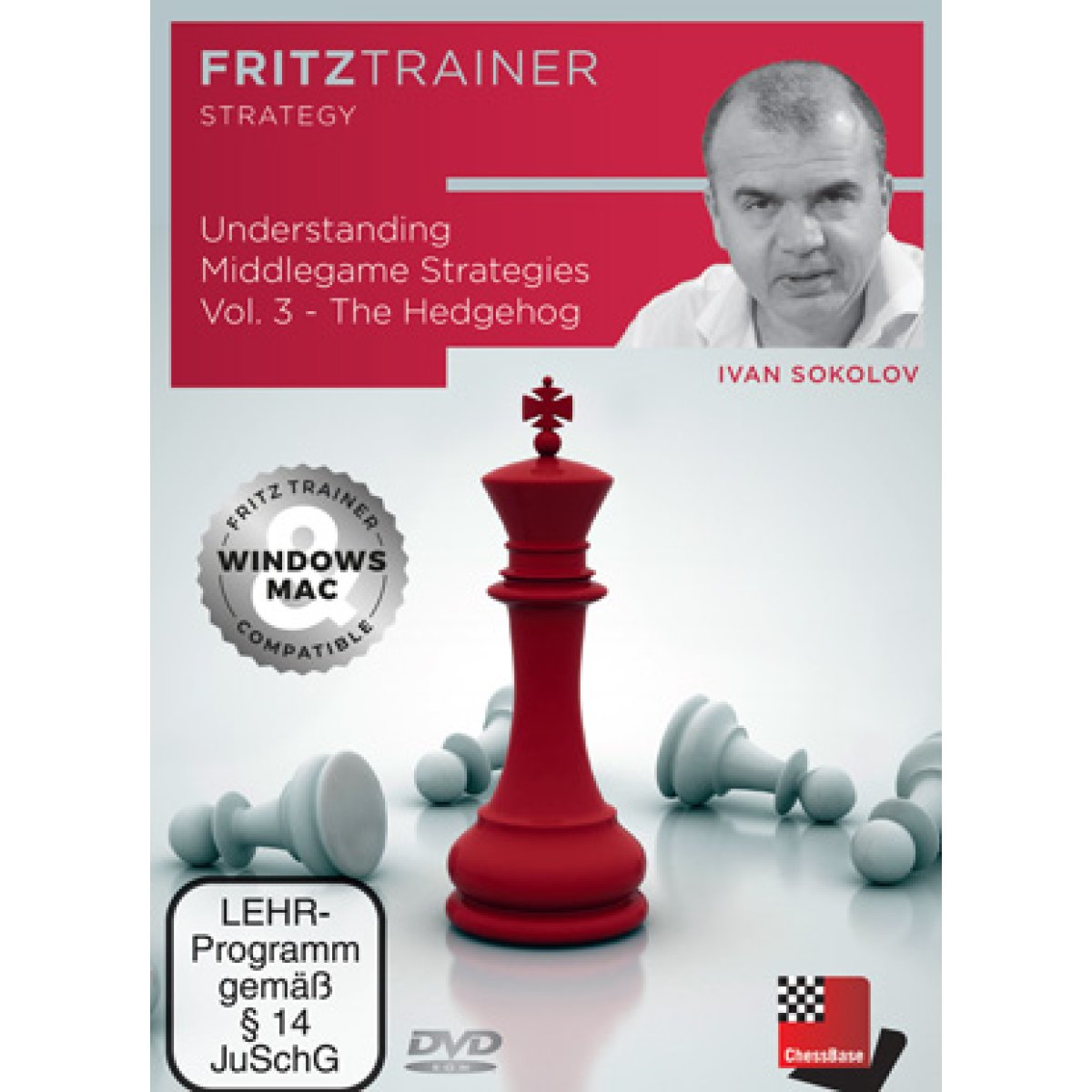


Understanding Middlegame Strategies Vol.3 - The Hedgehog
search
  • Understanding Middlegame Strategies Vol.3 - The Hedgehog

Understanding Middlegame Strategies Vol.3 - The Hedgehog

€29.90
Tax included
Master the complex structures of the "Hedgehog" pawn with this 4-hour video course. Learn how to choose the right plans in dynamic positions with both White and Black, avoiding common mistakes and taking advantage of tactical opportunities. Includes interactive exercises, analysis of classic games, and practice with the FritzTrainer app to improve your tournament performance and gain a deep understanding of this strategic formation.

FORMAT: DOWNLOAD
This product is not supplied in physical format. You will receive an email from our store with the download link and product activation code.

Quantity
In Stock

  Security policy

(edit with the Customer Reassurance module)

  Delivery policy

(edit with the Customer Reassurance module)

  Return policy

(edit with the Customer Reassurance module)

During my career as a player, I have found that Hedgehog-type positions (with both colors) are among the most difficult to master. With White (the side with more space), there is always the risk of overextending or overlooking the opponent's pawn break. With Black (the side with less space), the danger lies in mistiming the pawn break or simply failing to obtain counterplay and being overwhelmed.

The complexity of these positions is well illustrated in a Kasparov-Kramnik game, where both players made seemingly "obvious" mistakes. Another good example is Charbonneau-Anand, where a player of Anand’s caliber reached a terrible position and missed his attacking chances. The result was one of the biggest surprises at the 2006 Chess Olympiad. There are several types of Hedgehog positions, many derived from the English Opening with White’s fianchettoed bishop. In this video course, I focus on the basic Hedgehog pawn structure, such as the one arising from the Sicilian Kan, for example. Choosing the right plan at the right time is crucial since the resulting positions are full of dynamic possibilities. My goal is to show the most common plans (and some less frequent ones) for both sides, pointing out typical mistakes and motifs. The main purpose of this video is to improve understanding of these complex positions and help tournament players achieve better results.

• Video duration: 4 hours (in English)
• Extra: Training with ChessBase applications – Play key pawn structures against Fritz at various levels

More... Less...
This is what you will receive:
  • Fritztrainer application for Windows and Mac
  • Available for download or on DVD
  • Video course with an approximate duration of 4 to 8 hours
  • Repertoire database: save and integrate Fritztrainer games into your own repertoire (in WebApp Opening or ChessBase)
  • Interactive exercises with video feedback: the authors present exercises and key positions; the user must enter the solution, receiving video comments (including on mistakes) and additional explanations
  • Example games in ChessBase database format
  • New: many Fritztrainers now also available for streaming on the ChessBase video portal
What the FritzTrainer application can do for you:
  • Videos can be watched in the Fritztrainer application or in the ChessBase program with board, notation, and function bar
  • The analysis engine can be activated at any time
  • Video pause for manual navigation and analysis in the game notation
  • Input of own variations, engine analysis, and storage in the game
  • Learn variations: view specific lines in ChessBase WebApp Opening with automatic playback, memorize variations, and practice transformation (starting position – ending position)
  • Active opening training: selected positions are transferred to ChessBase WebApp Fritz-online to play against Fritz and put what you’ve learned into practice
Even more features: launch FritzTrainer from within the ChessBase program
  • The database with all games and analyses opens directly
  • Games can be easily added to the opening reference
  • Direct evaluation with game reference; games can be replayed on the analysis board
  • Own variations are saved and can be incorporated into the personal repertoire
  • Replay training
  • Active LiveBook
  • All engines installed in ChessBase can be used for analysis
  • Assisted analysis
  • Printing of notation and diagrams (for worksheets)

Sample Video

Contents

  • Hedgehog - Part 1
  • Introduction and Fischer vs Andersson
  • Black advances rook pawn: Charbonneau vs Anand
  • Regrouping: Kasparov vs Kramnik
  • Pawn h advance: Topalov vs Kasimdzhanov
  • White against pawn h advance: Radjabov vs Kamsky
  • Aggressive ideas for White
  • Short castling and pawn g advance: J. Van Foreest vs Bilguun
  • Pawn advances on the kingside: Cramling vs Gruenfeld
  • Hedgehog - Part 2
  • Control of dark squares: Tal vs Polugaevsky
  • Pawn a advance: Agrest vs Nisipeanu
  • Pawn a2 advance: Firouzja vs Vachier-Lagrave
  • Doubled pawns: Acs vs Polgar
  • Doubled pawns 2: Eljanov vs Kudrin
  • White’s long castling
  • Diagonal control: Romanishin vs Petrosian
  • Diagonal control 2
  • Change in pawn structure: Carlsen vs Wojtaszek
  • Positions for practice
  • Description
  • Position 1 - Black to move
  • Position 1 - White to move
  • Position 2 - Black to move
  • Position 2 - White to move
  • Position 3 - Black to move
  • Position 3 - White to move
  • Position 4 - Black to move
  • Position 4 - White to move
  • Position 5 - Black to move
  • Position 5 - White to move
  • Position 6 - Black to move
  • Position 6 - White to move
More...
Less...
UMSV-TH-CGGK