

FORMAT: DOWNLOAD
This product is not supplied in physical format. You will receive an email from our store with the download link and product activation code.
 Security policy
(edit with the Customer Reassurance module)
 Delivery policy
(edit with the Customer Reassurance module)
 Return policy
(edit with the Customer Reassurance module)
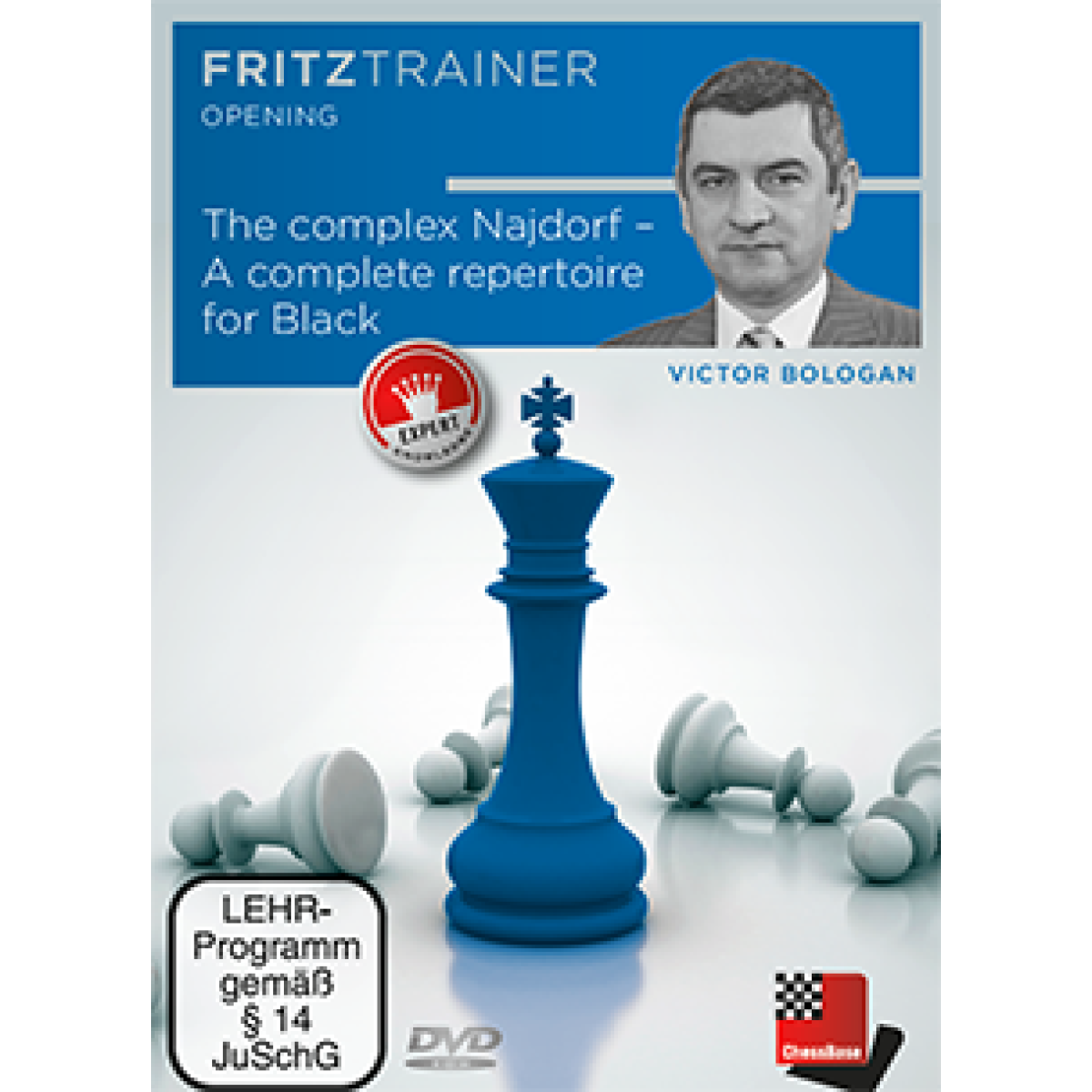
When choosing an opening repertoire, two types of variations are usually considered. One is typically a solid opening, such as 1...e5 against 1.e4, with many strategic ideas and quiet play paths. However, there are occasions when you want to seek victory with the black pieces by pressuring the opponent’s position with a forceful attack. The Najdorf is ideal for these moments, and it is no coincidence that Garry Kasparov used it more than any other Sicilian variation during his brilliant career. Personally, I have played it with both colors and continue discovering new depths every day. Strategy, combinations, attack and defense, sacrifices, and surprising maneuvers: exciting chess is experienced with the Najdorf.
• Video duration: 6 hours 31 minutes (in English)
• Interactive training with video feedback
• Bonus: 50 model games and complete variation analysis by GM Victor Bologan
• Includes CB 12 Reader
It is surprising that the most important system of the Sicilian begins with the seemingly harmless move 5...a6. This bishop’s pawn move does not develop pieces, so why does Black play it? Mainly, it prevents White’s minor pieces from occupying the b5 square and prepares a counterattack on the queenside with ...b7-b5. In certain positions, there is the threat of ...b4 to drive away the knight on c3, increasing pressure on the e4 pawn. In this way, 5...a6 is preparation to attack White’s center. The rise of the Najdorf Variation —named after the great Polish-Argentine Grandmaster Miguel Najdorf (1910–1997)— began in the 1950s. World champions such as Petrosian, Tal, and Fischer played it, and Kasparov was feared for his precise handling of the sharp Najdorf lines.
FORMAT: DOWNLOAD
This product is not supplied in physical format. You will receive an email from our store with the download link and product activation code.