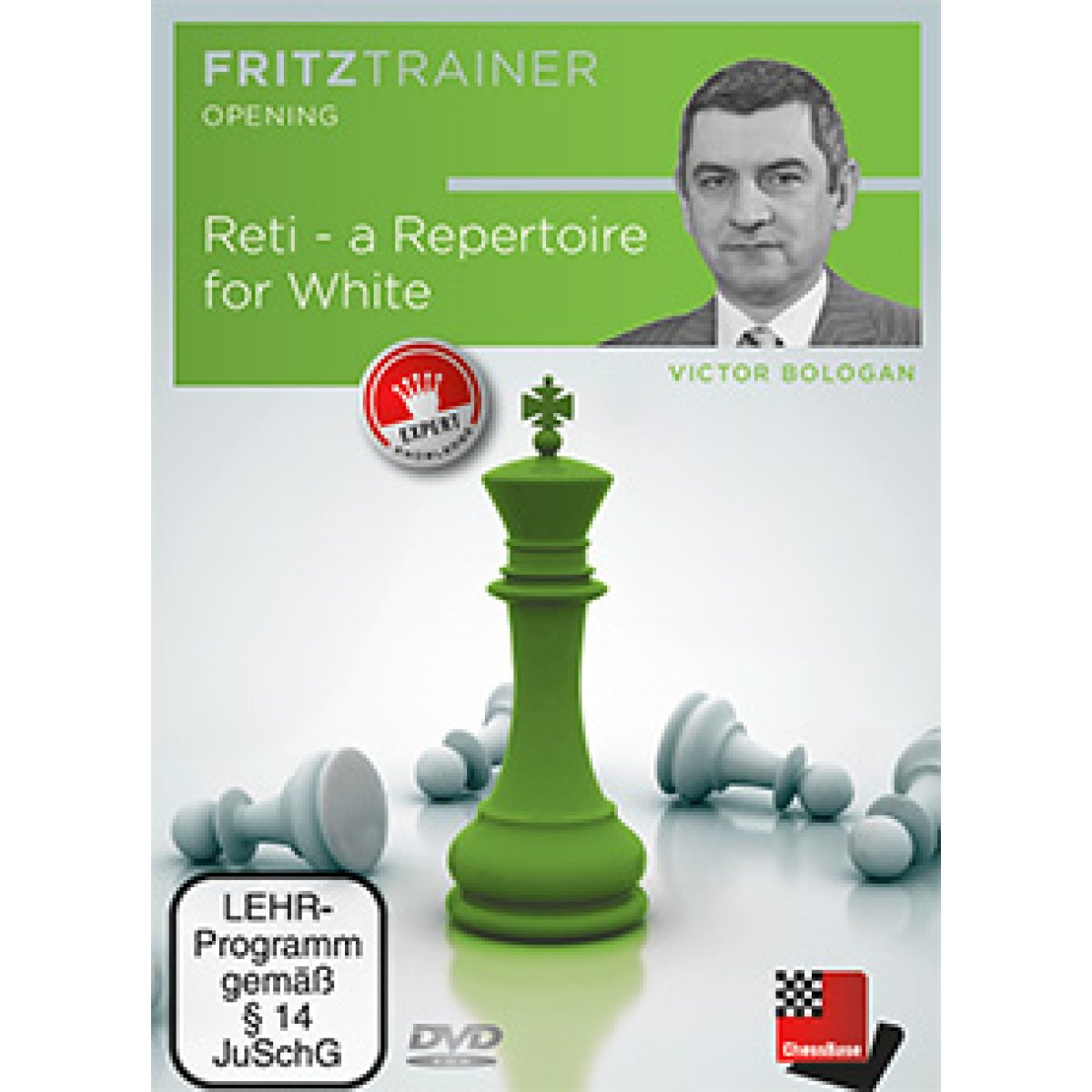


Reti - A Repertoire for White
search
  • Reti - A Repertoire for White

Reti - A Repertoire for White

€29.90
Tax included
Discover the complete repertoire for playing the Reti Opening with White (1.Nf3), based on the deep strategy of great masters like Richard Reti and Vladimir Kramnik. This video course of over 6 hours includes detailed analyses, more than 50 model games, interactive exercises with feedback, and a database to integrate into your repertoire. Ideal for players who prefer maneuvering and strategic planning without delving into lengthy theory.

FORMAT: DOWNLOAD
This product is not provided in physical format. You will receive an email from our store with the download link and product activation code.

Quantity
In Stock

  Security policy

(edit with the Customer Reassurance module)

  Delivery policy

(edit with the Customer Reassurance module)

  Return policy

(edit with the Customer Reassurance module)

It is always fascinating to find games from the early last century or even the 19th century when you prepare a game or review an opening. While working on this DVD, I noticed that the development of the knight to f3 followed by an attack on the center with c4 was used by almost all the great champions of the past. The greatest contribution to this opening was made by Richard Réti, who achieved several victories with it in the 1920s, but how would it be without Capablanca’s games or Smyslov’s refined ideas? Nowadays, the main exponent of 1.Nf3 with White is Vladimir Kramnik, who, in my opinion, possesses the deepest strategic knowledge in chess. This opening is especially suitable for players who enjoy strategy, maneuvers, and plans, and prefer to avoid extensive and complex theory. In this DVD I have tried to cover all possible Black responses to 1.Nf3. Although much theory remains outside, here you will find a complete repertoire for White. Enjoy it!

• Video duration: 6 h 31 min (in English)
• Interactive training with video feedback
• Extra: Bologan’s analysis and more than 50 model games
• Includes CB 12 reader

More...Less...
Product contents:
  • Fritztrainer application for Windows
  • Available for download or on DVD
  • Video course with an approximate duration of 4 to 8 hours
  • Repertoire database: save and integrate Fritztrainer games into your repertoire (in WebApp Opening or ChessBase)
  • Interactive exercises with video feedback: the authors present exercises and key positions for the user to input solutions, with additional explanations and error correction
  • Example games in database format for ChessBase
FritzTrainer application features:
  • Videos can be played in the Fritztrainer application or in ChessBase with board, notation, and extended function bar
  • Analysis engine activatable at any time
  • Ability to pause the video for manual navigation and analysis in the notation
  • Input of own variations and engine analysis, saving them in the game
  • Learning variants: view specific lines in ChessBase WebApp Opening with automatic playback, memorize variants, and practice transformation (from initial to final position)
  • Active opening training: selected positions are transferred to ChessBase WebApp Fritz-online to test your knowledge by playing against Fritz
More options: launch FritzTrainer in ChessBase
  • Database with all games and analysis directly accessible
  • Ease of adding games to the opening reference
  • Direct evaluation with game references, which can be replayed in the analysis board
  • Saving own variations to integrate into the personal repertoire
  • Replay training
  • Active LiveBook
  • Use of all engines installed in ChessBase for analysis
  • Assisted analysis
  • Printing notation and diagrams for study materials

Sample video

Contents

  • Reti – A repertoire for White: 1.Nf3
  • 01: Introduction [07:14]
  • 02: 1...g6 2.e4 c5 3.d4 cxd4 4.Nxd4 Nc6 5.c4 Nf6 6.Nc3 d6/Nxd4 – Analysis [13:08]
  • 03: 1...c5 2.c4 Nc6 3.Nc3 g6 4.e3 Nf6 5.d4 cxd4 6.exd4 d5 7.cxd5 Nxd5 8.Qb3 Nxc3 9.Bc4 Nd5/e6 – Analysis [18:55]
  • 04: 1...c5 2.c4 Nc6 3.Nc3 g6 4.e3 Nf6 5.d4 cxd4 6.exd4 d5 7.cxd5 Nxd5 8.Qb3 e6 9.Bb5 Bg7 – Analysis [15:22]
  • 05: 1...Nf6 2.c4 c5 3.Nc3 Nc6 4.g3 d5 5.cxd5 Nxd5 6.Bg2 g6 7.0-0 Bg7 8.Qa4 Nb6/e6/0-0 – Analysis [15:57]
  • 06: 1...Nf6 2.c4 c5 3.Nc3 Nc6 4.g3 d5 5.cxd5 Nxd5 6.Bg2 e6 7.0-0 Be7 8.d4 0-0/Nxc3 – Analysis [16:47]
  • 07: 1...Nf6 2.c4 c5 3.Nc3 Nc6 4.g3 d5 5.cxd5 Nxd5 6.Bg2 Nc7 7.a3 e5/f6/g6 – Analysis [17:13]
  • 08: 1...Nc6 2.d4 d5 3.c4 dxc4 4.Nc3 Nf6 5.e4 Bg4 6.Be3 e6 7.Bxc4 Bb4 8.Qc2/Qd3 – Analysis [11:59]
  • 09: 1...b6 2.e4 Bb7 3.Nc3 Nf6 and 3...e6 4.d4 Bb4 5.Bd3 Nf6/Ne7/Bxc3+/c5 – Analysis [09:10]
  • 10: 1...b5 2.e4 a6 3.d4 Bb7 4.Bd3 e6 and 2...Bb7 3.Bxb5 Bxe4 4.0-0 Nf6 5.d4 e6/c6 – Analysis [05:42]
  • 11: 1...f5 2.d3 Nf6/Nc6/d6/g6 – Analysis [16:39]
  • 12: 1...Nf6 2.c4 d6 3.g3 e5 4.Bg2 Be7 5.Nc3 c6 6.0-0 0-0 7.d3 Nbd7/a5/h6 – Analysis [06:53]
  • 13: 1...Nf6 2.c4 g6 3.b4 Bg7 4.Bb2 0-0 5.g3 d6/c6/d5/b6/a5 – Analysis [19:10]
  • 14: 1...Nf6 2.c4 g6 3.Nc3 d5 4.cxd5 Nxd5 5.Qb3 Nb6 6.d4 Bg7/Be6 – Analysis [16:39]
  • 15: 1...Nf6 2.c4 b6 3.g3 Bb7 4.Bg2 e6 5.0-0 Be7 6.Nc3 c5 7.d4 cxd4 8.Qxd4 0-0/d6 – Analysis [17:28]
  • 16: 1...Nf6 2.c4 e6 3.g3 d5 4.b3 Be7 5.Bg2 0-0 6.0-0 b6/c6 – Analysis [10:38]
  • 17: 1...Nf6 2.c4 e6 3.g3 d5 4.b3 Be7 5.Bg2 0-0 6.0-0 c5 7.Bb2 and 7.e3 dxc4/Nc6/b6 – Analysis [27:50]
  • 18: 1...Nf6 2.c4 e6 3.g3 d5 4.b3 Be7 5.Bg2 0-0 6.0-0 c5 7.e3 b6 8.Bb2 Bb7 9.Nc3 dxc4 10.bxc4 Nc6 11.Qe2 Qc7/a6 – Analysis [09:53]
  • 19: 1...Nf6 2.c4 e6 3.g3 d5 4.b3 Be7 5.Bg2 0-0 6.0-0 c5 7.cxd5/Bb2 – Analysis [12:23]
  • 20: 1...d5 2.c4 dxc4 3.Na3 c5 4.Nxc4 Nc6 5.e3 Nf6 and 3...a6 4.Nxc4 b5 5.Ne3 Bb7 6.g3 e6/Bxf3 – Analysis [11:11]
  • 21: 1...d5 2.c4 d4 3.b4 f6/Bg4/Nf6/c5 – Analysis [13:49]
  • 22: 1...d5 2.c4 e6 3.b3 c5 4.e3 Nc6 5.cxd5 exd5 6.Bb2 Nf6 7.Be2 Be7/d4/a6/Bd6 – Analysis [09:09]
  • 23: 1...d5 2.c4 c6 3.g3 dxc4 4.Bg2 Bf5 5.Na3 e5 6.Nxc4 e4 7.Nfe5 Qc7/f6/Nd7/Be6/Nf6 and 4...Nf6/Nd7/e6/b5 – Analysis [13:05]
  • 24: 1...d5 2.c4 c6 3.g3 g6 4.Bg2 Nf6 5.b3 Bg7 6.Bb2 0-0 7.d3 Bg4 8.Nbd2 Bxf3 9.Nxf3 Nfd7/e6/Qa5+ – Analysis [09:03]
  • 25: 1...d5 2.c4 c6 3.g3 Bg4 4.Ne5 Bf5 and 3...Bf5 4.Bg2 e6 5.cxd5 exd5/cxd5 – Analysis [11:39]
  • 26: 1...d5 2.c4 c6 3.g3 Nf6 4.Bg2 dxc4 5.0-0 Nbd7 6.Na3 Nb6 7.Ne5 Be6 8.Qc2 g6/Qd4/Bd5 – Analysis [07:11]
  • 27: 1...d5 2.c4 c6 3.g3 Nf6 4.Bg2 Bf5 5.0-0 e6 6.cxd5 cxd5 6.Qb3 Qc8/Qb6/Qd7/Qc7 – Analysis [06:41]
  • 28: 1...d5 2.c4 c6 3.g3 Nf6 4.Bg2 Bg4 5.Ne5 Be6/Bh5/dxc4/Bf5/e6 – Analysis [11:18]
  • Interactive positions
  • 29: Test 1 [02:52]
  • 30: Test 2 [01:47]
  • 31: Test 3 [01:07]
  • 32: Test 4 [02:18]
  • 33: Test 5 [02:25]
  • 34: Test 6 [01:48]
  • 35: Test 7 [01:25]
  • 36: Test 8 [01:59]
  • 37: Test 9 [02:43]
  • 38: Test 10 [02:03]
  • 39: Test 11 [02:27]
  • 40: Test 12 [04:26]
  • 41: Test 13 [01:04]
  • 42: Test 14 [01:44]
  • 43: Test 15 [01:57]

Reti Opening

In the 1920s, the so-called "hypermodernists" broke with the dogma that the center must be occupied immediately with pawns at the start of the game. Instead of 1.e4 or 1.d4, they opened with 1.Nf3 and allowed Black to respond classically with 1...d5. This initial position gives rise to Richard Réti’s system (1889–1929), who since 1923 used this strategy very successfully against the best opponents. In the Reti system, White temporarily delays advancing their central pawns, preferring to increase their influence in the center by fianchettoing with g3 and Bg2, and plans to attack Black’s d5 pawn with c2–c4, either on the second move or later.

R-ARFW-ECMZ