
The flexible Panov
search
  • The flexible Panov

The flexible Panov

€29.90
Tax included
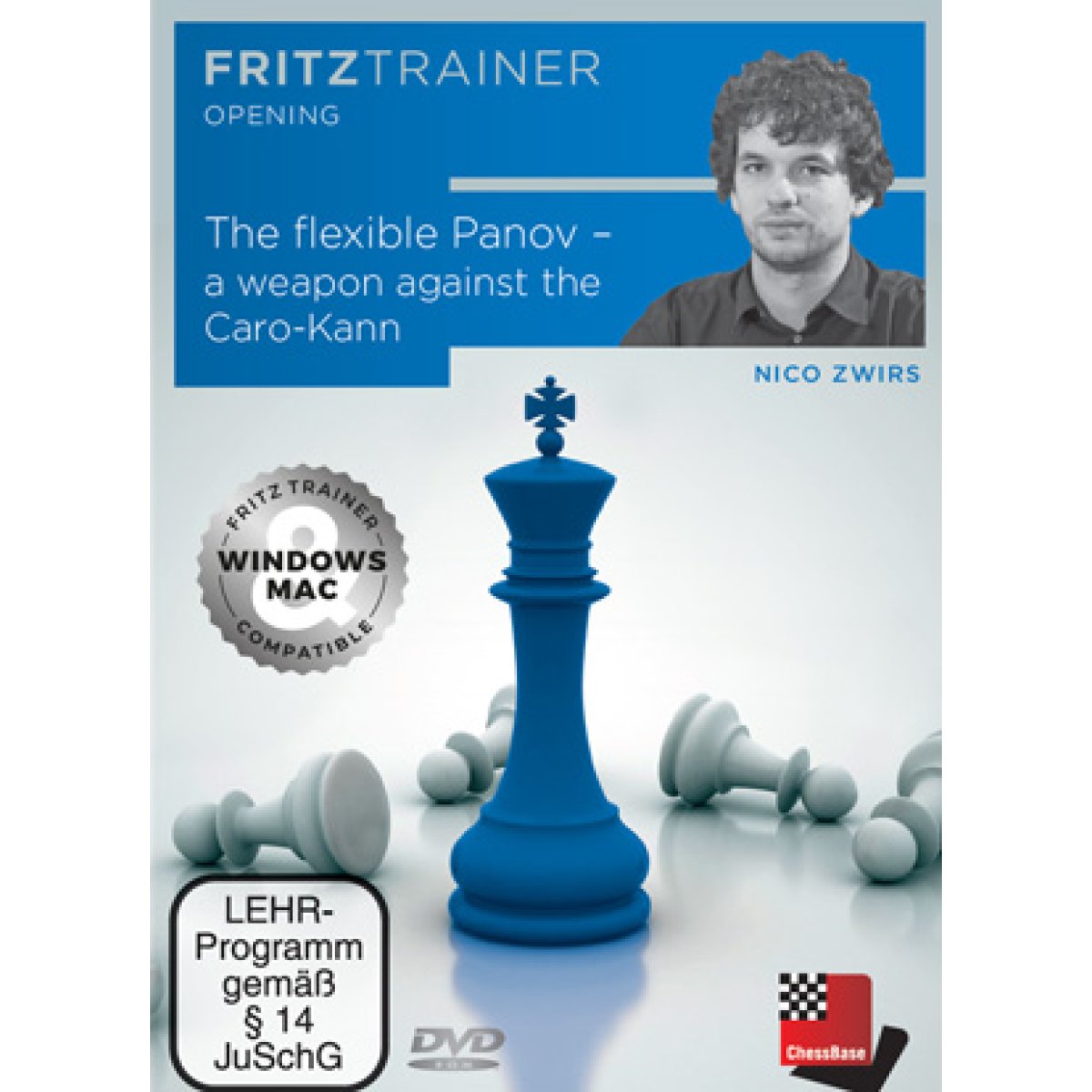
Discover "The Flexible Panov," an 8-hour video training that teaches you how to master the Panov variation in the Caro-Kann Defense, a solid response to 1.e4. GM Nico Zwirs shares his personal experience and guides you through sharp and versatile lines, including the key move 6.Bg5. With interactive exercises, detailed analyses, and a database of model games, improve your repertoire and surprise your opponents with this strategic weapon.

FORMAT: DOWNLOAD
This product is not supplied in physical format. You will receive an email from our store with the download link and product activation code.

Quantity
In Stock

  Security policy

(edit with the Customer Reassurance module)

  Delivery policy

(edit with the Customer Reassurance module)

  Return policy

(edit with the Customer Reassurance module)

The Caro-Kann Defense is one of the most solid and respected responses against 1.e4. Due to its firmness, it represents a true mental challenge for most players facing 1.e4. If you are looking for aggressive and tactical lines against this solid opening, but the variations with 3.Nc3 and 3.e5 seem too theoretical and well-explored to you, the Panov is the perfect solution! In this Fritztrainer, IM Nico Zwirs will show you how to put Black to the ultimate test. He will share his experience with the Panov: the game that inspired him to adopt it, his initial encounters, and how he managed to master this opening, which even became the one that earned him the most points. The repertoire will focus on the aggressive move 6.Bg5 (1.e4 c6 2.d4 d5 3.exd5 cxd5 4.c4 Nf6 5.Nc3 Nc6 6.Bg5). Starting with the main line, all Black’s responses will be analyzed.

The Panov is characterized by positions with an isolated pawn on d4 (IQP). Black can force these positions from move 4, and even on moves 5, 6, and 7, and Zwirs will explain the differences in each case. Another great asset of this Fritztrainer is that it offers multiple options and suggestions to vary the lines in the Panov. From safe alternatives to risky and tactical variations, everything is included, making it difficult for your opponent to prepare. Additionally, it includes a video dedicated to move orders, where you will learn how to steer opponents unfamiliar with the Caro-Kann into this opening, which is a very powerful weapon. Don’t miss the opportunity to become a master of the Panov with this Fritztrainer.

• Video duration: 8 hours (in English)
• Interactive training with video feedback
• Additional chapter with repertoire and practice functions
• Extra: Database with model games

More... Less...
Included content:
  • Fritztrainer application for Windows and Mac
  • Available for download or on DVD
  • Video course with an approximate duration of 4 to 8 hours
  • Repertoire database: save and integrate Fritztrainer games into your repertoire (in WebApp Opening or ChessBase)
  • Interactive exercises with video feedback: authors present key positions and exercises you must solve, with explanations and corrections
  • Model games in ChessBase database format
  • New: many Fritztrainers also available for streaming on the ChessBase video portal
FritzTrainer application features:
  • Videos playable in the Fritztrainer app or in ChessBase with board, notation, and function bar
  • Analysis engine activatable at any time
  • Video pause for navigation and manual notation analysis
  • Input of own variations, engine analysis, and saving in the game
  • Learn variations: view specific lines in ChessBase WebApp Opening with automatic playback, memorize and practice transformations (starting position – final position)
  • Active opening training: selected positions are transferred to ChessBase WebApp Fritz-online to face Fritz and put what you learned into practice
More options: use FritzTrainer from the ChessBase program
  • Direct access to the database with all games and analyses
  • Easy incorporation of games into the opening repertoire
  • Direct evaluation with reference to games, playback on analysis board
  • Saving and use of own variations in personal repertoire
  • Repetition training
  • Active LiveBook
  • Use of all engines installed in ChessBase for analysis
  • Assisted analysis
  • Printing of notation and diagrams for study material

Sample video

Content

  • Introduction
  • Main line
  • Main line after 1.e4 c6 2.d4 d5 3.exd5 cxd5 4.c4
  • Appetizer: Kasparov-Anand 1996 Part 1
  • Appetizer: Kasparov-Anand 1996 Part 2
  • 4...Nf6 5.Nc3 Nc6 6.Bg5 e6 7.Nf3: Main line without 10...Nxe7
  • 4...Nf6 5.Nc3 Nc6 6.Bg5 e6 7.Nf3 Be7 8.c5 0-0 9.Bb5 Ne4 10.Bxe7: Main line with 10...Nxe7 Part 1
  • 4...Nf6 5.Nc3 Nc6 6.Bg5 e6 7.Nf3 Be7 8.c5 0-0 9.Bb5 Ne4 10.Bxe7: Main line with 10...Nxe7 Part 2
  • 4...Nf6 5.Nc3 Nc6 6.Bg5 e6 7.Nf3 dxc4 8.Bxc4 Be7 9.0-0 0-0 10.Rc1 a6/b6
  • 4...Nf6 5.Nc3 Nc6 6.Bg5 e6 7.Nf3 dxc4 8.Bxc4 Be7 9.0-0 0-0 10.Rc1 h6
  • 4...Nf6 5.Nc3 Nc6 6.Bg5 dxc4 7.Bxc4 Qxd4/Nxd4
  • 4...Nf6 5.Nc3 Nc6 6.Bg5 dxc4 7.Bxc4 h6
  • 4...Nf6 5.Nc3 Nc6 6.Bg5 Qa5/Qb6
  • 4...Nf6 5.Nc3 Nc6 6.Bg5 Ne4
  • 4...Nf6 5.Nc3 Nc6 6.Bg5 Be6 Part 1
  • 4...Nf6 5.Nc3 Nc6 6.Bg5 Be6 Part 2
  • Secondary variations
  • Secondary variations after 1.e4 c6 2.d4 d5 3.exd5 cxd5 4.c4
  • 4...Nc6 5.cxd5 Qxd5 6.Nf3 e5/e6
  • 4...Nc6 5.cxd5 Qxd5 6.Nf3 Bg4
  • 4...Nf6 5.Nc3 e6 6.Nf3 Be7/Bb4
  • 4...dxc4 5.Bxc4 Qc7
  • 4...dxc4 5.Bxc4 Nf6
  • 4...Nf6 5.Nc3 g6 6.Qb3 Bg7 7.cxd5 0-0: Fianchetto main line
  • 4...Nf6 5.Nc3 g6 6.Qb3 dxc4/e6: Fianchetto secondary variations
  • Alternatives and move orders
  • Exercises 01-10
  • Description
  • Exercise 01
  • Exercise 02
  • Exercise 03
  • Exercise 04
  • Exercise 05
  • Exercise 06
  • Exercise 07
  • Exercise 08
  • Exercise 09
  • Exercise 10
  • Exercises 11-20
  • Exercise 11
  • Exercise 12
  • Exercise 13
  • Exercise 14
  • Exercise 15
  • Exercise 16
  • Exercise 17
  • Exercise 18
  • Exercise 19
  • Exercise 20

Caro-Kann Defense

The Caro-Kann Defense is named in honor of the English master Horatio Caro (1862–1920), resident in Berlin, and the Austrian player Marcus Kann (1820–1886). However, the move 1...c6 did not gain popularity until the 1920s, when greats like José Raúl Capablanca and Aaron Nimzowitsch began employing it. In 1960/61, Botvinnik was seeking a reliable defense against Mihail Tal’s sacrificial attacks for his World Championship matches and chose the Caro-Kann. Other world champions who adopted it were Tigran Petrosian and Anatoly Karpov.

TFP-IGBV