

Mastering the Sicilian Najdorf
search
  • Mastering the Sicilian Najdorf

Mastering the Sicilian Najdorf

€29.90
Tax included
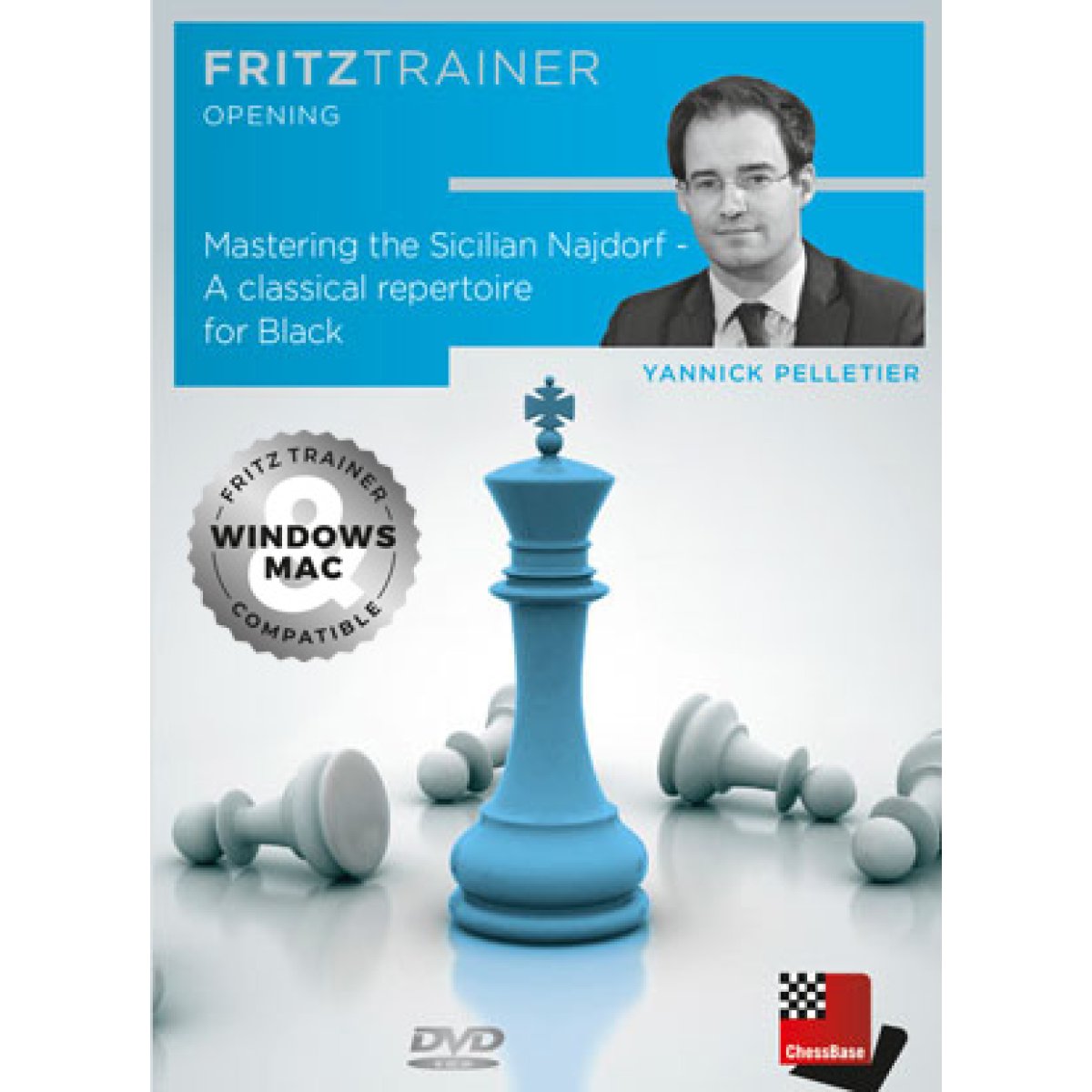
Discover the Najdorf Defense of the Sicilian, one of the most popular and dynamic chess openings, used by champions such as Fischer and Kasparov. This course, lasting over 7 hours and taught by GM Yannick Pelletier, offers a complete repertoire, in-depth analysis, and interactive exercises with video feedback. Improve your strategy, learn to fight for the initiative, and master this key opening with practical examples and tests to consolidate your knowledge.

FORMAT: DOWNLOAD
This product is not supplied in a physical format. You will receive an email from our store with the download link and product activation code.

Quantity
In Stock

  Security policy

(edit with the Customer Reassurance module)

  Delivery policy

(edit with the Customer Reassurance module)

  Return policy

(edit with the Customer Reassurance module)

The Najdorf Variation of the Sicilian Defense has been one of the most popular openings for decades. Players of all levels prefer it, and it was a key part of the repertoire of two legendary world champions: Bobby Fischer and Garry Kasparov.

The Najdorf is not only solid but also offers Black chances to play for a win. Studying and practicing this variation will help you improve at chess, as it teaches essential strategic concepts such as the battle for the initiative, defense, and play on dark or light squares. To master this opening, a good understanding of positional ideas and strategic plans is necessary. Through illustrative games, GM Yannick Pelletier explains everything you need to know about the Najdorf Variation. You will receive a complete and coherent repertoire that provides you with a strong weapon against both main and side lines, which are very popular even at the elite level. Additionally, a database with 250 carefully selected games is included, many with analysis and annotations by Pelletier. This database contains numerous recommendations to deepen your theoretical knowledge. At the end, you will find an interactive test that allows you to check what you have learned, presenting critical positions where you must enter the best move and receive feedback from the author.

• Video duration: over 7 hours (in English)
• Interactive training with video feedback
• Model games commented by Pelletier
• Additional training chapter with repertoire and playing features

More... Less...
Included content:
  • Fritztrainer application for Windows and Mac
  • Available as download or DVD
  • Video course with approximate duration of 4 to 8 hours
  • Repertoire database: saves and integrates Fritztrainer games into your repertoire (in WebApp Opening or ChessBase)
  • Interactive exercises with video feedback: authors present exercises and key positions, the user must enter the solution. Includes video correction and additional explanations
  • Model games as a ChessBase database
  • New: many Fritztrainers also available via streaming on the ChessBase video portal
FritzTrainer application features:
  • Videos play in the Fritztrainer application or in the ChessBase program with board, notation, and function bar
  • Analysis engine can be activated at any time
  • Video pause for manual navigation and notation analysis
  • Input of your own variations, engine analysis, and saving in the game
  • Learning variations: visualizes specific lines in ChessBase WebApp Opening with automatic playback, memorizes variations, and practices transformation (starting position - final position)
  • Active opening training: selected positions transfer to ChessBase WebApp Fritz-online to play games against Fritz and practice what you learned
More options: start FritzTrainer from the ChessBase program
  • Open directly the database with all games and analyses
  • Easily add games to the opening reference
  • Direct evaluation with game reference, playback on the analysis board
  • Save and add your own variations to the repertoire
  • Repetition training
  • Active LiveBook
  • Use of all engines installed in ChessBase for analysis
  • Assisted analysis
  • Printing notation and diagrams for worksheets

Sample video

Contents

  • Introduction
  • Structure and thematic games
  • Byrne-Fischer (6.Bc4)
  • Anand-Kasparov (6.Be2)
  • Mamedyarov-Gelfand (6.Bc4)
  • Alekseev-Dominguez (6.g3)
  • Carlsen-Vachier-Lagrave (6.f3 English Attack)
  • Anand-Sadler (6.Be3 English Attack)
  • Georgiadis-Mamedyarov (6.Be2)
  • Tari-Ding (6.Be2)
  • Petrovic-Tringov (6.f4)
  • Dolmatov-Ribli (6.f4)
  • Kagan-Polugaevsky (6.g3)
  • Shirov-Anand (6.Bg5)
  • Theory
  • 6.g3
  • 6.f3 - English Attack
  • 6.Be3
  • 6.Bc4
  • 6.f4
  • 6.Be2
  • 6.Bg5
  • 6.h3
  • Alternatives
  • Summary and exercises
  • Summary
  • Exercise 1
  • Exercise 2
  • Exercise 3
  • Exercise 4
  • Exercise 5
  • Exercise 6
  • Exercise 7
  • Exercise 8
  • Exercise 9
  • Exercise 10
  • Conclusion
More...
Less...

Najdorf Variation

It is surprising that the most important system of the Sicilian Defense begins with the seemingly harmless move 5...a6. This rook pawn move does not contribute immediately to piece development, so why do Black players play it? Mainly because it prevents White's minor pieces from occupying the b5 square and also prepares a counterattack on the queenside with ...b7-b5. In certain situations, the threat of ...b4 can drive away the knight on c3, putting pressure on the pawn on e4. Thus, 5...a6 is a preparation to attack White’s center. The rise of the Najdorf Variation — named after the Polish-Argentine grandmaster Miguel Najdorf (1910–1997) — began in the 1950s. World champions such as Petrosian, Tal, and Fischer used this opening, and Kasparov was feared for his precise handling of the sharp lines of the Najdorf.

MTSN-NGYF