

FORMAT: DOWNLOAD
This product is not supplied in physical format. You will receive an email from our store with the download link and product activation code.
 Security policy
(edit with the Customer Reassurance module)
 Delivery policy
(edit with the Customer Reassurance module)
 Return policy
(edit with the Customer Reassurance module)
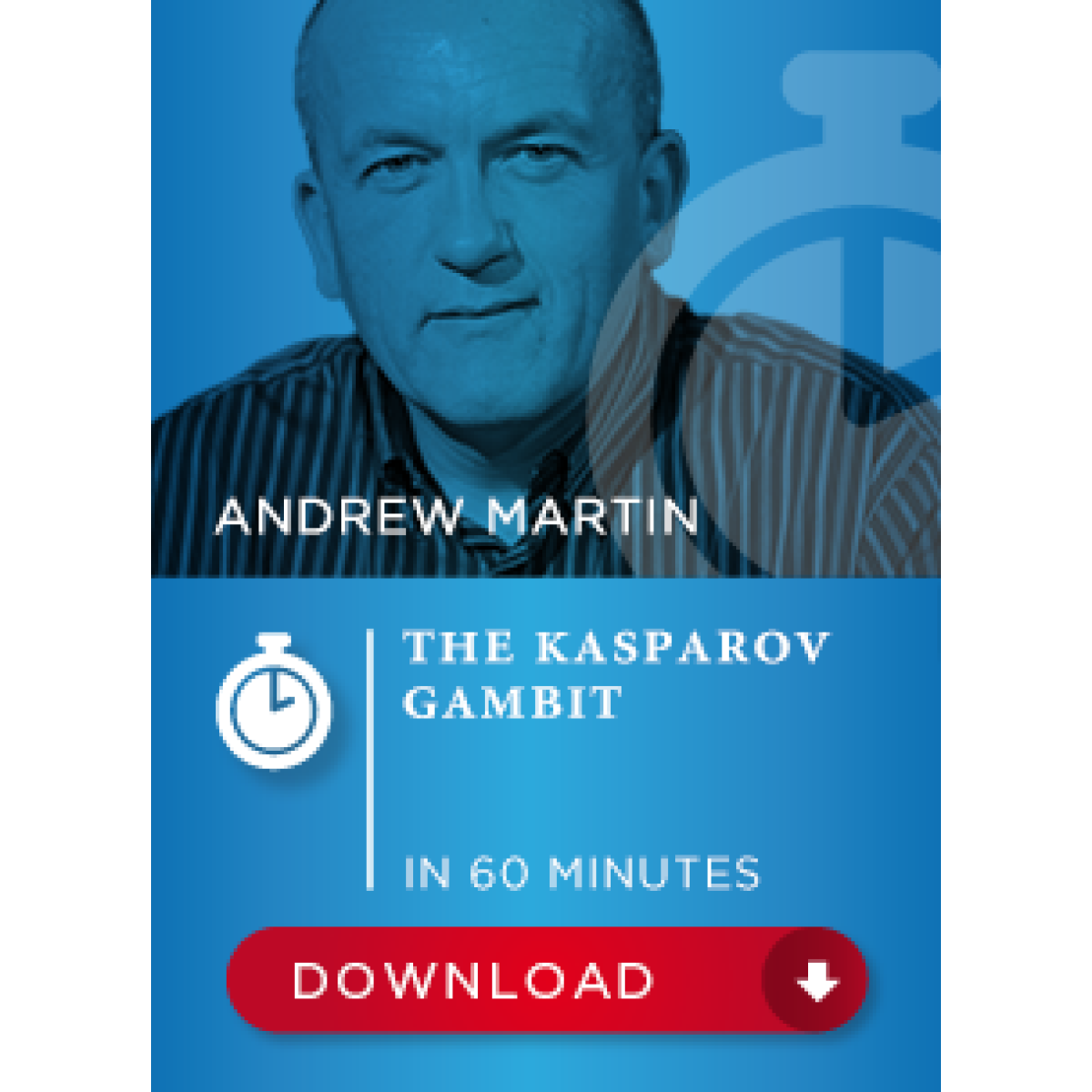
The initial position of the Kasparov Gambit can arise after 1.d4, 1.Nf3, or 1.c4, which attracts various types of players. The usual sequence is 1.d4 Nf6 2.c4 c5 3.Nf3 cxd4 4.Nxd4 e5!? 5.Nb5 d5 6.cxd5 Bc5, thus reaching a very dynamic position. In this 60-minute session, senior FIDE coach Andrew Martin presents the perspective from Black's side, showing classic Kasparov games along with current examples, and explains that White's defense is not easy. This practical gambit will help players of all levels increase their wins. It is ideal in situations where Black needs to win, as it is a gambit that White cannot decline: if White tries, Black immediately obtains a favorable position. Therefore, White must accept the challenge and fight.
In 1843, in a match considered unofficially as a world championship, English master Howard Staunton (1810–1874) played 1.c4 against the Frenchman Pierre Saint-Amant (1800–1872). Since then, this move has been known as the English Opening. However, it did not gain full recognition until the 1920s, and was later successfully adopted by modern world champions such as Botvinnik, Petrosian, Karpov, and Kasparov.
FORMAT: DOWNLOAD
This product is not supplied in physical format. You will receive an email from our store with the download link and product activation code.