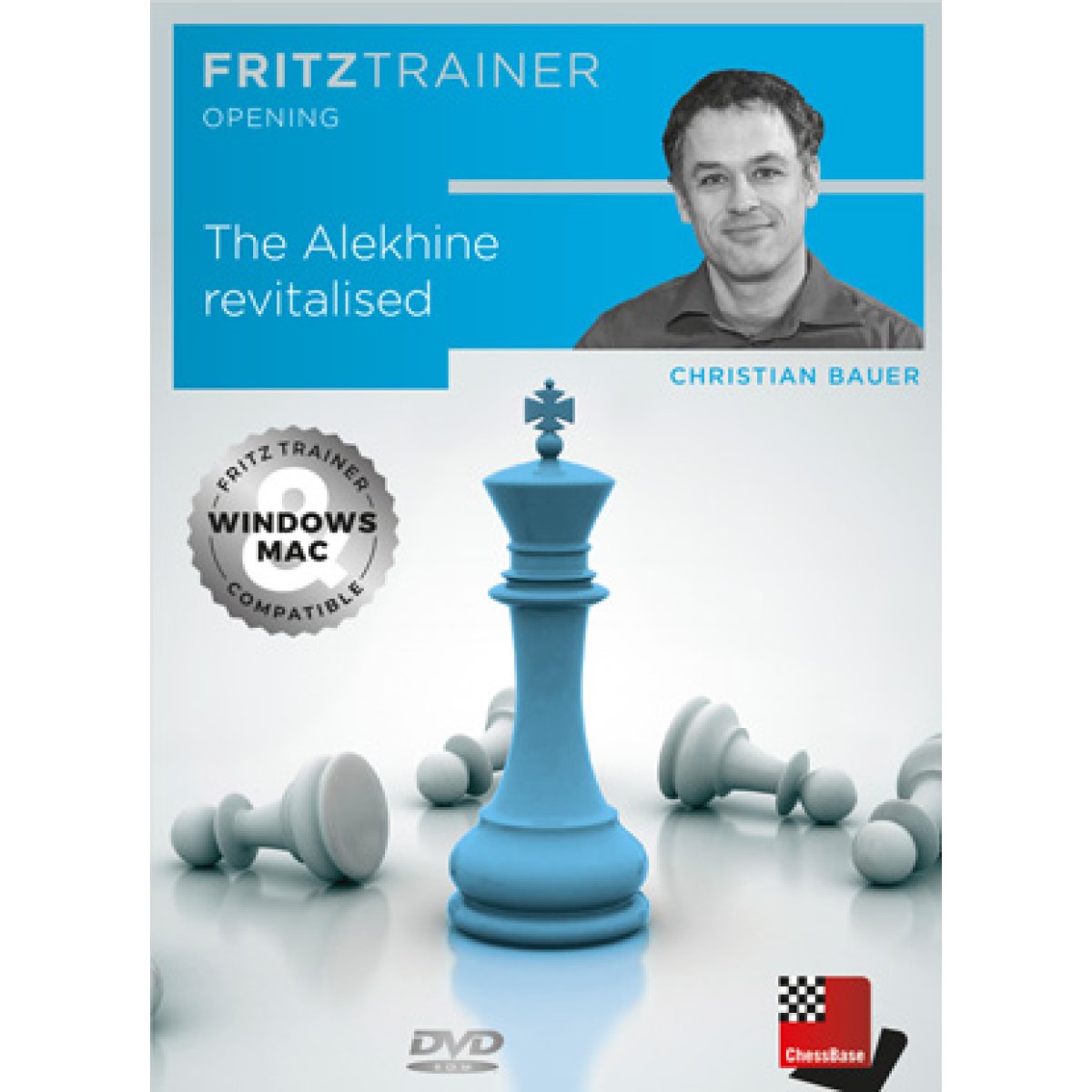


The Alekhine revitalised
search
  • The Alekhine revitalised

The Alekhine revitalized

€32.90
Tax included
Discover "The Alekhine Revitalised," a video course of over 5 hours that explores the bold Alekhine Defense (1.e4 Nf6), used even by Magnus Carlsen. This interactive training includes modern analyses, exercises with video feedback, and a database of model games to master innovative variations like the Voronezh. Ideal for surprising your opponents in rapid games and expanding your repertoire with an unconventional strategic approach.

FORMAT: DOWNLOAD
This product is not supplied in physical format. You will receive an email from our store with the download link and product activation code.

Quantity
In Stock

  Security policy

(edit with the Customer Reassurance module)

  Delivery policy

(edit with the Customer Reassurance module)

  Return policy

(edit with the Customer Reassurance module)

The Alekhine Defense (1.e4 Nf6) is an uncommon opening, especially at high levels. However, during the pandemic, this bold opening was used on several occasions, notably by the world champion Magnus Carlsen. Faster time controls and the unusual atmosphere of online games favored some players choosing this marginal opening to surprise their opponents.

Playing the Alekhine regularly is quite demanding, even somewhat risky. It's not that this provocative opening is bad, but there are well-established lines where White can obtain a slight advantage more easily than against more classical openings. This also means the surprise factor will be greater, especially in rapid games, where an unprepared opponent will have difficulties finding the best responses. In this video course, we will cover some modern lines that were still little explored 3 or 4 years ago, such as the surprising piece sacrifice in the well-known Voronezh Variation: 1.e4 Nf6 2.e5 Nd5 3.d4 d6 4.c4 Nb6 5.exd6 cxd6 6.Bc3 g6 7.Be3 Bg7 8.Rc1 O-O 9.b3 d5 10.c5 e5!?

In some correspondence games, Alekhine enthusiasts have employed the current trend of fianchetto against 1.e4 Nf6 2.e5 Nd5 3.d4 d6 4.Nf3, achieving quite positive results. The impression that White cannot easily obtain an advantage in the opening was later confirmed in over-the-board practice.

• Video duration: 5 hours 17 minutes

• Interactive training with video feedback

• Extras: model games database and training with ChessBase applications to memorize the repertoire and play key positions against Fritz at different levels

More... Less...
Included content:
  • Fritztrainer application for Windows and Mac
  • Available for download or on DVD
  • Video course with an approximate duration of 4 to 8 hours
  • Repertoire database: saves and integrates Fritztrainer games into your own repertoire (in WebApp Opening or ChessBase)
  • Interactive exercises with video feedback: authors present exercises and key positions; the user must enter the solution. Includes explanations and corrections on video
  • Example games in ChessBase database
  • New: many Fritztrainers now also available for streaming on the ChessBase video portal
FritzTrainer application features:
  • Videos can be watched in the Fritztrainer app or in the ChessBase program with board graphics, notation, and function bar
  • Analysis engine can be activated at any time
  • Video pause for manual navigation and notation analysis
  • Input of own variations, engine analysis, and storage in the game
  • Learn variations: view specific lines with autoplay in ChessBase WebApp Opening, memorize and practice transformations (starting position - final position)
  • Active opening training: selected positions are transferred to ChessBase WebApp Fritz-online. In a match against Fritz, you test your new knowledge by playing the opening
More options: launch FritzTrainer from the ChessBase program
  • The database with all games and analyses can be opened directly
  • Games can be easily added to the opening reference
  • Direct evaluation with game reference; games can be replayed on the analysis board
  • Own variations are saved and can be incorporated into the personal repertoire
  • Reproduction training
  • Active LiveBook
  • All engines installed in ChessBase can be used for analysis
  • Assisted analysis
  • Printing of notation and diagrams (for worksheets)

Sample video

Content

  • Introduction
  • Secondary lines
  • 1.e4 Nf6 2.e5 Nd5
  • Alternatives on the second move
  • Alternatives on the third move
  • 3.Bc3 Nxc3 4.bxc3
  • 3.c4 Nb6 4.a4 and 4.c5 Nd5 5.Bc3
  • Four Pawns Attack
  • 1.e4 Nf6 2.e5 Nd5 3.d4 d6 4.c4 Nb6 5.f4
  • 5...dxe5 6.fxe5 g6 and 6...c5 7.d5 g6
  • 5...g6
  • Exchange variation
  • 1.e4 Nf6 2.e5 Nd5 3.d4 d6 4.c4 Nb6 5.exd6
  • 5...exd6
  • 5...cxd6 6.d5 and 6.Bc3 g6 7.Bd3 Bg7 8.Nge2
  • 5...cxd6 6.Nf3 and 6.Bc3
  • Voronezh Variation
  • 1.e4 Nf6 2.e5 Nd5 3.d4 d6 4.c4 Nb6 5.exd6 cxd6 6.Bc3 g6 7.Be3 Bg7
  • Deviations before 9...e5
  • 8.Rc1 O-O 9.b3: alternatives on the ninth move
  • 9...Bf5
  • Endgame after 9...e5 10.dxe5 dxe5 11.Qxd8 Rxd8
  • Modern Variation
  • 1.e4 Nf6 2.e5 Nd5 3.d4 d6 4.Nf3 g6
  • 5.Ng5
  • 5.Bc4 Nb6 6.Bb3 Bg7: alternatives on the seventh move and previous deviations
  • 5.Bc4 Nb6 6.Bb3 Bg7 7.Qe2
  • 5.Bc4 Nb6 6.Bb3 Bg7 7.O-O
  • 5.Bc4 Nb6 6.Bb3 Bg7 7.Ng5 e6 8.f4 dxe5 9.dxe5
  • 5.Bc4 Nb6 6.Bb3 Bg7 7.Ng5 e6 8.f4 dxe5 9.fxe5
  • 5.Bc4 Nb6 6.Bb3 Bg7 7.Ng5 e6 8.Qf3
  • Exercises 1-15
  • Description
  • Exercise 1
  • Exercise 2
  • Exercise 3
  • Exercise 4
  • Exercise 5
  • Exercise 6
  • Exercise 7
  • Exercise 8
  • Exercise 9
  • Exercise 10
  • Exercise 11
  • Exercise 12
  • Exercise 13
  • Exercise 14
  • Exercise 15
  • Exercises 16-25
  • Exercise 16
  • Exercise 17
  • Exercise 18
  • Exercise 19
  • Exercise 20
  • Exercise 21
  • Exercise 22
  • Exercise 23
  • Exercise 24
  • Exercise 25
More...
Less...

Alekhine Defense

The Alekhine Defense is a provocative opening. Instead of contesting the center with a pawn as White does, Black invites the opponent to chase their knight, allowing White to form a broad pawn center while Black gains time. This is clearly seen in the main Four Pawns variation: 2.e5 Nd5 3.d4 d6 4.c4 Nb6 5.f4 dxe5 6.fxe5. White has three central pawns, while Black has moved their knight from g8 to the seemingly insignificant square b6.

This opening was not taken seriously until the future world champion Alexander Alekhine (1892–1946) began playing it in 1921. It developed at a time when old doctrines were questioned and innovation sought. The basic idea of provoking a pawn center that will later become a target of attacks was very influential and can be appreciated in many modern openings.

TAR-RAQW