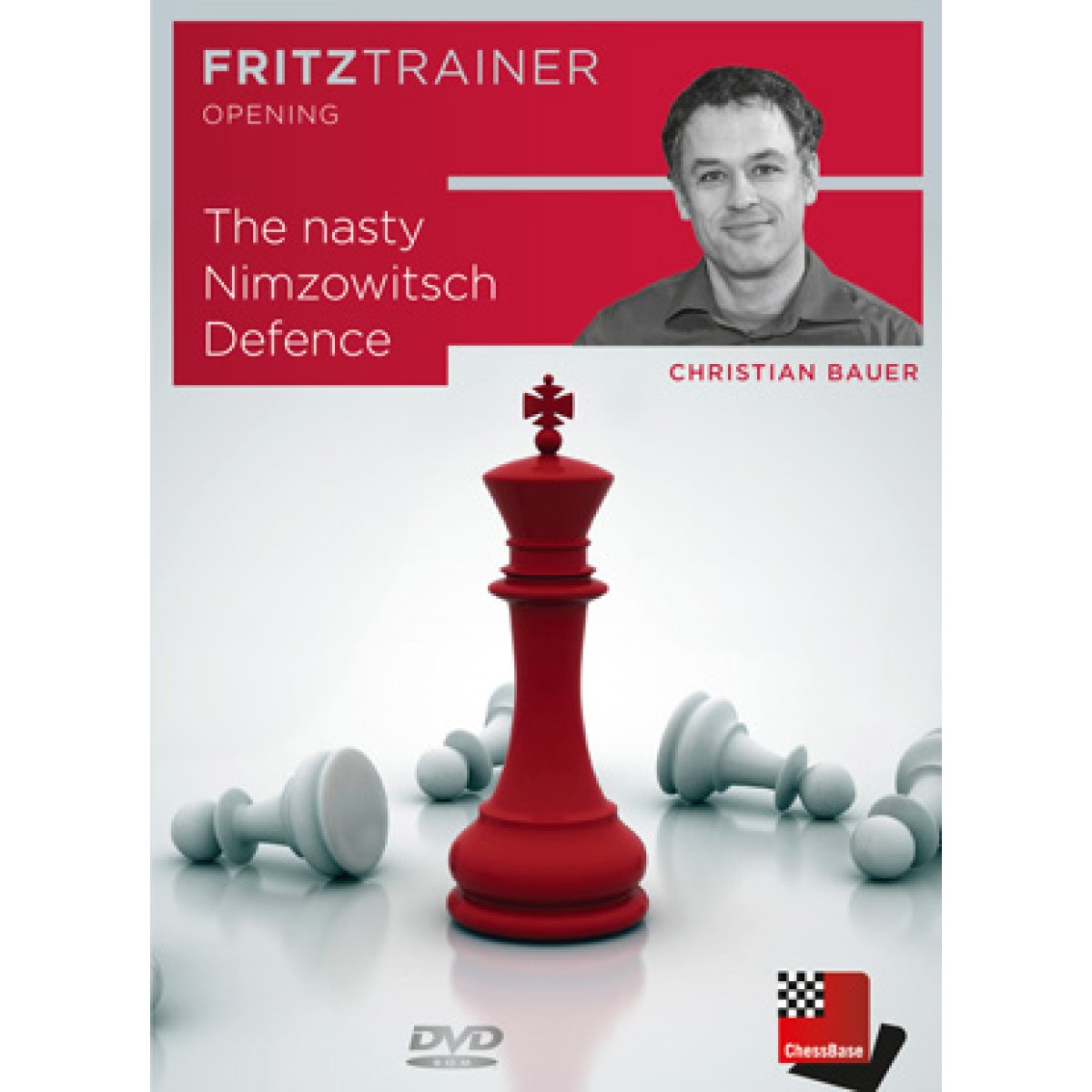

The nasty Nimzowitsch Defence
search
  • The nasty Nimzowitsch Defence

The nasty Nimzowitsch Defence

€29.90
Tax included
Discover the Nimzowitsch Defense (1.e4 Nc6), an uncommon and strategic opening to surprise your opponents. This nearly 4-hour video course, taught by Christian Bauer, explores rare but effective lines for Black, including a version of the Pirc Attack. It includes interactive training with video feedback, a database of model games, and compatibility with ChessBase Reader to enhance your repertoire and analysis.

FORMAT: DOWNLOAD
This product is not supplied in physical format. You will receive an email from our store with the download link and product activation code.

Quantity
In Stock

  Security policy

(edit with the Customer Reassurance module)

  Delivery policy

(edit with the Customer Reassurance module)

  Return policy

(edit with the Customer Reassurance module)

The Nimzowitsch Defense, 1.e4 Nc6, is a lesser-known and much less popular variation within opening theory, developed by the great strategist Aron Nimzowitsch. Unlike the Nimzo-Indian Defense, which is considered one of the most solid responses to 1.d4, the move 1...Nc6 in response to 1.e4 is usually regarded as one of the least reliable. This is mainly because Black voluntarily blocks their c-file pawn from the very first move, something many more orthodox players view with suspicion. However, there are factors beyond the mobility of the c-pawn, and this video series explores uncommon but entirely playable lines for Black. The main focus is a variation of the Pirc Defense following 1.e4 Nc6 2.Nf3 d6 3.d4 Nf6 4.Nc3 g6, where Black avoids the sharpest lines at the cost of some flexibility, since their knight is already committed to c6. Christian Bauer also offers recommendations for handling White's secondary options, as well as the second main line beginning with 2.d4.

• Video duration: 3 hours and 44 minutes (in English)
• Interactive training with video feedback
• Bonus: Database with model games
• Includes ChessBase Reader

Product contents:
  • Fritztrainer application for Windows
  • Available for download or on DVD
  • Video course with an approximate duration of 4 to 8 hours
  • Repertoire database: saves and integrates Fritztrainer games into your own repertoire (in WebApp Opening or ChessBase)
  • Interactive exercises with video feedback: the authors present exercises and key positions; the user must input the solution. Includes video explanations and corrections.
  • Model games in ChessBase database
FritzTrainer application features:
  • Videos can be played in the Fritztrainer application or in the ChessBase program with board, notation, and function bar
  • Analysis engine available at any time
  • Video pause for manual navigation and analysis in game notation
  • Input of your own variations, engine analysis, and saving within the game
  • Variant learning: view specific lines in ChessBase WebApp Opening with automatic playback, memorize and practice transformations (starting position - end position)
  • Active opening training: selected positions are transferred to ChessBase WebApp Fritz-online. In games against Fritz, you test and actively practice the learned opening.
More options: launch FritzTrainer from ChessBase:
  • Direct access to the database with all games and analyses
  • Easy incorporation of games into your opening repertoire
  • Direct evaluation with reference to games, playback on analysis board
  • Your own variations saved and added to your personal repertoire
  • Repetition training
  • Active LiveBook
  • Use of all engines installed in ChessBase for analysis
  • Assisted analysis
  • Printing notation and diagrams (for study materials)

Sample video

Contents

  • 01: Introduction [06:43]
  • 02: Synopsis [09:13]
  • Theory
  • 01: 2.Nc3 - Analysis [13:11]
  • 02: 2.Bb5 - Analysis [14:17]
  • 03: 2.d4 e5 3.dxe5 Nxe5 - Analysis [17:29]
  • 04: 2.d4 e5 3.d5 Nce7 - Analysis [15:08]
  • 05: 2.d4 d5 3.exd5 Qxd5 - Analysis [07:19]
  • 06: 2.d4 d5 3.e5 - Analysis [19:19]
  • 07: 2.d4 d5 3.Nc3 Nf6 - Analysis [11:21]
  • 08: 2.Nf3 without playing d6 - Analysis [16:16]
  • 09: 2.Nf3 d6 3.Bb5 or 3.d4 Nf6 4.Nc3 Bg4 5.Bb5 - Analysis [11:01]
  • 10: 2.Nf3 d6 3.d4 Nf6 4.c3 - Analysis [11:01]
  • 11: 2.Nf3 d6 3.d4 Nf6 4.Nc3 g6 5.Be2/Be3 without d4-d5 - Analysis [15:33]
  • 12: 2.Nf3 d6 3.d4 Nf6 4.Nc3 g6 5.Be3 and d4-d5 - Analysis [13:49]
  • 13: 2.Nf3 d6 3.d4 Nf6 4.Nc3 g6 5.Be2 and d4-d5 - Analysis [13:22]
  • 14: 2.Nf3 d6 3.d4 Nf6 4.Nc3 g6 5.d5 - Analysis [16:52]
  • 15: Conclusion [04:58]
  • Test
  • 01: Test 1 - Solution [00:45]
  • 02: Test 2 - Solution [01:12]
  • 03: Test 3 - Solution [00:48]
  • 04: Test 4 - Solution [01:11]
  • 05: Test 5 - Solution [00:51]
  • 06: Test 6 - Solution [01:10]
  • 07: Test 7 - Solution [00:44]
  • 08: Test 8 - Solution [01:11]
  • 09: Test 9 - Solution [01:00]
  • 10: Test 10 - Solution [01:36]
  • 11: Test 11 - Solution [01:02]
  • 12: Test 12 - Solution [01:46]
  • 13: Test 13 - Solution [00:48]
  • Training
  • 1.e4 Nc6 2.Nf3
  • 1.e4 Nc6 2.d4
  • 1.e4 Nc6 2.Nc3/Bb5
  • Model games: analyze various games to see how this opening is played in practice.
  • 1.e4 Nc6 2.d4:
  • 2...e5 3.dxe5 Nxe5 4.Nf3 Qf6 5.Nxe5 Qxe5 6.Bd3 Bb4+ 7.Nc3 Bxc3 8.bxc3 d6 9.O-O Nf6 10.f4 Qxc3 11.Be3 Bg4 12.Qb1
  • 2...e5 3.d5 Nce7 4.Nf3 Ng6 5.h4 h5 6.Bg5 Nf6 7.Nc3 Bc5 8.Na4 Bb4+ 9.c3 Be7 10.Bxf6
  • 2...d5 3.exd5 Qxd5 4.Nf3 e5 5.Nc3 Bb4+ 6.Bd2 Bxc3 7.Bxc3 e4 8.Nd2 Nf6 9.Nc4
  • 2...d5 3.e5 Bf5 4.Nf3 e6 5.Bd3 Nge7 6.O-O Bg4 7.c3 f6 8.Re1 fxe5 9.dxe5
  • 2...d5 3.Nc3 Nf6 4.e5 Nd7 5.f4 Nb6 6.Nf3 Bg4 7.Be2 e6 8.O-O Be7 9.h3
  • 1.e4 Nc6 2.Nf3 d6
  • 3.d4 Nf6 4.Nc3 Bg4 5.Bb5 a6 6.Bxc6 bxc6 7.Qd3 e6 8.Bg5 Be7 9.Nd2
  • 3.d4 Nf6 4.c3 g6 5.Bd3 Bg7 6.O-O O-O 7.h3 e5 8.Re1
  • 3.d4 Nf6 4.Nc3 g6 5.Be2 Bg7 6.O-O O-O 7.h3 e5 8.dxe5 dxe5 9.Be3
  • 3.d4 Nf6 4.Nc3 g6 5.Be3 Bg7 6.Qd2 O-O 7.d5 Nb8 8.Bh6 c6 9.h3 b5 10.a3
  • 3.d4 Nf6 4.Nc3 g6 5.Be2 Bg7 6.O-O O-O 7.d5 Nb8 8.Re1 c6 9.Bf1 Bg4 10.h3 Bxf3 11.Qxf3
  • 3.d4 Nf6 4.Nc3 g6 5.d5 Nb8 6.h3 c6 7.a4 Bg7 8.Bc4

Semi-Open Games

When Black does not respond with 1...e5 after 1.e4, the openings enter the semi-open category. Among them, the Sicilian Defense (1...c5) stands out as probably the most popular today. The French Defense (1...e6) and Caro-Kann Defense (1...c6) also have many followers. Additionally, this group includes modern systems such as the Alekhine Defense (1...Nf6), the Scandinavian Defense (1...d5), and the Pirc Defense (1...d6 or 1...g6).

TNND-HWLS