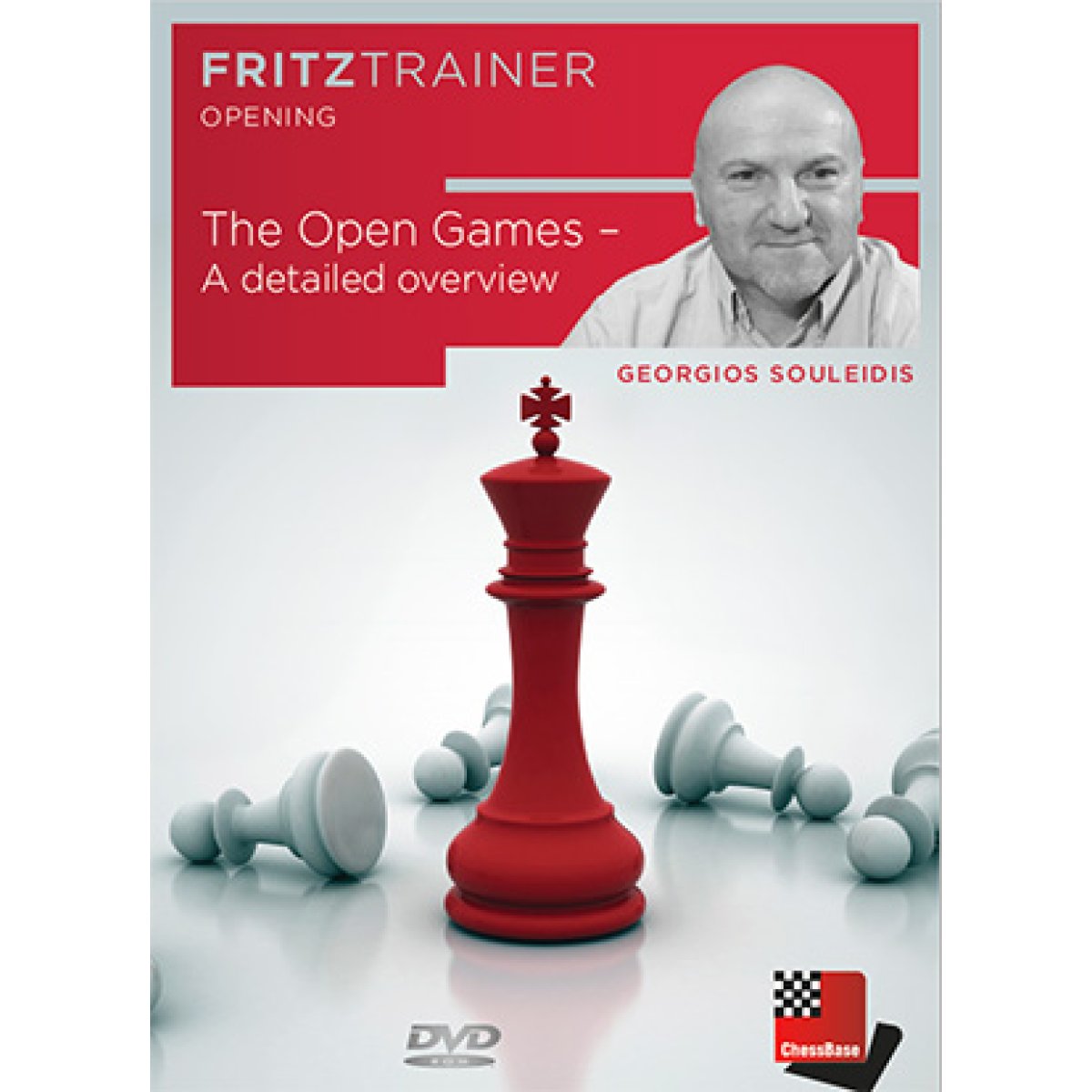

The Open Games - A detailed overview
search
  • The Open Games - A detailed overview

The Open Games - A detailed overview

€29.90
Tax included
Discover the Open Openings after 1.e4 e5 with International Grandmaster Georgios Souleidis. This 8-hour video course offers a detailed analysis of the main lines, such as the Italian Opening and the Ruy López, as well as less common variations. It includes interactive exercises, PDF materials, and a database with model games to perfect your play. Ideal for ambitious players and enthusiasts looking to master these classic openings.

FORMAT: DOWNLOAD
This product is not supplied in physical format. You will receive an email from our store with the download link and product activation code.

Quantity
In Stock

  Security policy

(edit with the Customer Reassurance module)

  Delivery policy

(edit with the Customer Reassurance module)

  Return policy

(edit with the Customer Reassurance module)

Open Openings begin after the moves 1.e4 e5. Their name comes from the fact that the position usually opens up quickly, which can lead to an early clash between opposing pieces. Typical examples are the Scotch Opening, the Two Knights Defense, or the classic King's Gambit. However, the most important openings after 1.e4 e5 are the Italian Game and the Ruy López, where the game usually develops more calmly. In this DVD, International Master Georgios Souleidis presents these and all other relevant openings arising after 1.e4 e5 in 36 videos.

It focuses especially on the main lines and explains the usual plans and ideas from both White’s and Black’s perspectives. Additionally, it analyzes the Open Openings that include more variations in 36 text articles (PGN format). The videos offer an introduction to each opening and include interactive exercises that allow you to directly apply what you have learned. The articles are more detailed and facilitate a deeper understanding of the material. The author also presents carefully selected model games by grandmasters and correspondence chess experts, which begin where the lines explained in the videos and articles end. The difficulty progressively increases according to the relevance of each opening. This DVD is ideal for ambitious young players and enthusiasts who wish to play any of the presented openings, but it is also very useful for advanced players who want to use the content as a basis to deepen their knowledge of a specific opening. Of course, it is also perfect for those who want to have a complete overview of the Open Openings in a single DVD.

• Video duration: 8 hours (in English)
• Interactive training with video feedback
• Extra: training in database format and PDF
• Includes CB Reader

More... Less...
Included content:
  • Fritztrainer application for Windows
  • Available for download or on DVD
  • Video course with an approximate duration of 4 to 8 hours
  • Repertoire database: save and integrate Fritztrainer games into your own repertoire (in WebApp Opening or ChessBase)
  • Interactive exercises with video feedback: the authors present exercises and key positions that the user must solve, with explanations and corrections
  • Model games in ChessBase database format
FritzTrainer application features:
  • Videos play in the Fritztrainer app or in ChessBase with board, notation, and function bar
  • Analysis engine can be activated at any time
  • Video pause for navigation and manual analysis in the notation
  • Input of own variations, engine analysis, and saving in the game
  • Variation learning: view specific lines in ChessBase WebApp Opening with automatic playback, memorize and practice transformations (starting position – final position)
  • Active opening training: selected positions transfer to ChessBase WebApp Fritz-online to play against Fritz and put what you’ve learned into practice
More options: launch FritzTrainer in ChessBase:
  • Database with all games and analyses accessible directly
  • Easy incorporation of games into the opening repertoire
  • Direct evaluation with reference to the game, playback on the analysis board
  • Saving and adding own variations to the repertoire
  • Playback training
  • Active LiveBook
  • Use of all engines installed in ChessBase for analysis
  • Assisted analysis
  • Printing notation and diagrams for worksheets

Sample video

Content

  • Introduction [06:26]
  • The database includes all articles, analyses, and selected model games:
  • Model Games
  • All articles in PDF combined in a single file:
  • PDF: The Open Openings
  • Uncommon openings
  • PDF analysis to avoid the Scholar’s Mate [03:48]
  • Exercise to avoid Scholar’s Mate 1 [01:47]
  • PDF analysis of the Center Game [10:16]
  • Center Game Exercise 1 [00:52]
  • Center Game Exercise 2 [00:57]
  • PDF analysis of the Latvian Gambit [09:23]
  • Latvian Gambit Exercise 1 [00:54]
  • Latvian Gambit Exercise 2 [00:50]
  • PDF analysis of the Ponziani Opening [08:07]
  • Ponziani Opening Exercise 1 [02:00]
  • Ponziani Opening Exercise 2 [02:02]
  • King’s Gambit
  • PDF analysis of Accepted King’s Gambit [11:11]
  • Accepted King’s Gambit Exercise 1 [02:34]
  • Accepted King’s Gambit Exercise 2 [01:34]
  • Accepted King’s Gambit Exercise 3 [01:38]
  • PDF analysis of Declined King’s Gambit [09:50]
  • Declined King’s Gambit Exercise 1 [02:19]
  • Declined King’s Gambit Exercise 2 [02:14]
  • Declined King’s Gambit Exercise 3 [01:24]
  • Vienna Game
  • PDF analysis of Vienna Game [10:45]
  • Vienna Game Exercise 1 [01:38]
  • Vienna Game Exercise 2 [02:56]
  • Vienna Game Exercise 3 [02:41]
  • Bishop’s Opening
  • PDF analysis of Bishop’s Opening [09:54]
  • Bishop’s Opening Exercise 1 [01:00]
  • Bishop’s Opening Exercise 2 [01:36]
  • Philidor Defense
  • PDF analysis of Philidor Defense [09:12]
  • Philidor Defense Exercise 1 [00:41]
  • Philidor Defense Exercise 2 [01:49]
  • Petrov Defense
  • PDF analysis of Petrov Defense 3.d4 [09:04]
  • Petrov Defense 3.d4 – Exercise 1 [02:28]
  • Petrov Defense 3.d4 – Exercise 2 [02:08]
  • Petrov Defense 3.d4 – Exercise 3 [01:54]
  • PDF analysis of Petrov Defense 3.Nxe5 [09:49]
  • Petrov Defense 3.Nxe5 – Exercise 1 [02:56]
  • Petrov Defense 3.Nxe5 – Exercise 2 [02:16]
  • Petrov Defense 3.Nxe5 – Exercise 3 [02:23]
  • Four Knights Game
  • PDF analysis of Four Knights Game [11:39]
  • Four Knights Game Exercise 1 [01:03]
  • Four Knights Game Exercise 2 [01:22]
  • Scotch Opening
  • PDF analysis of Scotch Opening 4...Nf6 [10:25]
  • Scotch Opening 4...Nf6 – Exercise 1 [02:08]
  • Scotch Opening 4...Nf6 – Exercise 2 [02:10]
  • PDF analysis of Scotch Opening 4...Bc5 [09:26]
  • Scotch Opening 4...Bc5 – Exercise 1 [02:06]
  • Scotch Opening 4...Bc5 – Exercise 2 [01:30]
  • Hungarian Defense
  • PDF analysis of Hungarian Defense [09:52]
  • Hungarian Defense Exercise 1 [01:41]
  • Hungarian Defense Exercise 2 [01:08]
  • Hungarian Defense Exercise 3 [01:24]
  • Two Knights Defense
  • PDF analysis of Two Knights Defense 4.d4 [10:15]
  • Two Knights Defense 4.d4 – Exercise 1 [01:15]
  • Two Knights Defense 4.d4 – Exercise 2 [00:57]
  • Two Knights Defense 4.d4 – Exercise 3 [01:09]
  • PDF analysis of Two Knights Defense 4.Ng5 [08:40]
  • Two Knights Defense 4.Ng5 – Exercise 1 [01:00]
  • Two Knights Defense 4.Ng5 – Exercise 2 [03:25]
  • PDF analysis of Two Knights Defense main line [10:21]
  • Two Knights Defense main line – Exercise 1 [01:17]
  • Two Knights Defense main line – Exercise 2 [00:50]
  • Giuoco Piano
  • PDF analysis of Evans Gambit [11:39]
  • Evans Gambit Exercise 1 [01:42]
  • Evans Gambit Exercise 2 [01:01]
  • Evans Gambit Exercise 3 [01:00]
  • PDF analysis of Italian Gambit [11:10]
  • Italian Gambit Exercise 1 [00:52]
  • Italian Gambit Exercise 2 [01:07]
  • Italian Gambit Exercise 3 [00:47]
  • PDF analysis of Möller Attack [09:06]
  • Möller Attack Exercise 1 [01:02]
  • Möller Attack Exercise 2 [01:19]
  • Möller Attack Exercise 3 [01:21]
  • PDF analysis of main line with a2-a4 [11:10]
  • Main line with a2-a4 Exercise 1 [01:07]
  • Main line with a2-a4 Exercise 2 [01:55]
  • PDF analysis of main line [11:30]
  • Main line Exercise 1 [00:50]
  • Main line Exercise 2 [01:47]
  • Main line Exercise 3 [00:53]
  • Ruy López
  • PDF analysis of uncommon moves after 3.Bb5 [10:50]
  • Uncommon moves after 3.Bb5 – Exercise 1 [01:05]
  • Uncommon moves after 3.Bb5 – Exercise 2 [01:27]
  • Uncommon moves after 3.Bb5 – Exercise 3 [01:05]
  • PDF analysis of Schliemann-Jaenisch Gambit [11:54]
  • Schliemann-Jaenisch Gambit Exercise 1 [01:00]
  • Schliemann-Jaenisch Gambit Exercise 2 [01:13]
  • PDF analysis of Berlin Defense [11:19]
  • Berlin Defense Exercise 1 [01:02]
  • Berlin Defense Exercise 2 [01:30]
  • Berlin Defense Exercise 3 [02:02]
  • PDF analysis of Exchange Variation [10:07]
  • Exchange Variation Exercise 1 [02:23]
  • Exchange Variation Exercise 2 [01:00]
  • PDF analysis of Modern Steinitz Defense [11:23]
  • Modern Steinitz Defense Exercise 1 [00:57]
  • Modern Steinitz Defense Exercise 2 [01:14]
  • Modern Steinitz Defense Exercise 3 [01:43]
  • PDF analysis of Open Defense [09:59]
  • Open Defense Exercise 1 [00:46]
  • Open Defense Exercise 2 [02:04]
  • Open Defense Exercise 3 [01:29]
  • PDF analysis of Modern Variation [14:48]
  • Modern Variation Exercise 1 [01:04]
  • Modern Variation Exercise 2 [01:37]
  • Modern Variation Exercise 3 [01:04]
  • PDF analysis of 6.d3 (deviations from 6.Ne1) [08:57]
  • 6.d3 (deviations from 6.Ne1) Exercise 1 [01:47]
  • 6.d3 (deviations from 6.Ne1) Exercise 2 [01:38]
  • PDF analysis of Marshall Attack [10:57]
  • Marshall Attack Exercise 1 [01:08]
  • Marshall Attack Exercise 2 [01:12]
  • PDF analysis of Karpov Variation [08:36]
  • Karpov Variation Exercise 1 [00:50]
  • Karpov Variation Exercise 2 [00:57]
  • PDF analysis of Saizev Variation [10:33]
  • Saizev Variation Exercise 1 [00:48]
  • Saizev Variation Exercise 2 [00:55]
  • Saizev Variation Exercise 3 [01:24]
  • PDF analysis of Breyer Variation [11:21]
  • Breyer Variation Exercise 1 [00:54]
  • Breyer Variation Exercise 2 [01:30]
  • Breyer Variation Exercise 3 [00:54]
  • PDF analysis of Chigorin Variation [08:41]
  • Chigorin Variation Exercise 1 [00:55]
  • Chigorin Variation Exercise 2 [01:09]

Open Openings

After 1.e4 e5, the so-called Open Openings arise. In the past, this sequence was almost obligatory, and some of the most famous games in chess history, such as the Immortal and the Evergreen, began this way. Nowadays, beginners usually learn to play these openings first, and it is in this group where the Scholar's Mate can appear (2.Qh5 Nc6 3.Bc4 Nf6 4.Qxf7 checkmate). At the same time, 1...e5 is considered the most solid response of all and dominates high-level chess.

TOG-ADO-MKNS