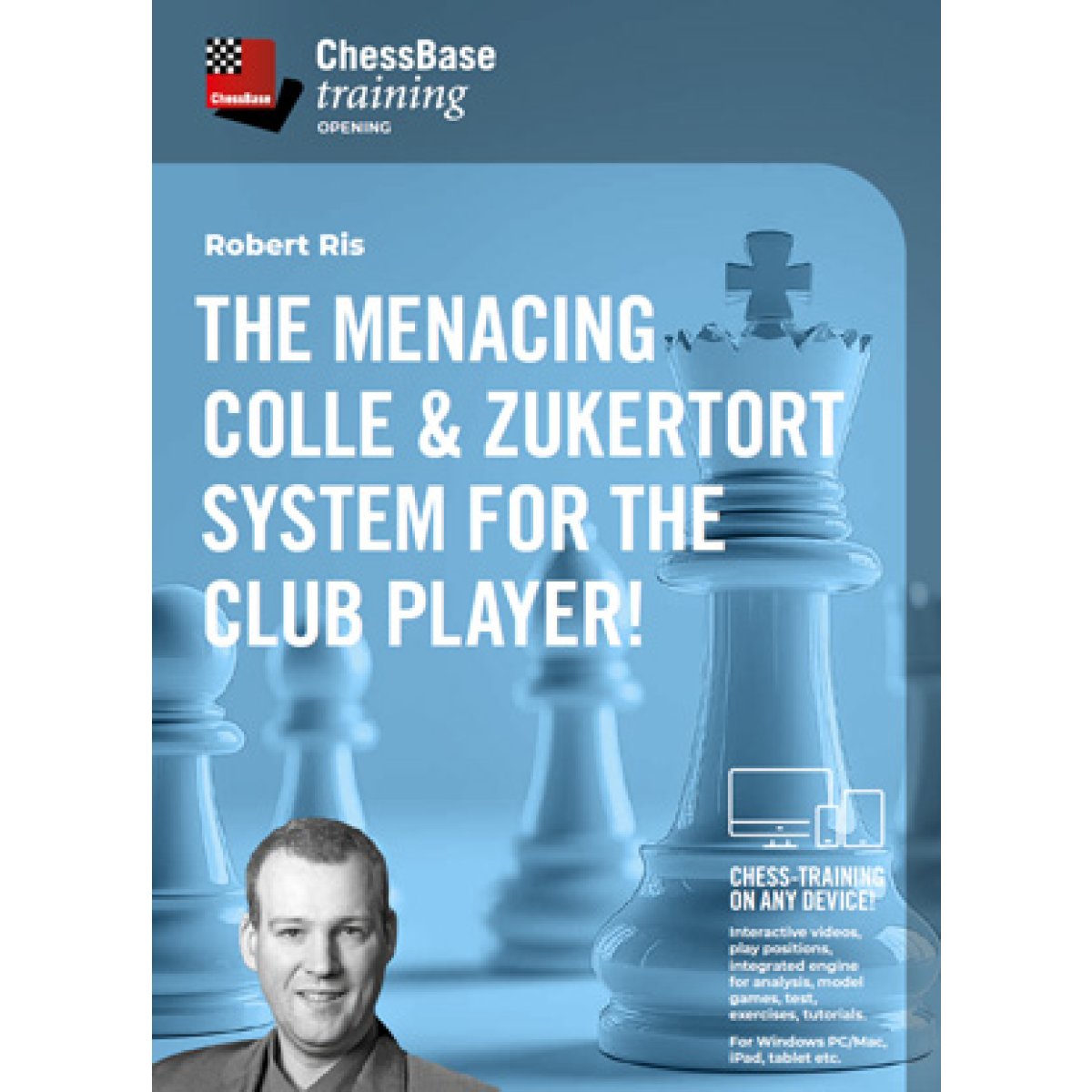
¡El amenazante Sistema Colle & Zukertort para el jugador de club!
€39.90
Tax included
Discover the Colle and Zukertort systems, simple and powerful openings for club players seeking a clear and quick plan to attack on the kingside. This course explains two key variations, with classic and modern examples, interactive exercises, and detailed analysis. Ideal for those who want to master the game without memorizing extensive theory and strengthen their control of the center with solid foundations and aggressive strategies.
FORMAT: DOWNLOAD This product is not supplied in physical format. You will receive an email from our store with the download link and product activation code.
One of the easiest openings for White to learn and, at the same time, one of the most complicated for Black. With the moves d4-Nf3-e3-Bd3, White aims for rapid piece development and to prepare a relentless attack on the kingside.
Free sample video: Introduction
Free sample video: Attack ideas with e4-e5
This course details two main setups. The Colle-Koltanowski system, named after Edgard Colle and George Koltanowski, who developed it in the 1920s, is based on c2-c3 followed by Nbd2 and the central break e3-e4. The alternative is the Zukertort system, which involves b2-b3 and the fianchetto of the dark-squared bishop, and is much more aggressive than it seems. Both systems are easy to learn and very popular among club players, with no need to memorize long theories, just a clear plan to attack quickly. Whichever you choose, White’s position has a solid foundation, no weaknesses, and firm control of the center—ready for action! The course presents thematic sacrifices, maneuvers, and attacking motifs, illustrated with classical games and recent grandmaster encounters.
More...Less...
Included content:
FritzTrainer for 4 platforms: app for Windows, Mac, ChessBase books, and ChessBase Videostream
Delivery in downloadable format or by mail (card with serial number)
Video course with an approximate duration of 4-8 hours
Repertoire database: saves and integrates FritzTrainer games into your own repertoire (in WebApp Opening or ChessBase)
Interactive exercises with video feedback: the authors present exercises and key positions; the user must enter the solution, with explanations and corrections
All videos, additional tasks, tests, and texts included in the ChessBase books
Example games in ChessBase database
FritzTrainer app features:
Video playback in the app or ChessBase program with board, notation, and control bar
Analysis engine available at any time
Video pause for navigation and manual analysis in the notation
Input of personal variations and engine analysis, saving modifications
Variation learning: view specific lines in ChessBase WebApp Opening with automatic playback, memorize and practice position transformations
Active opening training: selected positions transfer to ChessBase WebApp Fritz-online to play against Fritz and practice the opening
More possibilities: launch FritzTrainer in ChessBase
Direct access to database with all games and analyses
Easy incorporation of games into the opening reference
Direct evaluation with references, playable games on the analysis board
Personal variations saved and addable to your personal repertoire
Playback training
Active LiveBook
Use of all engines installed in ChessBase for analysis
Assisted analysis
Printing of notation and diagrams for study materials
New ChessBase product installer:
The CB booklet contains all the necessary information to install the product on your computer
Does not include a DVD, but holds a valuable place in your collection
Includes complete instructions and serial number to activate the product
No DVD drive required for installation
The booklet is environmentally friendly, made without plastic
Sample video
Content
Introduction
The Colle-Koltanowski system (c3)
Introduction to White’s basic attacking structure: Colle-Burger
Different tactical motifs: Colle-Delvaux
Greek gift: Colle-O'Hanlon
Attack ideas with e4-e5: Koltanowski-O'Hanlon
Long-term problems for Black with e4-e5: Maroczy-Singer
Play against isolated pawn: Koltanowski-Defosse
An early ...cxd4, exd4: exploiting the e5 square: Ivanisevic-Peng
Plan dxc5 & b4 – Power of the bishops: Hoexter-Pibernik
Meran-type ideas with colors reversed: Koellner-Polaczek
Majority on the queenside – Total pressure on the board: Tartakower-Domenech
Black plays an early ...c5-c4: Przepiorka-Nimzowitsch
Ne5 & f2-f4 attack on the kingside: San Marco-Biro
The initiative: Lakdawala-Akobian
Open center: Gomez-Martinez
Modern classics
Rook lift: Wei Yi-Vidit
Colle system in a World Championship: Ding Liren-Nepomniachtchi
Inverted triangle variation – Queenside vs. center, basic ideas: Ju Wenjun-Lei Tingjie
Inverted triangle variation – Queenside vs. center, modern theory ...g7-g5!: Abdusattorov-Ding Liren
The Zukertort system (b3)
Power of White’s bishops: Jussupow-Scheeren
Super grandmaster vs. amateur – basic ideas explained: Jussupow-Uurits
A free attack: Maroczy-Blake
How to anticipate Black’s defenses: Bruzon-Anand
Sensational new interpretation of Zukertort: Carlsen-Korobov
Attack plans c4-d4 against d6-e6 for White: Colle-Gruenfeld
Idea ...Ba3, model game for Black and improvements for White: Bogoljubow-Capablanca
Repertoire against King’s Indian Defense: Nakamura-Idani
Repertoire against Benko/Ben-Oni: Efimenko-Hnydiuk
Exercises
Exercise 1
Exercise 2
Exercise 3
Exercise 4
Exercise 5
Exercise 6
Exercise 7
Exercise 8
Exercise 9
Exercise 10
Repertoire training
Colle system with c3
Modern classics (early c5)
Zukertort system with b3
Positions to practice
Position 1
Position 2
Position 3
Position 4
Position 5
Position 6
Position 7
Position 8
Position 9
Position 10
Position 11
Position 12
Position 13
Position 14
Position 15
Conclusion
Bonus
Model games
Analysis
Exercises
More...
Less...
Colle Opening
The Colle system is one of the preferred queen’s pawn openings, especially among amateurs, because of its simplicity to learn and play. It is named after the Belgian master Edgar Colle (1897–1932), who achieved beautiful aggressive victories in the 1920s. Although the move 3.e3 seems to limit the light-squared bishop, the preparation with c3, Nbd2, castling, and possibly Re1 or Qe2, followed by the advance e3-e4, allows White to occupy the advanced e5 square and exert strong pressure that can prove decisive against an unprepared opponent.
Discover the Colle and Zukertort systems, simple and powerful openings for club players seeking a clear and quick plan to attack on the kingside. This course explains two key variations, with classic and modern examples, interactive exercises, and detailed analysis. Ideal for those who want to master the game without memorizing extensive theory and strengthen their control of the center with solid foundations and aggressive strategies.
FORMAT: DOWNLOAD This product is not supplied in physical format. You will receive an email from our store with the download link and product activation code.


 Security policy
 Delivery policy
 Return policy