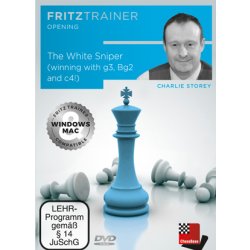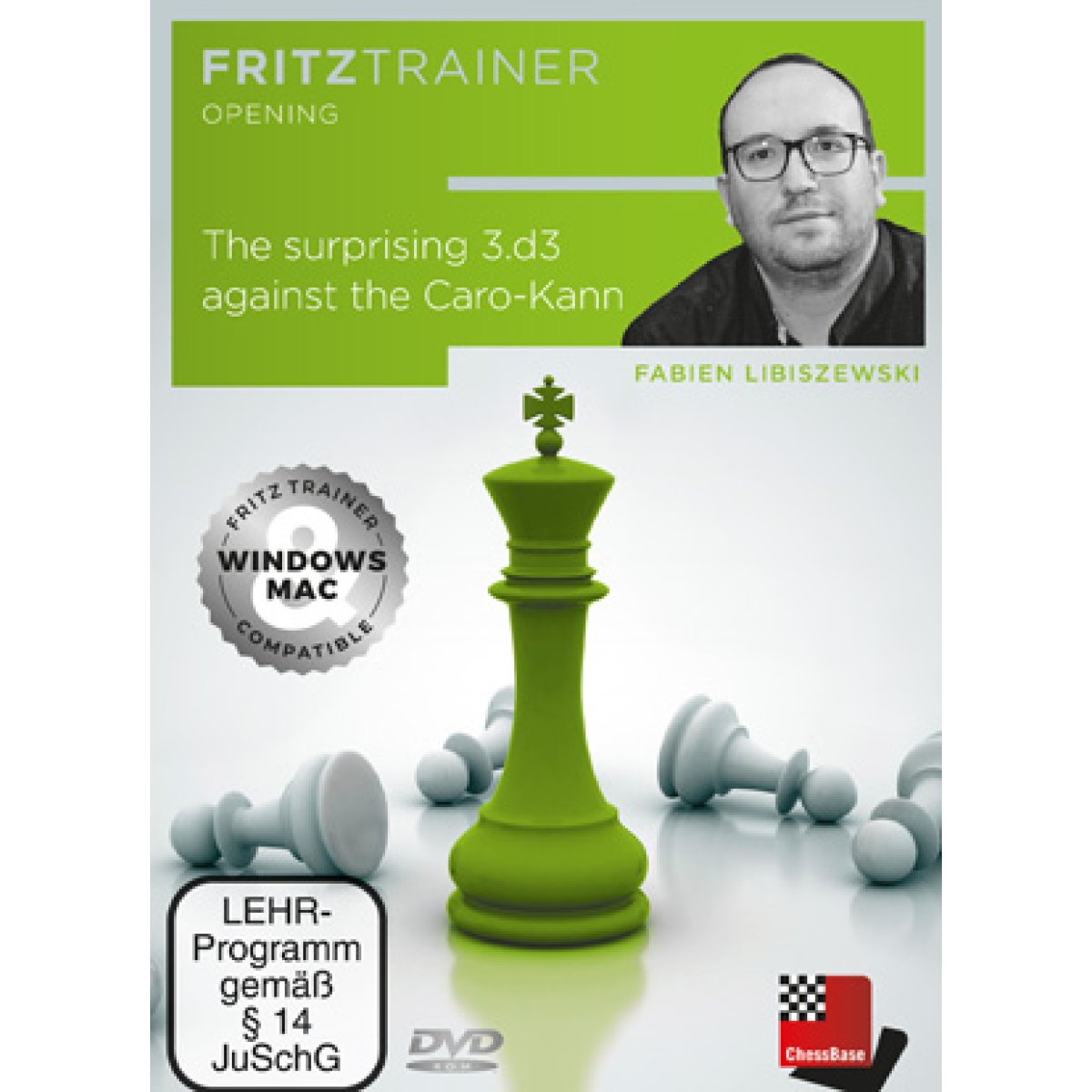


The surprising 3.d3 against the Caro-Kann
search
  • The surprising 3.d3 against the Caro-Kann

The surprising 3.d3 against the Caro-Kann

€32.90
Tax included
Discover a new strategy to face the Caro-Kann Defense with the surprising move 3.d3. This innovative line, supported by the AI Leela Zero and used by grandmasters such as Carlsen and Vachier-Lagrave, leads you to an early endgame full of opportunities. With over 3 hours of interactive content, learn to master pawn structures, key maneuvers, and how to overcome your opponent’s responses with a complete and practical repertoire.

FORMAT: DOWNLOAD
This product is not supplied in physical format. You will receive an email from our store with the download link and product activation code.

Quantity
In Stock

  Security policy

(edit with the Customer Reassurance module)

  Delivery policy

(edit with the Customer Reassurance module)

  Return policy

(edit with the Customer Reassurance module)

Transform your strategy against the Caro-Kann Defense with this exclusive guide. We boldly face the Caro-Kann with the innovative move 1.e4 c6 2.Nf3 d5 3.d3!?, a strategic choice that disrupts Black's usual patterns and leads us to an early endgame full of opportunities for you. This line, driven by the AI phenomenon Leela Zero, is employed by grandmasters such as Carlsen, Vachier-Lagrave, Nepomniachtchi, Firouzja, Giri, among others.

Free sample video: Introduction

Free sample video: Model game

Free sample video: 3...Nf6 and 3...e6

In this Fritztrainer, you will learn how to handle the endgame after 3... dxe4 4.dxe4 Qxd1+ 5.Kxd1, exploring the details of pawn structure changes to get the most out of it. Additionally, you will deepen your understanding of the positions and master responses to other Black's third moves, without relying on lengthy theoretical lines, thus creating a complete repertoire. Get ready to dominate the board and enjoy facing the Caro-Kann.

  • Total video duration: 3 hours and 25 minutes
  • Interactive training with video feedback
  • Bonus: Train with ChessBase applications to memorize the repertoire and play key positions against Fritz at different levels
More... Less...
This product includes:
  • Fritztrainer application for Windows and Mac
  • Available for download or on DVD
  • Video course with an approximate duration of 4 to 8 hours
  • Repertoire database: save and integrate Fritztrainer games into your personal repertoire (in WebApp Opening or ChessBase)
  • Interactive exercises with video feedback: the authors present exercises and key positions; the user must enter the solution. Includes explanations and corrections in video
  • Example games in ChessBase database
  • New: many Fritztrainers also available for streaming on the ChessBase video portal
Features of the FritzTrainer application:
  • Videos can be watched in the Fritztrainer application or in ChessBase with board, notation, and function bar
  • Ability to activate the analysis engine at any time
  • Pause for manual navigation and analysis in game notation
  • Input of your own variations, engine analysis, and saving in the game
  • Variation learning: view specific lines in ChessBase WebApp Opening with automatic playback, memorize and practice transformations (starting position – final position)
  • Active opening training: selected positions transfer to ChessBase WebApp Fritz-online to play against Fritz and test your knowledge
More options: launch FritzTrainer from the ChessBase program
  • Direct access to the database with all games and analyses
  • Easy incorporation of games into your opening references
  • Direct evaluation with game references, board playback of analysis
  • Saving your own variations to expand your repertoire
  • Repetition training
  • Active LiveBook
  • Use of all engines installed in ChessBase for analysis
  • Assisted analysis
  • Printing of notation and diagrams for study materials

Sample Video

Contents

  • Introduction
  • Model games
  • Anderson – Tempone
  • Anderson – Franco Ocampos
  • Carlsen – Ostmoe
  • Theory
  • 1.e4 c6 2.Nf3 d5 3.d3
  • 3... Nf6 and 3... e6
  • 3... g6
  • 3... Qc7 and 3... Nd7
  • 3...Bg4 4.h3 Bxf3
  • 3...Bg4 4.h3 Bh5
  • Endgame after 3...dxe4 4.dxe4 Qxe1 5.Kxe1 Bg4
  • Endgame after 3...dxe4 4.dxe4 Qxe1 5.Kxe1 Nf6
  • Conclusion
  • Exercises
  • Exercise 1
  • Exercise 2
  • Exercise 3
  • Exercise 4
  • Exercise 5
  • Exercise 6
  • Exercise 7
  • Exercise 8
  • Exercise 9
  • Exercise 10
  • Exercise 11
  • Practice positions
  • Position 1 (Variation 3...g6)
  • Position 2 (Variation 3...Nbd7)
  • Position 3 (Variation 3...Qc7)
  • Position 4 (Variation 3...Qc7)
  • Position 5 (Endgame with 3...dxe4)
  • Position 6 (Endgame with 3...dxe4 and 5...Bg4)
  • Position 7 (Endgame with 3...dxe4 and 5...Bg4)
  • Repertoire training
  • Description
  • 3...Bg4
  • Endgame with 3...dxe4
  • Alternatives on the 3rd move
  • 3...Qc7 and 3...Nd7
  • Bonus
  • Analysis
More...
Less...

French Defense

When Black responds to White's double king pawn advance with 1...e6, the French Defense is employed. Its name comes from a correspondence match between London and Paris in 1834, where the French successfully used this move. In the 19th century, it was the main alternative to 1...e5 and today remains the third most popular reply to 1.e4, after the Sicilian Defense and 1...e5.

TS3ATC-FYML