

The Tarrasch Defence
search
  • The Tarrasch Defence

The Tarrasch Defence

€29.90
Tax included
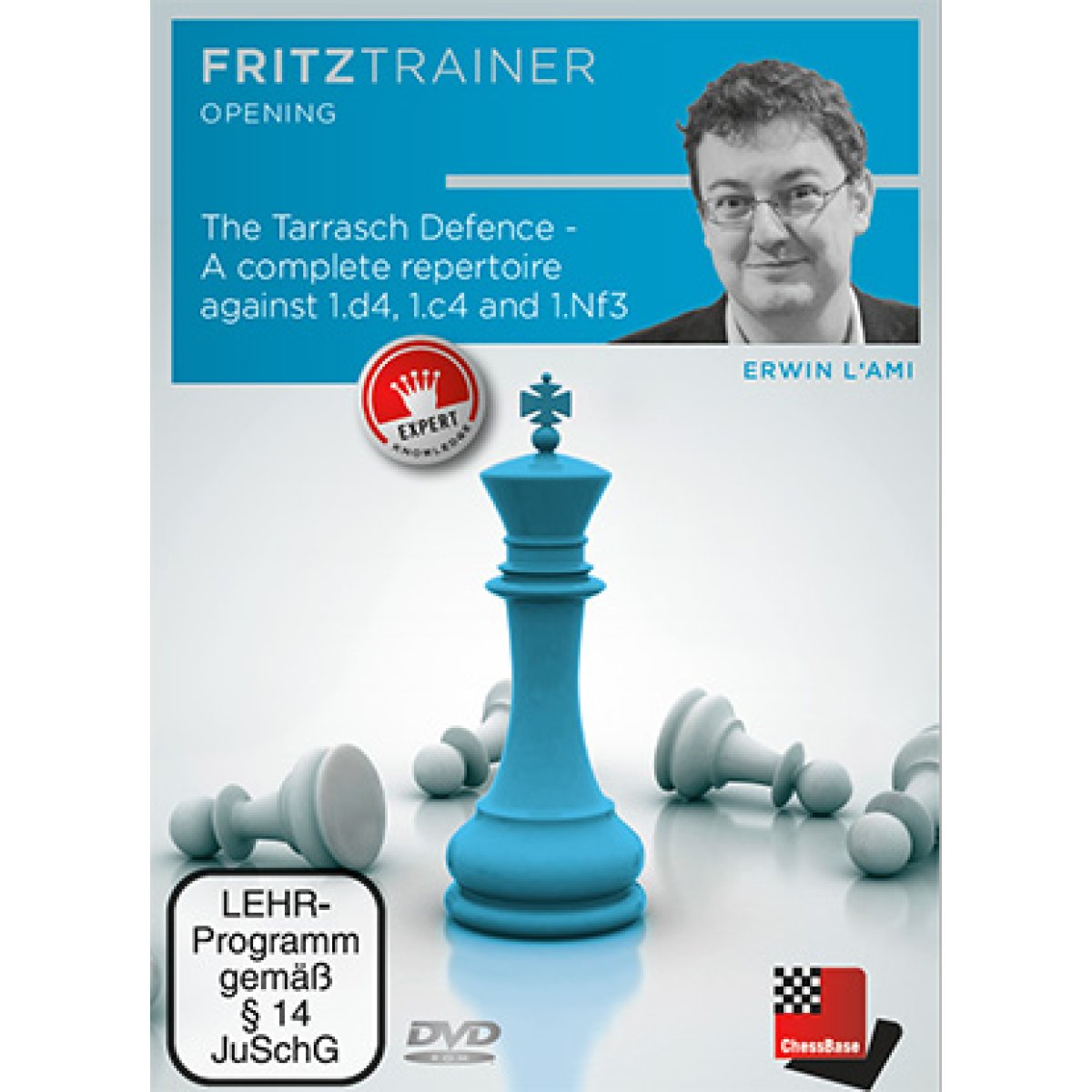
Discover the Tarrasch Defense, an ambitious and active response to 1.d4 that was mastered by world champions like Spassky and Kasparov. With over 7 hours of video content in English, Grandmaster Erwin l’Ami reveals new ideas and essential strategies to master this opening. Includes interactive training, a database with analysis and model games, and the Fritztrainer app to practice and deepen your repertoire. Ideal for players looking to improve their tournament play.

FORMAT: DOWNLOAD
This product is not supplied in physical format. You will receive an email from our store with the download link and product activation code.

Quantity
In Stock

  Security policy

(edit with the Customer Reassurance module)

  Delivery policy

(edit with the Customer Reassurance module)

  Return policy

(edit with the Customer Reassurance module)

Looking for an active defense against 1.d4? Look no further!

The Tarrasch Defense (1.d4 d5 2.c4 e6 3.Nc3 c5) is one of Black's most ambitious responses to 1.d4. It’s no coincidence that world champions Boris Spassky and Garry Kasparov have employed it.

This opening is characterized by an immediate struggle for the center and active piece play. Grandmaster Erwin L'Ami masters the Tarrasch Defense and has used it successfully with both colors. In this DVD, L'Ami presents numerous new ideas never before seen in tournament practice. Additionally, in a broad strategic section, he explains the typical concepts of this opening. Essential for ambitious tournament players!

• Video duration: 7 hours (in English)
• Interactive training with video feedback
• Bonus: database with exhaustive analyses and model games
• Includes CB Reader

More... Less...
Included content:
  • Fritztrainer application for Windows
  • Available for download or on DVD
  • Video course with approximate duration of 4 to 8 hours
  • Repertoire database: saves and integrates Fritztrainer games into your personal repertoire (in WebApp Opening or ChessBase)
  • Interactive exercises with video feedback: authors present exercises and key positions; the user must enter the solution. Includes explanations and feedback, even on mistakes.
  • Example games in database format for ChessBase
FritzTrainer application features:
  • Videos can be played in the Fritztrainer application or in ChessBase, with graphic board, notation, and extended function bar
  • Analysis engine available at all times
  • Video pause for manual navigation and analysis in game notation
  • Input of own variations, engine analysis, and storage in the game
  • Learn variations: view specific lines in ChessBase WebApp Opening with automatic playback, memorize and practice transformations (starting position - end position)
  • Active opening training: selected positions are transferred to ChessBase WebApp Fritz-online. In games against Fritz, you test and practice the new opening
More options: launch FritzTrainer in ChessBase:
  • Database with all games and analyses accessible directly
  • Easy integration of games into the opening reference
  • Direct evaluation with game references, games playable on analysis board
  • Own variations saved and addable to personal repertoire
  • Reproduction training
  • Active LiveBook
  • All engines installed in ChessBase can be used for analysis
  • Assisted analysis
  • Printing of notation and diagrams (for study materials)

Sample Video

Contents

  • 01: Welcome [01:00]
  • 02: Introduction [07:41]
  • 03: The correct exchange [16:21]
  • 04: Structure vs Activity [16:51]
  • 05: Changing the pawn structure [09:01]
  • 06: The pressure [21:51]
  • 07: The exchange sacrifice on e3 [10:43]
  • Chapter 2: 6.g3 and 9.Bg5
  • 01: 9.Bg5 c4 10.Ne5 Be6 11.b3 Qa5 - video notation [15:19]
  • 02: 9.Bg5 c4 10.Ne5 Be6 11.b3 h6 12.Bxf6 Bxf6 13.Nxc6 bxc6 14.Na4/Rc1 - video notation [14:15]
  • 03: 9.Bg5 c4 10.Ne5 Be6 11.b3 h6 12.Bxf6 Bxf6 13.Nxc6 bxc6 14.bxc4 dxc4 15.e3 Qa5/Rc8 - video notation [14:52]
  • 04: 9.Bg5 c4 10.Ne5 Be6 11.b3 h6 12.Bxf6 Bxf6 13.Nxc6 bxc6 14.bxc4 dxc4 15.e3 c5 - video notation [17:12]
  • 05: 9.Bg5 c4 10.Ne5 Be6 11.Nxc6 - video notation [01:25]
  • 06: 9.Bg5 c4 10.Ne5 Be6 11.e3 h6 12.Bxf6 Bxf6 13.f4 Ne7 - video notation [09:01]
  • 07: 9.Bg5 c4 10.Ne5 Be6 11.e3 h6 12.Bxf6 Bxf6 13.f4 Bxe5 - video notation [06:24]
  • 08: 9.Bg5 c4 10.Ne5 Be6 11.f4 - video notation [10:05]
  • Chapter 3: 6.g3 and 9.dxc5
  • 01: 9.dxc5 Bxc5 10.Na4 Be7 11.Be3 Bg4 12.h3/Bc5/Nc5 - video notation [08:26]
  • 02: 9.dxc5 Bxc5 10.Na4 Be7 11.Be3 Bg4 12.Rc1 - video notation [07:09]
  • 03: 9.dxc5 Bxc5 10.Bg5 d4 11.Bxf6 - Timman Variation - video notation [07:19]
  • 04: 9.dxc5 Bxc5 10.Bg5 d4 11.Ne4 - video notation [12:17]
  • 05: 9.dxc5 Bxc5 10.a3/b3 - video notation [17:00]
  • 06: 9.dxc5 Bxc5 10.Bf4 - video notation [05:07]
  • 07: 9.b3/Be3/e3/Bf4 - video notation [12:40]
  • Chapter 4: 6.dxc5
  • 01: 6...d4 7.Na4 Bxc5 8.Nxc5 Qa5 9.Bd2 Qc5 10.Rc1 - video notation [10:27]
  • 02: 6...d4 7.Na4 Bxc5 8.Nxc5 Qa5 9.Bd2 Qc5 10.b4 - video notation [06:25]
  • 03: 6...d4 7.Na4 Bxc5 8.Nxc5 Qa5 9.Qd2 Qc5 10.e3 - video notation [07:40]
  • 04: 6...d4 7.Na4 Bxc5 8.Nxc5 Qa5 9.Qd2 Qc5 10.a3 - video notation [09:53]
  • 05: 5.dxc5 - video notation [08:19]
  • Chapter 5: Other lines and theoretical summary
  • 01: 4.cxd5 exd5 5.Nf3 Nc6 6.Bf4 - video notation [04:34]
  • 02: 4.cxd5 exd5 5.e4 - video notation [08:44]
  • 03: 3.Nf3 c5 4.cxd5 exd5 5.Bg5 and 5.Nc3 Nc6 6.Bg5 - video notation [14:10]
  • 04: 3.Nf3 c5 4.cxd5 exd5 5.g3 Nc6 6.Bg2 Nf6 7.O-O Be7 8.dxc5 Bxc5 9.a3/Bg5 - video notation [09:04]
  • 05: 3.Nf3 c5 4.cxd5 exd5 5.g3 Nc6 6.Bg2 Nf6 7.O-O Be7 8.dxc5 Bxc5 9.Qc2 - video notation [06:47]
  • 06: 3.Nf3 c5 4.cxd5 exd5 5.Nc3 Nc6 6.e3 - video notation [09:35]
  • 07: 3.Nc3 c5 4.e3 - video notation [08:59]
  • 08: Theoretical summary [08:11]
  • Chapter 6: Games
  • 01: Taimanov, M - Spassky, B [09:39]
  • 02: Petrosian, T - Spassky, B [13:53]
  • 03: Tal, M - Keres, P [07:15]
  • 04: Polugaevsky, L - Pfleger, H [09:46]
  • 05: Forgacs, L - Tarrasch, S [10:58]
  • Chapter 7: Test section
  • 01: Test 1 - Koneru, H - Zhukova, N [01:06]
  • 02: Test 2 - Mory, E - Efimov, I [02:27]
  • 03: Test 3 - Onischuk, A - Graf, A [02:11]
  • 04: Test 4 - Zhao, X - Petrosian, T [02:22]
  • 05: Test 5 - Berkes, F - Petrosian, T [01:32]
  • 06: Test 6 - Schussler, H - Petursson, M [01:59]
  • 07: Test 7 - Kagramanianz, V - Vysochin, S [01:39]
  • 08: Test 8 - Andersson, U - Ricardi, P [02:23]
  • 09: Test 9 - Tadic, B - Dobrev, N [01:48]
  • 10: Test 10 - Antic, D - Kotronias, V [02:25]
  • 11: Farewell [01:45]
More...
Less...

Queen's Gambit

Occupying the center with 1.d4 is, along with 1.e4, one of the most common ways to start a game. If Black responds symmetrically with 1...d5, after 2.c4 the Queen's Gambit arises. In most cases, Black supports the pawn on d5, gaining participation in the center: either with 2...e6 – Queen's Gambit Declined – or with 2...c6 – Slav Defense. A third and very different option is 2...dxc4, the Queen's Gambit Accepted.

TTD-HJMJ