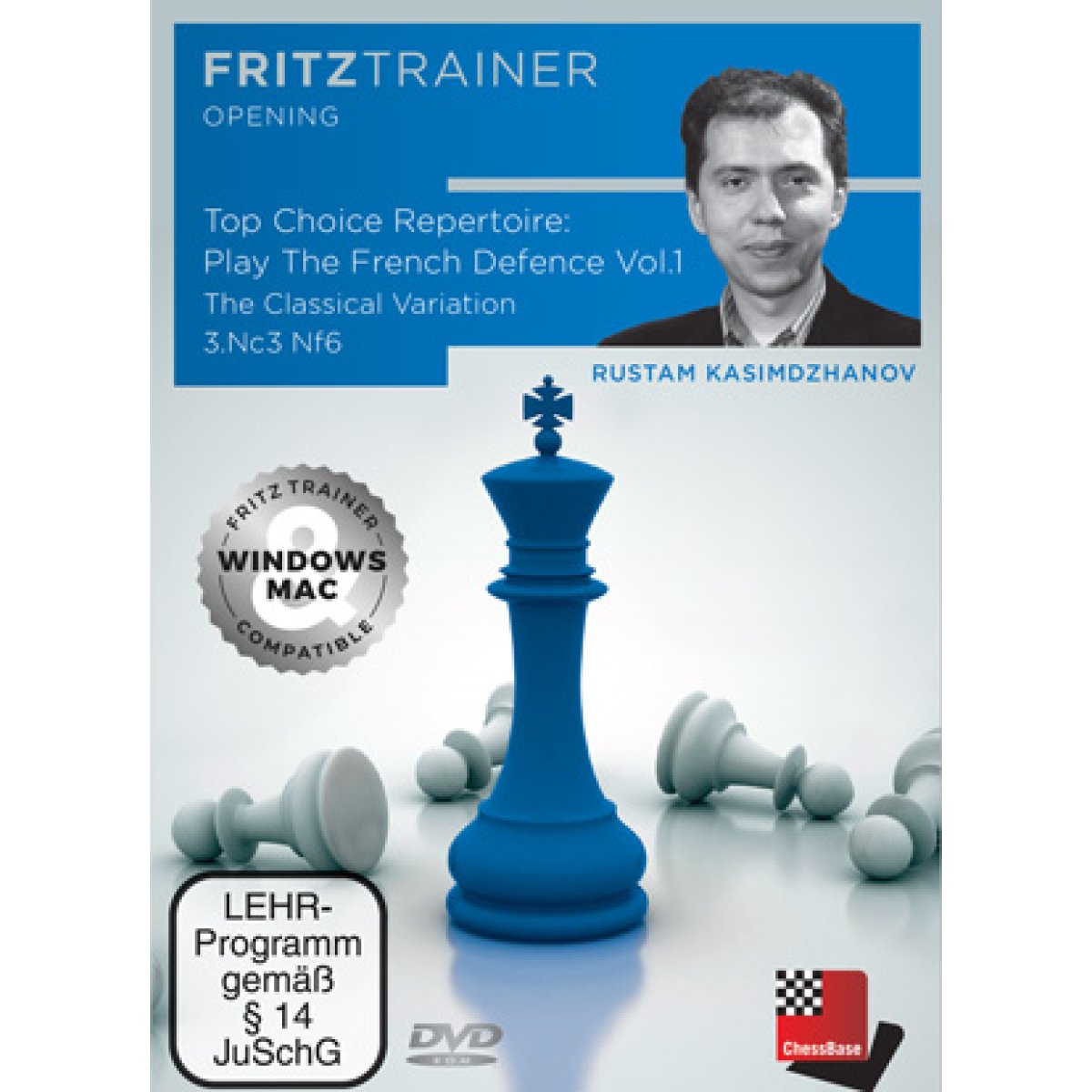


Top Choice Repertoire: Play the French Defence Vol.1
search
  • Top Choice Repertoire: Play the French Defence Vol.1

Top Choice Repertoire: Play the French Defence Vol.1

€29.90
Tax included
Discover the French Defense with Rustam Kasimdzhanov, former World Champion and star coach. This video course, with over 5 hours of content in English, offers you a complete and solid repertoire to face 1.e4 e6. It includes interactive training with video feedback, game databases, and practical exercises, as well as integration with ChessBase apps to memorize and practice key positions. Master this essential opening and take your game to the next level!

FORMAT: DOWNLOAD
This product is not supplied in physical format. You will receive an email from our store with the download link and product activation code.

Quantity
In Stock

  Security policy

(edit with the Customer Reassurance module)

  Delivery policy

(edit with the Customer Reassurance module)

  Return policy

(edit with the Customer Reassurance module)

The French Defence is one of the most popular openings, used by club players up to grandmasters. It is a solid defense against 1.e4 that offers opportunities for counterattack and initiative. In this two-volume video course, former world champion and elite coach Rustam Kasimdzhanov guides you through the details of this complex opening. Drawing on his extensive experience as a player and second to Vishy Anand and Fabiano Caruana, Kasimdzhanov has developed a complete repertoire after 1.e4 e6 for you. Start your learning now!

• 3.Nc3 Nf6 4.e5
• 3.Nc3 Nf6 4.Bg5
• 3.Nc3 Nf6 Secondary Variations

• Video length: 5 hours (in English)
• Interactive training with video feedback
• Bonus: Train with ChessBase applications – Memorize the repertoire and play key positions against Fritz at different levels

More... Less...
Included content:
  • Fritztrainer application for Windows and Mac
  • Available for download or on DVD
  • Video course with an approximate duration of 4-8 hours
  • Repertoire database: save and integrate Fritztrainer games into your own repertoire (in WebApp Opening or ChessBase)
  • Interactive exercises with video feedback: the authors present exercises and key positions, the user must enter the solution, receiving comments and additional explanations
  • Example games in ChessBase database
  • New: many Fritztrainers also available for streaming on the ChessBase video portal
FritzTrainer application features:
  • Videos can be played in the Fritztrainer application or in ChessBase with board, notation, and function bar
  • The analysis engine can be activated at any time
  • Pause video for manual navigation and analysis in game notation
  • Input of own variations, engine analysis, and storage within the game
  • Variation study: display of specific lines in ChessBase WebApp Opening with auto-projection, memorization, and practice of transitions (starting position – final position)
  • Active opening training: selected positions are transferred to ChessBase WebApp Fritz-online to play against Fritz and test what you have learned
More options: start FritzTrainer in ChessBase:
  • Database with all games and analysis accessible directly
  • Easy incorporation of games into the opening reference
  • Direct evaluation with game reference, playback on the analysis board
  • Own variations saved and added to the personal repertoire
  • Repetition training
  • Active LiveBook
  • Ability to use all engines installed in ChessBase for analysis
  • Assisted analysis
  • Printing of notation and diagrams for study materials

Sample video

Contents

  • Introduction
  • Model game 1: Karjakin-Morozevich
  • Model game 2: Aronian-Bluebaum
  • Model game 3: Movsesian-Meier
  • Analysis database
  • 1.e4 e6 2.d4 d5 3.Nc3 Nf6 4.e5
  • 1.e4 e6 2.d4 d5 3.Nc3 Nf6
  • 4.e5 Nfd7 5.Nce2 c5 6.c3 Nc6 without f4
  • 4.e5 Nfd7 5.Nce2 c5 6.c3 Nc6 7.f4 Be7 8.Nf3 0-0 9.h4/g3/a3
  • 4.e5 Nfd7 5.Nce2 c5 6.c3 Nc6 7.f4 Be7 8.Nf3 0-0 9.Be3
  • 4.e5 Nfd7 5.Nf3
  • 4.e5 Nfd7 5.f4 c5 6.Nf3 Nc6 7.Be3 cxd4 8.Nxd4 Qb6 Introduction
  • 4.e5 Nfd7 5.f4 c5 6.Nf3 Nc6 7.Be3 cxd4 8.Nxd4 Qb6 Secondary variations
  • 4.e5 Nfd7 5.f4 c5 6.Nf3 Nc6 7.Be3 cxd4 8.Nxd4 Qb6 9.Qd2 Qxb2 10.Rb1 Qa3 11.Ncb5 Qxa2 12.Rb3
  • 4.e5 Nfd7 5.f4 c5 6.Nf3 Nc6 7.Be3 cxd4 8.Nxd4 Qb6 9.Qd2 Qxb2 10.Rb1 Qa3 11.Ncb5 Qxa2 12.Rd1/Rc1
  • 4.e5 Nfd7 5.f4 c5 6.Nf3 Nc6 7.Be3 cxd4 8.Nxd4 Qb6 9.Qd2 Qxb2 10.Rb1 Qa3 11.Bb5 Nxd4 12.Bxd4 a6 early deviations
  • 4.e5 Nfd7 5.f4 c5 6.Nf3 Nc6 7.Be3 cxd4 8.Nxd4 Qb6 9.Qd2 Qxb2 10.Rb1 Qa3 11.Bb5 Nxd4 12.Bxd4 a6 13.Bxd7 Bxd7 14.Rxb7
  • 4.e5 Nfd7 5.f4 c5 6.Nf3 Nc6 7.Be3 cxd4 8.Nxd4 Qb6 9.Qd2 Qxb2 10.Rb1 Qa3 11.Bb5 Nxd4 12.Bxd4 a6 13.Bxd7 Bxd7 14.Rb3 Qe7 15.0-0
  • 4.e5 Nfd7 5.f4 c5 6.Nf3 Nc6 7.Be3 cxd4 8.Nxd4 Qb6 9.Qd2 Qxb2 10.Rb1 Qa3 11.Bb5 Nxd4 12.Bxd4 a6 13.Bxd7 Bxd7 14.Rb3 Qe7 15.Rxb7 Rc8
  • 4.e5 Nfd7 5.f4 c5 6.Nf3 Nc6 7.Be3 cxd4 8.Nxd4 Qb6 9.Qd2 Qxb2 10.Rb1 Qa3 11.Bb5 Nxd4 12.Bxd4 a6 13.Bxd7 Bxd7 14.Rb3 Qe7 15.Rxb7 Qd8
  • 4.e5 Nfd7 5.f4 c5 6.Nf3 Nc6 7.Be3 cxd4 8.Nxd4 Qb6 9.Qd2 Qxb2 10.Rb1 Qa3 11.Bb5 Nxd4 12.Bxd4 a6 13.Bxd7 Bxd7 14.Rb3 Qe7 15.Rxb7 Qh4 16.g3/Bf2
  • 4.e5 Nfd7 5.f4 c5 6.Nf3 Nc6 7.Be3 cxd4 8.Nxd4 Qb6 9.Qd2 Qxb2 10.Rb1 Qa3 11.Bb5 Nxd4 12.Bxd4 a6 13.Bxd7 Bxd7 14.Rb3 Qe7 15.Rxb7 Qh4 16.Qf2
  • 1.e4 e6 2.d4 d5 3.Nc3 Nf6 4.Bg5
  • 1.e4 e6 2.d4 d5 3.Nc3 Nf6 4.Bg5
  • 4...h6
  • 4...dxe4 5.Nxe4 Be7 6.Nxf6 Bxf6 7.Bxf6 Qxf6 8.Nf3 c5
  • 4...dxe4 5.Nxe4 Be7 6.Nxf6 Bxf6 7.Bxf6 Qxf6 8.Nf3 0-0 9.Qd3 c5 and secondary variations
  • 4...dxe4 5.Nxe4 Be7 6.Nxf6 Bxf6 7.Bxf6 Qxf6 8.Nf3 0-0 9.Qd3 Rd8
  • 4...dxe4 5.Nxe4 Be7 6.Bxf6 gxf6 7.g3/Qd2
  • 4...dxe4 5.Nxe4 Be7 6.Bxf6 gxf6 7.Nc3
  • 4...dxe4 5.Nxe4 Be7 6.Bxf6 gxf6 7.Nf3 a6 8.c4
  • 4...dxe4 5.Nxe4 Be7 6.Bxf6 gxf6 7.Nf3 a6 8.Bd3/Qd2
  • 4...dxe4 5.Nxe4 Be7 6.Bxf6 gxf6 7.Nf3 a6 8.Qe2 f5 9.Nc3 b5 10.Qe3/g3
  • 4...dxe4 5.Nxe4 Be7 6.Bxf6 gxf6 7.Nf3 a6 8.Qe2 f5 9.Nc3 b5 10.0-0-0
  • 4...dxe4 5.Nxe4 Be7 6.Bxf6 gxf6 7.Nf3 a6 8.g3 Nc6/b5
  • 4...dxe4 5.Nxe4 Be7 6.Bxf6 gxf6 7.Nf3 a6 8.g3 f5
  • 1.e4 e6 2.d4 d5 3.Nc3 Nf6 Secondary variations
  • 1.e4 e6 2.d4 d5 3.Nc3 Nf6
  • 4.exd5 exd5
  • 4.Bd3 c5
  • Conclusion
  • Exercises
  • Description
  • Exercise 1
  • Exercise 2
  • Exercise 3
  • Exercise 4
  • Exercise 5
  • Exercise 6
  • Exercise 7
  • Exercise 8
  • Exercise 9
  • Exercise 10
  • Exercise 11
  • Exercise 12
  • Exercise 13
  • Exercise 14
  • Exercise 15
  • Exercise 16
  • Exercise 17
More...
Less...

French Defence

When Black responds to White's king pawn opening with 1...e6, the French Defence is established. Its name comes from a correspondence match between London and Paris in 1834, where the French successfully employed this move. In the 19th century, this move was the main alternative to 1...e5 and today remains the third most popular reply to 1.e4, after the Sicilian and 1...e5.

TCRPTFDV-ANCZ