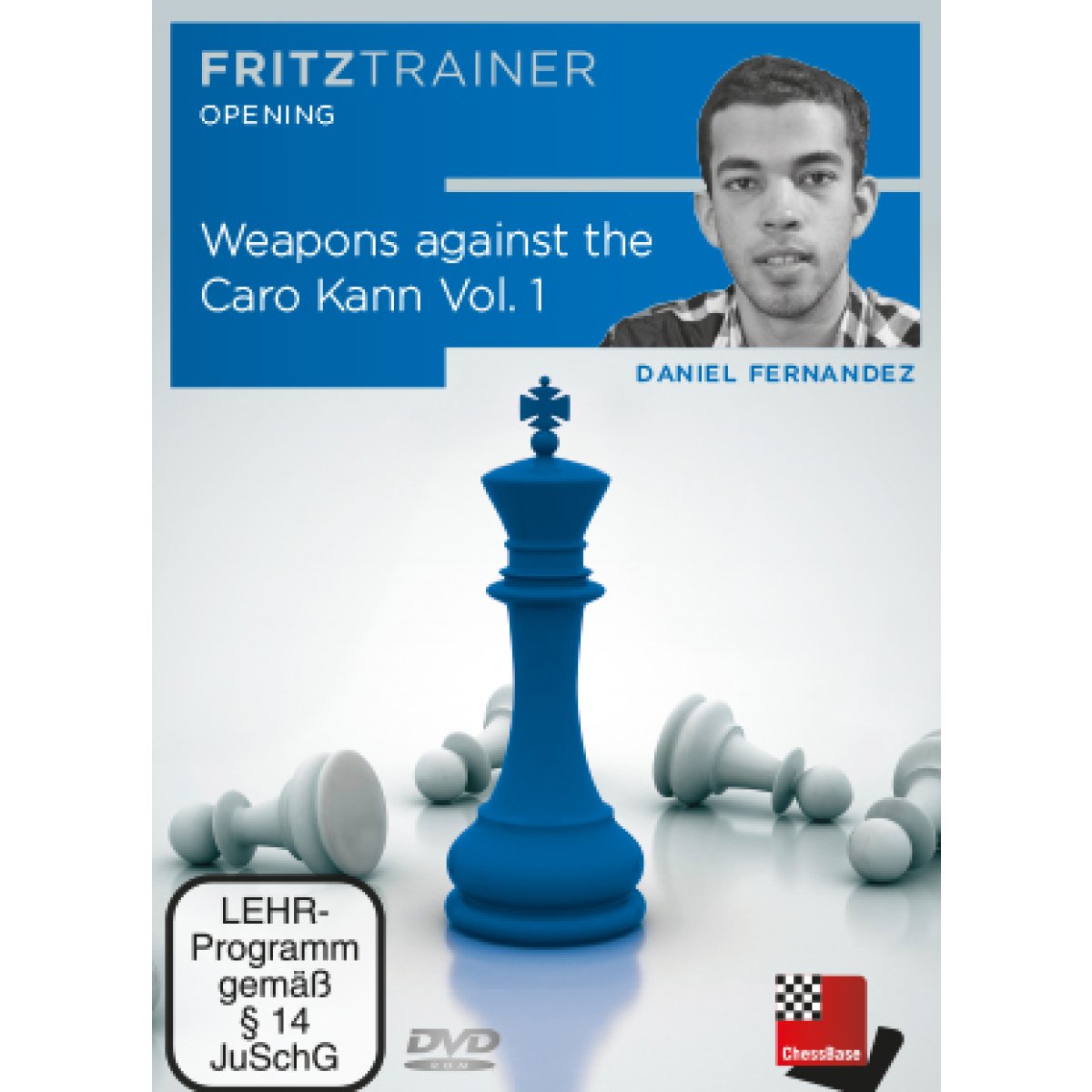

Weapons against the Caro Kann  Vol. 1: Panov and Two Knights
search
  • Weapons against the Caro Kann  Vol. 1: Panov and Two Knights

Weapons against the Caro-Kann Vol. 1: Panov and Two Knights

€32.90
Tax included
Discover fresh alternatives to challenge the Caro-Kann Defense with Grandmaster Daniel Fernández. This video course of over 4 hours guides you through the Panov and Two Knights variations, offering strategies for both White and Black. It includes interactive training, exercises with video feedback, and practice against Fritz. Ideal for surprising your opponents and confidently expanding your opening repertoire.

FORMAT: DOWNLOAD
This product is not supplied in physical format. You will receive an email from our store with the download link and product activation code.

Quantity
In Stock

  Security policy

(edit with the Customer Reassurance module)

  Delivery policy

(edit with the Customer Reassurance module)

  Return policy

(edit with the Customer Reassurance module)

Beyond the usual main lines (1.e4 c6 2.d4 d5 3.Nc3 and 3.e5), there are other very interesting options for White, each with its specific advantages and disadvantages. Grandmaster Daniel Fernandez, an expert in the Caro-Kann Defense within his repertoire, knows well which systems can complicate the game for Black. In this video course, he thoroughly details his preferred systems.

Nowadays, it is increasingly important to have several alternatives to face an opening, whether to surprise your opponent or to adapt the lines according to the opponent or time control. This course will help you find the variation that best suits your style as White, and it will also be useful for Caro-Kann players, as the author explains the best ways for Black to fight for equality.

This volume includes the Panov Attack (3.exd5 cxd5 4.c4) and the Two Knights Variation (2.Nc3 d5 3.Nf3).

After enjoying the videos, you will be able to practice the acquired repertoire in the opening trainer, ensuring you memorize the key lines and are ready to apply them in your games.

After watching the videos, you have the opportunity to train with the new repertoire in the opening trainer to reinforce the important lines and be prepared to use them in your games.

  • Total video duration: 4 hours and 3 minutes.
  • Bonus: Training with ChessBase applications – memorize the repertoire and play key positions against Fritz at various levels.
  • Includes download and streaming for iPad, tablet, etc., unlockable with a printed key.
More... Less...
Included content:
  • Fritztrainer app for Windows and Mac
  • Available for download or on DVD
  • Video course with an approximate duration of 4 to 8 hours
  • Repertoire database: save and integrate Fritztrainer games into your own repertoire (in WebApp Opening or ChessBase)
  • Interactive exercises with video feedback: the authors present exercises and key positions; the user must enter the solution, receiving explanations and corrections, even in case of mistakes
  • Example games in the ChessBase database
  • New: many Fritztrainers now available for streaming on the ChessBase video portal
FritzTrainer application features:
  • Videos can be played in the Fritztrainer app or in the ChessBase program with board graphics, notation, and function bar
  • The analysis engine can be activated at any time
  • Video pause for manual navigation and analysis in the game notation
  • Input of your own variations and engine analysis, saved within the game
  • Variation learning: view specific lines in ChessBase WebApp Opening with automatic playback, memorize and practice the transformation (starting position – final position)
  • Active opening training: selected positions transfer to ChessBase WebApp Fritz-online to play against Fritz and test your knowledge
More possibilities: start FritzTrainer from ChessBase:
  • Database with all games and analysis accessible directly
  • Easy addition of games to the opening reference
  • Direct evaluation with game references, reproducible on the analysis board
  • Your own variations saved and added to the personal repertoire
  • Training through playback
  • Active LiveBook
  • All engines installed in ChessBase available for analysis
  • Assisted analysis
  • Printing of notation and diagrams for study materials

Sample video

Content

  • Introduction
  • Panov Attack
  • 1.e4 c6 2.d4 d5 3.exd5 cxd5 4.c4
  • Introduction
  • 4...Nf6 5.Nc3 g6 6.Qb3 Bg7 7.cxd5 short castling 8.Be2
  • 4...Nf6 5.Nc3 Nc6 6.Nf3
  • 4...Nf6 5.Nc3 e6 6.Nf3 Be7 7.cxd5 Nxd5 8.Bd3
  • Two Knights Variation 3...dxe4
  • 1.e4 c6 2.Nc3 d5 3.Nf3
  • 3...dxe4 Introduction
  • 3...dxe4 4.Nxe4 Nf6 5.Qe2 Nxe4 6.Qxe4 Be6 7.b3 Nd7 8.Bb2 Morris vs Fernandez
  • 6...Be6 Analysis
  • 6...Qa5 Analysis
  • 3...dxe4 4.Nxe4 Nf6 5.Qe2 Nxe4 6.Qxe4 Qd5 7.Qh4
  • 3...dxe4 4.Nxe4 Nf6 5.Qe2 Nxe4 6.Qxe4 Qd5 7.Qh4 Qe6 8.Be2 Qg6
  • 3...dxe4 4.Nxe4 Nf6 5.Qe2 Nxe4 6.Qxe4 Qd5 7.Qh4 Qe6 8.Be2 Qg4
  • 3...dxe4 4.Nxe4 Nf6 5.Qe2 Nxe4 6.Qxe4 Qd5 7.Qh4 Qe6 8.Be2 Qg4 9.Qg3 Qxg3 10.hxg3 Bf5
  • 3...dxe4 4.Nxe4 Nf6 5.Qe2 Nxe4 6.Qxe4 Nd7 7.Bc4 Nf6 8.Ne5 e6 9.Qf4
  • 3...dxe4 4.Nxe4 Nf6 5.Qe2 Nxe4 6.Qxe4 Nd7 7.Bc4 Nf6 8.Ne5 e6 9.Qe2 b5 10.Bd3 - 14.Bb7
  • 10.Bb3 Analysis
  • 14.Be5: Ragger vs Donchenko
  • Analysis of options up to move 18
  • Two Knights Variation 3...Bg4
  • 1.e4 c6 2.Nc3 d5 3.Nf3
  • 3...Bg4 4.h3 Bxf3 5.Qxf3 e6 6.g3 Sideline variations
  • 3...Bg4 4.h3 Bxf3 5.Qxf3 e6 6.g3 Nf6
  • 3...Bg4 4.h3 Bxf3 5.Qxf3 e6 6.g3 Nd7 7.Bg2 d4 8.Ne2 Qb6 9.Qd3
  • 3...Bg4 4.h3 Bxf3 5.Qxf3 e6 6.g3 Nd7 7.Bg2 d4 8.Ne2 Qb6 9.Qd3 e5 10.Qc4
  • 3...Bg4 4.h3 Bxf3 5.Qxf3 e6 6.g3 Nd7 7.Bg2 d4 8.Ne2 Qb6 9.Qd3 c5 10.Ng1
  • 3...Bg4 4.h3 Bxf3 5.Qxf3 e6 6.d4: Erdos vs Firouzja
  • 3...Bg4 4.h3 Bxf3 5.Qxf3 e6 6.Be2 Nf6 7.Short castling Bc5
  • 3...Bg4 4.h3 Bxf3 5.Qxf3 e6 6.Be2 Nf6 7.Short castling Nbd7
  • Two Knights Variation Sideline variations
  • 1.e4 c6 2.Nc3 d5 3.Nf3
  • 3...Nf6
  • Analysis of minor moves
  • Analysis of 3...g6 4.d4 Bg7
More...
Less...

Caro-Kann Defense

The Caro-Kann Defense is named after the English master Horatio Caro (1862–1920), resident in Berlin, and the Austrian player Marcus Kann (1820–1886). However, the move 1...c6 did not gain popularity until the 1920s, when figures like José Raúl Capablanca and Aaron Nimzowitsch adopted it. In 1960/61, Botvinnik sought a solid defense for his World Championship games against the sacrificial attacks of Mikhail Tal and chose the Caro-Kann. Other world champions such as Tigran Petrosian and Anatoly Karpov also employed 1...c6 in their repertoires.

WATCKV1PATK-FWRI